OpenStax Organic Chemistry: A Tenth Edition Student Solutions Manual
Chapter 24 – Amines and Heterocycles
Solutions to Problems
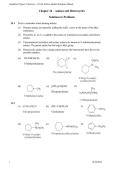
24.1 Facts to remember about naming amines:
(1) Primary amines are named by adding the suffix -amine to the name of the alkyl
substituent.
(2) The prefix di- or tri- is added to the names of symmetrical secondary and tertiary
amines.
(3) Unsymmetrical secondary and tertiary amines are named as N-substituted primary
amines. The parent amine has the largest alkyl group.
(4) Heterocyclic amines have unique parent names; the heteroatoms have the lowest
possible numbers.
(a) CH3NHCH2CH3 (b) (c)
N-Methylethylamine
(d) (e) [(CH3)2CH]2NH (f)
Diisopropylamine
24.2
(a) [(CH3)2CH]3N (b) (H2C=CHCH2)3N (c)
Triisopropylamine Triallylamine
(d) (e) (f)
1 10/30/2023
, OpenStax Organic Chemistry: A Tenth Edition Student Solutions Manual
24.3 The numbering of heterocyclic rings is described in Section 24.1.
(a) (b) (c)
(d)
24.4 Amines are less basic than hydroxide but more basic than amides. The pKa values of the
conjugate acids of the amines in (c) are shown. The larger the pKa, the stronger the base.
More Basic Less Basic
(a) CH3CH2NH2 CH3CH2CONH2
(b) NaOH CH3NH2
(c) CH3NHCH3 pyridine
pKa = 10.73 pKa = 5.25
24.5
The stronger base (propylamine) holds a proton more tightly than the weaker base
(benzylamine). Thus, the propylammonium ion is less acidic (larger pKa) than the
benzylammonium ion (smaller pKa).
To calculate pKb: Ka · Kb = 10 – 14, pKa + pKb = 14 and pKb = 14 – pKa.
11/6/2023 2
,OpenStax Organic Chemistry: A Tenth Edition Student Solutions Manual
24.6 The basicity order of substituted arylamines is the same as their reactivity order in electrophilic
aromatic substitution reactions because, in both cases, electron-withdrawing substituents make
the site of reaction more electron-poor and destabilize a positive charge.
(a)
(b)
(c)
24.7 Use the expressions shown in Section 24.5.
[RNH 2 ]
log = pH − pK a = 7.3 −1.3 = 6.0
[RNH 3+ ]
[RNH 2 ]
= 106.0 = 106 :[RNH 2 ] = 106 [RNH 3+ ]
[RNH 3+ ]
At pH = 7.3, virtually 100% of the pyrimidine molecules are in the neutral form.
24.8 Amide reduction can be used to synthesize most amines, but nitrile reduction can be used
to synthesize only primary amines. Thus, the compounds in (b) and (d) can be
synthesized only by amide reduction.
(a)
(b)
(c)
(d)
The compounds in parts (b) and (d) can’t be prepared by reduction of a nitrile.
3 11/6/2023
, OpenStax Organic Chemistry: A Tenth Edition Student Solutions Manual
24.9
Step 1: Addition of hydroxide.
Step 2: Ring opening.
Step 3: Proton transfer.
Step 4: Addition of hydroxide.
Step 5: Elimination of amine.
Step 6: Proton transfer.
24.10 The upper reaction is the azide synthesis, and the lower reaction is the Gabriel synthesis.
24.11 Look at the target molecule to find the groups bonded to nitrogen. One group comes from
the aldehyde/ketone precursor, and the other group comes from the amine precursor. In
most cases, two combinations of amine and aldehyde/ketone are possible.
10/30/2023 4
Chapter 24 – Amines and Heterocycles
Solutions to Problems
24.1 Facts to remember about naming amines:
(1) Primary amines are named by adding the suffix -amine to the name of the alkyl
substituent.
(2) The prefix di- or tri- is added to the names of symmetrical secondary and tertiary
amines.
(3) Unsymmetrical secondary and tertiary amines are named as N-substituted primary
amines. The parent amine has the largest alkyl group.
(4) Heterocyclic amines have unique parent names; the heteroatoms have the lowest
possible numbers.
(a) CH3NHCH2CH3 (b) (c)
N-Methylethylamine
(d) (e) [(CH3)2CH]2NH (f)
Diisopropylamine
24.2
(a) [(CH3)2CH]3N (b) (H2C=CHCH2)3N (c)
Triisopropylamine Triallylamine
(d) (e) (f)
1 10/30/2023
, OpenStax Organic Chemistry: A Tenth Edition Student Solutions Manual
24.3 The numbering of heterocyclic rings is described in Section 24.1.
(a) (b) (c)
(d)
24.4 Amines are less basic than hydroxide but more basic than amides. The pKa values of the
conjugate acids of the amines in (c) are shown. The larger the pKa, the stronger the base.
More Basic Less Basic
(a) CH3CH2NH2 CH3CH2CONH2
(b) NaOH CH3NH2
(c) CH3NHCH3 pyridine
pKa = 10.73 pKa = 5.25
24.5
The stronger base (propylamine) holds a proton more tightly than the weaker base
(benzylamine). Thus, the propylammonium ion is less acidic (larger pKa) than the
benzylammonium ion (smaller pKa).
To calculate pKb: Ka · Kb = 10 – 14, pKa + pKb = 14 and pKb = 14 – pKa.
11/6/2023 2
,OpenStax Organic Chemistry: A Tenth Edition Student Solutions Manual
24.6 The basicity order of substituted arylamines is the same as their reactivity order in electrophilic
aromatic substitution reactions because, in both cases, electron-withdrawing substituents make
the site of reaction more electron-poor and destabilize a positive charge.
(a)
(b)
(c)
24.7 Use the expressions shown in Section 24.5.
[RNH 2 ]
log = pH − pK a = 7.3 −1.3 = 6.0
[RNH 3+ ]
[RNH 2 ]
= 106.0 = 106 :[RNH 2 ] = 106 [RNH 3+ ]
[RNH 3+ ]
At pH = 7.3, virtually 100% of the pyrimidine molecules are in the neutral form.
24.8 Amide reduction can be used to synthesize most amines, but nitrile reduction can be used
to synthesize only primary amines. Thus, the compounds in (b) and (d) can be
synthesized only by amide reduction.
(a)
(b)
(c)
(d)
The compounds in parts (b) and (d) can’t be prepared by reduction of a nitrile.
3 11/6/2023
, OpenStax Organic Chemistry: A Tenth Edition Student Solutions Manual
24.9
Step 1: Addition of hydroxide.
Step 2: Ring opening.
Step 3: Proton transfer.
Step 4: Addition of hydroxide.
Step 5: Elimination of amine.
Step 6: Proton transfer.
24.10 The upper reaction is the azide synthesis, and the lower reaction is the Gabriel synthesis.
24.11 Look at the target molecule to find the groups bonded to nitrogen. One group comes from
the aldehyde/ketone precursor, and the other group comes from the amine precursor. In
most cases, two combinations of amine and aldehyde/ketone are possible.
10/30/2023 4