OpenStax Organic Chemistry: A Tenth Edition Student Solutions Manual
Chapter 23 – Carbonyl Condensation Reactions
Solutions to Problems
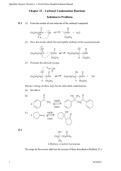
23.1 (1) Form the enolate of one molecule of the carbonyl compound.
(2) Have the enolate attack the electrophilic carbonyl of the second molecule.
(3) Protonate the alkoxide oxygen.
Practice writing out these steps for the other aldol condensations.
(a) See above.
(b)
(c)
23.2
The steps for the reverse aldol are the reverse of those described in Problem 23.1.
1 10/4/2023
, OpenStax Organic Chemistry: A Tenth Edition Student Solutions Manual
(1) Deprotonate the alcohol oxygen.
(2) Eliminate the enolate anion.
(3) Reprotonate the enolate anion.
23.3 As in Problem 23.1, align the two carbonyl compounds so that the location of the new
bond is apparent. After drawing the addition product, form the conjugated enone product
by dehydration. In parts (b) and (c), a mixture of E,Z isomers may be formed.
(a)
(b)
10/4/2023 2
,OpenStax Organic Chemistry: A Tenth Edition Student Solutions Manual
(c)
23.4 Including double bond isomers, 4 products can be formed. The major product is formed
by reaction of the enolate formed by abstraction of a proton at position “a” because
position “b” has more steric hindrance.
23.5 (a)
This is not an aldol product. The hydroxyl group in an aldol product must be β, not
α, to the carbonyl group.
3 10/4/2023
, OpenStax Organic Chemistry: A Tenth Edition Student Solutions Manual
(b)
This product results from the aldol self-condensation of 3-pentanone, followed by
dehydration.
23.6
23.7
23.8 (a)
This mixed aldol will succeed because one of the components, benzaldehyde, is a
good acceptor of nucleophiles, yet has no α-hydrogen atoms. Although it is possible
for acetone to undergo self-condensation, the mixed aldol reaction is much more
favorable.
10/4/2023 4
Chapter 23 – Carbonyl Condensation Reactions
Solutions to Problems
23.1 (1) Form the enolate of one molecule of the carbonyl compound.
(2) Have the enolate attack the electrophilic carbonyl of the second molecule.
(3) Protonate the alkoxide oxygen.
Practice writing out these steps for the other aldol condensations.
(a) See above.
(b)
(c)
23.2
The steps for the reverse aldol are the reverse of those described in Problem 23.1.
1 10/4/2023
, OpenStax Organic Chemistry: A Tenth Edition Student Solutions Manual
(1) Deprotonate the alcohol oxygen.
(2) Eliminate the enolate anion.
(3) Reprotonate the enolate anion.
23.3 As in Problem 23.1, align the two carbonyl compounds so that the location of the new
bond is apparent. After drawing the addition product, form the conjugated enone product
by dehydration. In parts (b) and (c), a mixture of E,Z isomers may be formed.
(a)
(b)
10/4/2023 2
,OpenStax Organic Chemistry: A Tenth Edition Student Solutions Manual
(c)
23.4 Including double bond isomers, 4 products can be formed. The major product is formed
by reaction of the enolate formed by abstraction of a proton at position “a” because
position “b” has more steric hindrance.
23.5 (a)
This is not an aldol product. The hydroxyl group in an aldol product must be β, not
α, to the carbonyl group.
3 10/4/2023
, OpenStax Organic Chemistry: A Tenth Edition Student Solutions Manual
(b)
This product results from the aldol self-condensation of 3-pentanone, followed by
dehydration.
23.6
23.7
23.8 (a)
This mixed aldol will succeed because one of the components, benzaldehyde, is a
good acceptor of nucleophiles, yet has no α-hydrogen atoms. Although it is possible
for acetone to undergo self-condensation, the mixed aldol reaction is much more
favorable.
10/4/2023 4