Block 1.5- Clinical Psychology
Problem 4. Schizophrenia
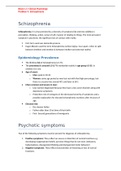
Schizophrenia
Schizophrenia: it is characterized by a diversity of symptoms like extreme oddities in
perception, thinking, action, sense of self, manner of relating to things. The most prevalent
symptom is psychosis; the significant loss of contact with reality.
First term used was dementia praecox
Eugen Bleuler used the term Schizophrenia (schizo/σχίζω= tear apart, refers to split
between intellect and emotion & between intellect and external reality)
Epidemiology-Prevalence
The lifetime risk of Schizophrenia is 0.7%.
The prevalence is around 0.3-0.7 % worldwide mainly in age group 15-35, in
children it is rare.
Age of onset:
o Men: peak in 20-24
o Woman: same age period as men but not with that high percentage, but
there is a second rise around 40’s and later at 60’s
More common and severe in men:
o Less women diagnosed because they have a less sever disorder along with
depressive symptoms
o Protective role of estrogens in the decreased severity of symptoms and a
possible explanation for elevated schizophrenia numbers after 40 years of
age.
Elevated risk:
o Dry cleaner father
o Father older than 50 at time of their birth
o First- Second generations of immigrants
Psychotic symptoms
Two of the following symptoms must be present for diagnosis of schizophrenia.
1. Positive symptoms: They reflect an excess or distortion of normal functions e.g.
developing inappropriate beliefs, perceive things that do not exist. (delusions,
hallucinations, disorganized thinking and disorganized motor behavior)
2. Negative symptoms: They reflect characteristics of lessening or loss of normal
functions.
,Block 1.5- Clinical Psychology
Problem 4. Schizophrenia
Delusions
Delusions: Firmly held but erroneous beliefs that usually involve misinterpretation of
perceptions or experiences and become fixed beliefs that are not easily changeable in the
presence of conflicting evidence.
o Prevalent on 75% of hospitalized patients
o Patients support the delusion with reason and logic. That led to conclusion that the
interpretation of the world based on prior knowledge is no longer possible but the
thinking process remain intact.
There are six (6) types of delusions:
1. Persecutory delusions: The individual believes that he is persecuted, spied upon, or
is in danger (as a result of some kind of conspiracy against him/her)
2. Grandiose delusions: The individual believes that he is someone with fame or power
or have exceptional abilities, wealth or fame. E.g. Jesus Christ, or famous music star.
3. Delusions of control: The individual believes that his/her thoughts, feelings, actions
are being controlled by external forces (e.g. extraterrestrial or supernatural), often it
is seen as a belief that electronic devices e.g. radio can exert control that send a
message direct to the brain.
4. Delusions of reference: The thought that external independent events are making
specific reference to him. E.g. belief that TV host, DJ of a radio is talking directly to
them.
5. Nihilistic delusions: Individuals believe that some aspect of either them or the world
has ceased to exist. E.g. the person believes that in fact he/she is dead.
6. Erotomanic delusions: Rare delusions, where the individual has a delusional belief
that a person of higher social status falls in love and makes amorous advances
towards them.
Common feature of them: The sufferers think that their thoughts are being interfered or
controlled in some way like open control or implanting. So self-produced actions are
experienced as external.
Hallucinations
Hallucinations: A sensory experience in which a person can see hear smell taste or feel sth
that is not actually there. They can occur in any modality e.g. auditory, olfactory, gustatory
and tactile, somatic.
o Auditory (70% of sufferers). Manifest like voices commanding the individual to act in
certain ways, two or more voices conversing each other or a voice commenting.
Neural activation of brain area that is attributed to external sources.
o Visual (2nd most common). Diffuse form as distort perception of colors shapes that
are not present or specific like the presence of a person that is not there.
, Block 1.5- Clinical Psychology
Problem 4. Schizophrenia
o Olfactory, Gustatory, Tactile, Somatic.
People diagnosed with schizophrenia participated in a study where they had to remember
some generated words from a list the source of them (self or experimenter) and that led to
the findings of:
o Reality monitoring deficit: Problem distinguish between what actually occurred and
what did not.
o Self-monitoring deficit: Problem distinguishing between thoughts or ideas they
generated themselves and thoughts or ideas generated by others.
Disorganized thinking (speech)
Formal thought disorder (term for disorganized thought expressed through disorganized
speech)
Disorganized thinking consists of a number of features:
Derailment: Deficit of speech where the individual drifts from one topic to another
during a conversation. “content”
Loose associations: Disorganized thinking where the individual drifts from one topic
to another during the conversation “form of thoughts”
o Tangentiality: Disorder of speech where the answers are more tangential
than relevant.
o Clanging: A form of speech in schizophrenia where thinking is driven by
word sounds. E.g. rhyming or alliterations may lead to the appearance of
logical connections when none in fact exists.
o Neologisms: Made up words constructed by condensing or combining
several words.
o Word salads: So disorganized speech that there seems to be no link
between one phrase with the next.
Poverty of content: Very little meaningful content despite the number of words, ideas
grammar. Because:
They are unable to inhibit associations so they use the first in mind.
They have difficulties in understanding the content of a conversation. E.g. sentences,
details etc.
Disorganized or Abnormal motor behavior
Disorganized/Abnormal behavior: Characterized by childlike, silly behavior and
inappropriate for age. Inappropriate behavior for the context (masturbating in public).
Unpredictable and agitated (shouting, cursing in the street) and face difficulties in
completing goal directed activities. Disheveled image or inappropriately dressed.
Catatonic motor behaviors are characterized by:
Problem 4. Schizophrenia
Schizophrenia
Schizophrenia: it is characterized by a diversity of symptoms like extreme oddities in
perception, thinking, action, sense of self, manner of relating to things. The most prevalent
symptom is psychosis; the significant loss of contact with reality.
First term used was dementia praecox
Eugen Bleuler used the term Schizophrenia (schizo/σχίζω= tear apart, refers to split
between intellect and emotion & between intellect and external reality)
Epidemiology-Prevalence
The lifetime risk of Schizophrenia is 0.7%.
The prevalence is around 0.3-0.7 % worldwide mainly in age group 15-35, in
children it is rare.
Age of onset:
o Men: peak in 20-24
o Woman: same age period as men but not with that high percentage, but
there is a second rise around 40’s and later at 60’s
More common and severe in men:
o Less women diagnosed because they have a less sever disorder along with
depressive symptoms
o Protective role of estrogens in the decreased severity of symptoms and a
possible explanation for elevated schizophrenia numbers after 40 years of
age.
Elevated risk:
o Dry cleaner father
o Father older than 50 at time of their birth
o First- Second generations of immigrants
Psychotic symptoms
Two of the following symptoms must be present for diagnosis of schizophrenia.
1. Positive symptoms: They reflect an excess or distortion of normal functions e.g.
developing inappropriate beliefs, perceive things that do not exist. (delusions,
hallucinations, disorganized thinking and disorganized motor behavior)
2. Negative symptoms: They reflect characteristics of lessening or loss of normal
functions.
,Block 1.5- Clinical Psychology
Problem 4. Schizophrenia
Delusions
Delusions: Firmly held but erroneous beliefs that usually involve misinterpretation of
perceptions or experiences and become fixed beliefs that are not easily changeable in the
presence of conflicting evidence.
o Prevalent on 75% of hospitalized patients
o Patients support the delusion with reason and logic. That led to conclusion that the
interpretation of the world based on prior knowledge is no longer possible but the
thinking process remain intact.
There are six (6) types of delusions:
1. Persecutory delusions: The individual believes that he is persecuted, spied upon, or
is in danger (as a result of some kind of conspiracy against him/her)
2. Grandiose delusions: The individual believes that he is someone with fame or power
or have exceptional abilities, wealth or fame. E.g. Jesus Christ, or famous music star.
3. Delusions of control: The individual believes that his/her thoughts, feelings, actions
are being controlled by external forces (e.g. extraterrestrial or supernatural), often it
is seen as a belief that electronic devices e.g. radio can exert control that send a
message direct to the brain.
4. Delusions of reference: The thought that external independent events are making
specific reference to him. E.g. belief that TV host, DJ of a radio is talking directly to
them.
5. Nihilistic delusions: Individuals believe that some aspect of either them or the world
has ceased to exist. E.g. the person believes that in fact he/she is dead.
6. Erotomanic delusions: Rare delusions, where the individual has a delusional belief
that a person of higher social status falls in love and makes amorous advances
towards them.
Common feature of them: The sufferers think that their thoughts are being interfered or
controlled in some way like open control or implanting. So self-produced actions are
experienced as external.
Hallucinations
Hallucinations: A sensory experience in which a person can see hear smell taste or feel sth
that is not actually there. They can occur in any modality e.g. auditory, olfactory, gustatory
and tactile, somatic.
o Auditory (70% of sufferers). Manifest like voices commanding the individual to act in
certain ways, two or more voices conversing each other or a voice commenting.
Neural activation of brain area that is attributed to external sources.
o Visual (2nd most common). Diffuse form as distort perception of colors shapes that
are not present or specific like the presence of a person that is not there.
, Block 1.5- Clinical Psychology
Problem 4. Schizophrenia
o Olfactory, Gustatory, Tactile, Somatic.
People diagnosed with schizophrenia participated in a study where they had to remember
some generated words from a list the source of them (self or experimenter) and that led to
the findings of:
o Reality monitoring deficit: Problem distinguish between what actually occurred and
what did not.
o Self-monitoring deficit: Problem distinguishing between thoughts or ideas they
generated themselves and thoughts or ideas generated by others.
Disorganized thinking (speech)
Formal thought disorder (term for disorganized thought expressed through disorganized
speech)
Disorganized thinking consists of a number of features:
Derailment: Deficit of speech where the individual drifts from one topic to another
during a conversation. “content”
Loose associations: Disorganized thinking where the individual drifts from one topic
to another during the conversation “form of thoughts”
o Tangentiality: Disorder of speech where the answers are more tangential
than relevant.
o Clanging: A form of speech in schizophrenia where thinking is driven by
word sounds. E.g. rhyming or alliterations may lead to the appearance of
logical connections when none in fact exists.
o Neologisms: Made up words constructed by condensing or combining
several words.
o Word salads: So disorganized speech that there seems to be no link
between one phrase with the next.
Poverty of content: Very little meaningful content despite the number of words, ideas
grammar. Because:
They are unable to inhibit associations so they use the first in mind.
They have difficulties in understanding the content of a conversation. E.g. sentences,
details etc.
Disorganized or Abnormal motor behavior
Disorganized/Abnormal behavior: Characterized by childlike, silly behavior and
inappropriate for age. Inappropriate behavior for the context (masturbating in public).
Unpredictable and agitated (shouting, cursing in the street) and face difficulties in
completing goal directed activities. Disheveled image or inappropriately dressed.
Catatonic motor behaviors are characterized by: