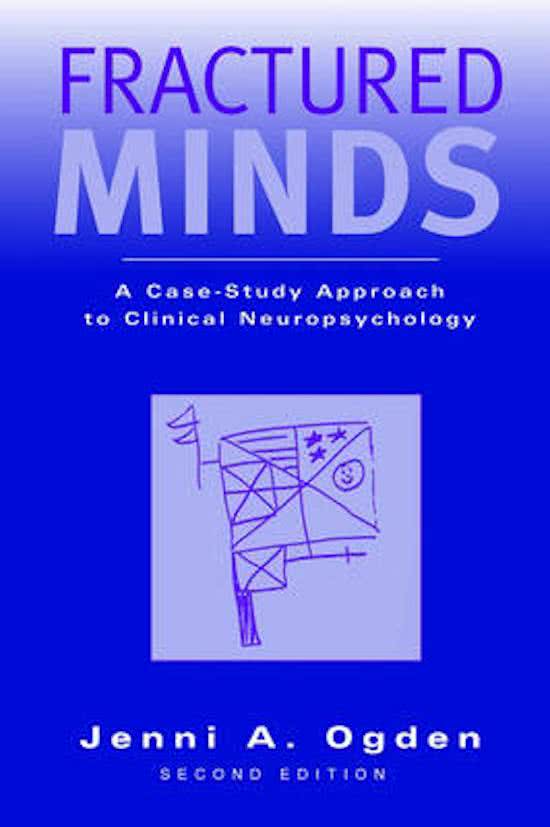
Fractured minds
Inhoudsopgave
Chapter 1 Introduction to clinical neuropsychology........................................................................................2
Chapter 2 The neuropsychological assessment............................................................................................... 5
Chapter 3 H.M., a case of global amnesia....................................................................................................... 9
Chapter 4 The consequences and treatment of epilepsy...............................................................................10
Chapter 5 Aphasia (language)....................................................................................................................... 14
Chapter 6 Autotopagnosia........................................................................................................................... 16
Chapter 7 Hemineglect................................................................................................................................. 18
Chapter 8 Visual object agnosia and prosopagnosia......................................................................................19
Chapter 9 The impaired executive (frontal-lobe dysfunction)........................................................................20
Chapter 10 Severe traumatic brain injury and the importance of ongoing rehabilitation...............................22
Chapter 11 Mild traumatic brain injury......................................................................................................... 24
Chapter 12 Subarachnoid haemorrhage....................................................................................................... 27
Chapter 13 Organic solvent neurotoxicity..................................................................................................... 29
Chapter 14 Multiple sclerosis....................................................................................................................... 32
Chapter 15 Parkinson’s Disease.................................................................................................................... 33
Chapter 16 Huntington’s Disease.................................................................................................................. 39
Chapter 17 Dementia................................................................................................................................... 42
Chapter 18 Split brain, split mind? Case L. B.................................................................................................46
Chapter 19 A whole life with a half brain: Kate’s story..................................................................................50
,Chapter 1 Introduction to clinical neuropsychology
A definition of clinical neuropsychology and its aims
- The study of human behaviours, emotions, and thoughts and how they relate to the brain, particularly
the damaged brain, is the subject matter of clinical neuropsychology
- Has both applied and academic aims
o Applied aims: learning more about neurological disorders and diseases so that we can more
accurately and usefully diagnose, treat, and rehabilitate people who suffer such dis-orders
and, along with other disciplines, ultimately to find ways to prevent their occurrence.
o Academic aims: Learn more about undamaged brains
Relationship of Clinical Neuropsychology to other disciplines
- Cognitive Neuropsychology
o A hybrid of cognitive psychology and clinical neuropsychology
o Concentrates on the detailed analysis of higher cognitive functions.
o Tend to be more interested in normal brains than impaired brains
o Goal is to figure out the workings of the mind.
- Clinical Neuropsychology positions itself between neurology and cognitive neuropsychology
o Often referred to as Behavioural Neurology
- Other important areas include.
o Animal psychology
o Neuroscience
o Neuropharmacology
o Human Neurophysiology
- A good clinical neuropsychologist should first be an accomplished clinical psychologist.
Function Neuroanatomy
- Gross Structure of the brain
o Three Major Areas
The Cerebral Hemispheres
The Cerebellum
The Brain Stem
o The brain stem
Is an upward extension of the spinal cord
Consists of 4 areas
The Medulla Onlongata
Pons
Midbrain
Diencephalon (thalamus + hypothalamus)
Life-support part of the brain, it controls (1) respiration, (2) cardiovascular function,
(3) gastrointestinal function
Also contains the nuclei for the cranial nerves connected with special sense, but is
not directly concerned with higher cognitive function
o The cerebellar hemispheres
Are paired structures at the base of the cerebral hemispheres which are mainly
concerned with motor coordination, muscle tone, and balance
o The cerebral hemispheres
Are paired structures above the midbrain and pons
Covered by a very convoluted layer of nerve cells called the cerebral cortex (grey
matter)
The axons or fibre tracts that connect the nerve cells together to the rest of the
brain for a layer directly below the cortex (white matter)
o Basal Ganglia
Areas of grey matter deep within the hemispheres
Associated with Parkinson’s
o Visual Indications
o Reticular formation
, Controls the overall arousal level of the cortex.
A diffuse system of metasyntactic neuron chains traveling through the brain stem
All major sensory pathways send impulses via collateral axons to the RF
Which then relays the information to the thalamus
o Thalamus
The thalamus serves as a relay centre for motor pathways, many sensory pathways,
and the RF
o Limbic system
The hippocampus and amygdala: lies medially to the temporal lobes
The cingulate gyrus: lies along the medial surface of the frontal and parietal lobes
Mamillary bodies
It is involved in emotion motivation and memory
o Meninges
The dura mater: adheres to the inner surface of the skull
The arachnoid mater: delicate, filamentous middle membrane, attached by cobweb-
like strands of tissue to the fine pia mater
The pia mater: is adhered closes to the cortex.
The subarachnoid space lies between the AM and PM and is filled with cerebrospinal
fluid, blood vessels also lie there and dip down into the sulci
o The ventricles
Are lakes of CSF located deep within the hemispheres
The lateral ventricles are largely paired structures in the centre of each hemisphere,
they connect in the centre to form the third ventricle and below that the fourth
ventricle
o Cerebrovascular system
Involves two pairs of cerebral arteries
The internal carotid arteries
The vertebral arteries
The two internal carotid arteries enter the skull and ascend on either side of the
optic chiasm, where each artery branches to form the anterior cerebral arteries and
the middle cerebral arteries, one set in each hemi-sphere
ACAs supply the medial and lower surfaces of the frontal lobes, the medial surfaces
of the parietal lobes, and the corpus callosum.
MCA travels laterally within the lateral fissure and branch to supply much of the
lateral surfaces of the frontal, temporal, and parietal lobes as well as parts of the
inferior surface if the frontal lobes and medial surfaces of the temporal lobes
MCA also branch to form the striate arteries, which supply the deeply situated
internal spine.
The MCA supplies 75% of the blood to the cerebral hemispheres
The paired vertebral arteries form the singular basilar artery on the under surface of
the brainstem.
This basilar artery then divides to form the paired posterior cerebral arteries, which
supply the occipital lobes and parts of the medial and inferior surfaces of the
temporal lobes, including the hippocampus.
The internal carotid and vertebral arterial systems are linked at the base of the brain
by a single anterior communicating artery and two posterior communicating
arteries, forming a ring of vessels lying in the subarachnoid space, called the Circle of
Willis.
o Cerebral Cortex
Cortical Zones
We can divide into primary, secondary and tertiary zones by function.
Cortical Lobes
Parietal lobe
o Functioning of tactile sensations, position sense, and spatial
relations
o Left parietal lobe has a bias toward sequential and logical abilities
, o The right parietal lobe is especially good at conceptualising
complex spatial relation
People with right parietal lesions often have difficulty
copying patterns
Temporal lobe
o Associated with auditory and olfactory abilities
o Are involved in integrating visual perceptions with other sensory
information
o Mediate some memory functions, especially new learning.
o Connections with hippocampi and limbic system, allow for
integration of emotion and motivation with sensory information
relayed from posterior lobes of the hemispheres.
o The left temporal lobe is concerned more with verbal and seqenual
functions. It includes the language comprehension area and is
involved in new verbal learning and memory
o Right temporal lobe, tends to be more concerned with nonverbal
function, i.e interpreting voice tone and facial expression.
Occipital lobe
o Are the visual lobes that mediate sight, visual perception, and
visual knowledge
o Being unable to see, although the eyes function correctly, is
termed cortical blindness
Frontal lobes
o Concerned with motor and executive function
I.e forming abstract concepts and planning and executing
actions based on information
o Left frontal lobe
Includes Broca’s area which is a speech area
Functional systems
- Composed of many brain areas working together
- I.e memory
- Luria proposed to that if damage is done to area A all subcomponents of area A (termed a) will
function
- However, because our brain is plastic we can get around this by relearning in other areas of the brain
“filling the gap”
Disconnection Syndrome
- Anatomic disconnection between two cortical areas
- i.e ideomotor apraxia
- It can be within one hemisphere or between them i.e corpus callosum
Neuropsychological Terminology
- Phasia = speech disorder
- Graphia = writing
- Lexia = Reading
- Praxia= Purposeful action
- Gnosia = to know
- If it begins with “a” it is fully compromised
- If it begins with “dis” it is partially compromised
Assumptions of clinical neuropsychology
- The brain of the patient was normal before the brain damage.
- We can generalise experiments about brain-behaviour relations from one normal human to another.
Focal lesions and diffuse brain damage
Inhoudsopgave
Chapter 1 Introduction to clinical neuropsychology........................................................................................2
Chapter 2 The neuropsychological assessment............................................................................................... 5
Chapter 3 H.M., a case of global amnesia....................................................................................................... 9
Chapter 4 The consequences and treatment of epilepsy...............................................................................10
Chapter 5 Aphasia (language)....................................................................................................................... 14
Chapter 6 Autotopagnosia........................................................................................................................... 16
Chapter 7 Hemineglect................................................................................................................................. 18
Chapter 8 Visual object agnosia and prosopagnosia......................................................................................19
Chapter 9 The impaired executive (frontal-lobe dysfunction)........................................................................20
Chapter 10 Severe traumatic brain injury and the importance of ongoing rehabilitation...............................22
Chapter 11 Mild traumatic brain injury......................................................................................................... 24
Chapter 12 Subarachnoid haemorrhage....................................................................................................... 27
Chapter 13 Organic solvent neurotoxicity..................................................................................................... 29
Chapter 14 Multiple sclerosis....................................................................................................................... 32
Chapter 15 Parkinson’s Disease.................................................................................................................... 33
Chapter 16 Huntington’s Disease.................................................................................................................. 39
Chapter 17 Dementia................................................................................................................................... 42
Chapter 18 Split brain, split mind? Case L. B.................................................................................................46
Chapter 19 A whole life with a half brain: Kate’s story..................................................................................50
,Chapter 1 Introduction to clinical neuropsychology
A definition of clinical neuropsychology and its aims
- The study of human behaviours, emotions, and thoughts and how they relate to the brain, particularly
the damaged brain, is the subject matter of clinical neuropsychology
- Has both applied and academic aims
o Applied aims: learning more about neurological disorders and diseases so that we can more
accurately and usefully diagnose, treat, and rehabilitate people who suffer such dis-orders
and, along with other disciplines, ultimately to find ways to prevent their occurrence.
o Academic aims: Learn more about undamaged brains
Relationship of Clinical Neuropsychology to other disciplines
- Cognitive Neuropsychology
o A hybrid of cognitive psychology and clinical neuropsychology
o Concentrates on the detailed analysis of higher cognitive functions.
o Tend to be more interested in normal brains than impaired brains
o Goal is to figure out the workings of the mind.
- Clinical Neuropsychology positions itself between neurology and cognitive neuropsychology
o Often referred to as Behavioural Neurology
- Other important areas include.
o Animal psychology
o Neuroscience
o Neuropharmacology
o Human Neurophysiology
- A good clinical neuropsychologist should first be an accomplished clinical psychologist.
Function Neuroanatomy
- Gross Structure of the brain
o Three Major Areas
The Cerebral Hemispheres
The Cerebellum
The Brain Stem
o The brain stem
Is an upward extension of the spinal cord
Consists of 4 areas
The Medulla Onlongata
Pons
Midbrain
Diencephalon (thalamus + hypothalamus)
Life-support part of the brain, it controls (1) respiration, (2) cardiovascular function,
(3) gastrointestinal function
Also contains the nuclei for the cranial nerves connected with special sense, but is
not directly concerned with higher cognitive function
o The cerebellar hemispheres
Are paired structures at the base of the cerebral hemispheres which are mainly
concerned with motor coordination, muscle tone, and balance
o The cerebral hemispheres
Are paired structures above the midbrain and pons
Covered by a very convoluted layer of nerve cells called the cerebral cortex (grey
matter)
The axons or fibre tracts that connect the nerve cells together to the rest of the
brain for a layer directly below the cortex (white matter)
o Basal Ganglia
Areas of grey matter deep within the hemispheres
Associated with Parkinson’s
o Visual Indications
o Reticular formation
, Controls the overall arousal level of the cortex.
A diffuse system of metasyntactic neuron chains traveling through the brain stem
All major sensory pathways send impulses via collateral axons to the RF
Which then relays the information to the thalamus
o Thalamus
The thalamus serves as a relay centre for motor pathways, many sensory pathways,
and the RF
o Limbic system
The hippocampus and amygdala: lies medially to the temporal lobes
The cingulate gyrus: lies along the medial surface of the frontal and parietal lobes
Mamillary bodies
It is involved in emotion motivation and memory
o Meninges
The dura mater: adheres to the inner surface of the skull
The arachnoid mater: delicate, filamentous middle membrane, attached by cobweb-
like strands of tissue to the fine pia mater
The pia mater: is adhered closes to the cortex.
The subarachnoid space lies between the AM and PM and is filled with cerebrospinal
fluid, blood vessels also lie there and dip down into the sulci
o The ventricles
Are lakes of CSF located deep within the hemispheres
The lateral ventricles are largely paired structures in the centre of each hemisphere,
they connect in the centre to form the third ventricle and below that the fourth
ventricle
o Cerebrovascular system
Involves two pairs of cerebral arteries
The internal carotid arteries
The vertebral arteries
The two internal carotid arteries enter the skull and ascend on either side of the
optic chiasm, where each artery branches to form the anterior cerebral arteries and
the middle cerebral arteries, one set in each hemi-sphere
ACAs supply the medial and lower surfaces of the frontal lobes, the medial surfaces
of the parietal lobes, and the corpus callosum.
MCA travels laterally within the lateral fissure and branch to supply much of the
lateral surfaces of the frontal, temporal, and parietal lobes as well as parts of the
inferior surface if the frontal lobes and medial surfaces of the temporal lobes
MCA also branch to form the striate arteries, which supply the deeply situated
internal spine.
The MCA supplies 75% of the blood to the cerebral hemispheres
The paired vertebral arteries form the singular basilar artery on the under surface of
the brainstem.
This basilar artery then divides to form the paired posterior cerebral arteries, which
supply the occipital lobes and parts of the medial and inferior surfaces of the
temporal lobes, including the hippocampus.
The internal carotid and vertebral arterial systems are linked at the base of the brain
by a single anterior communicating artery and two posterior communicating
arteries, forming a ring of vessels lying in the subarachnoid space, called the Circle of
Willis.
o Cerebral Cortex
Cortical Zones
We can divide into primary, secondary and tertiary zones by function.
Cortical Lobes
Parietal lobe
o Functioning of tactile sensations, position sense, and spatial
relations
o Left parietal lobe has a bias toward sequential and logical abilities
, o The right parietal lobe is especially good at conceptualising
complex spatial relation
People with right parietal lesions often have difficulty
copying patterns
Temporal lobe
o Associated with auditory and olfactory abilities
o Are involved in integrating visual perceptions with other sensory
information
o Mediate some memory functions, especially new learning.
o Connections with hippocampi and limbic system, allow for
integration of emotion and motivation with sensory information
relayed from posterior lobes of the hemispheres.
o The left temporal lobe is concerned more with verbal and seqenual
functions. It includes the language comprehension area and is
involved in new verbal learning and memory
o Right temporal lobe, tends to be more concerned with nonverbal
function, i.e interpreting voice tone and facial expression.
Occipital lobe
o Are the visual lobes that mediate sight, visual perception, and
visual knowledge
o Being unable to see, although the eyes function correctly, is
termed cortical blindness
Frontal lobes
o Concerned with motor and executive function
I.e forming abstract concepts and planning and executing
actions based on information
o Left frontal lobe
Includes Broca’s area which is a speech area
Functional systems
- Composed of many brain areas working together
- I.e memory
- Luria proposed to that if damage is done to area A all subcomponents of area A (termed a) will
function
- However, because our brain is plastic we can get around this by relearning in other areas of the brain
“filling the gap”
Disconnection Syndrome
- Anatomic disconnection between two cortical areas
- i.e ideomotor apraxia
- It can be within one hemisphere or between them i.e corpus callosum
Neuropsychological Terminology
- Phasia = speech disorder
- Graphia = writing
- Lexia = Reading
- Praxia= Purposeful action
- Gnosia = to know
- If it begins with “a” it is fully compromised
- If it begins with “dis” it is partially compromised
Assumptions of clinical neuropsychology
- The brain of the patient was normal before the brain damage.
- We can generalise experiments about brain-behaviour relations from one normal human to another.
Focal lesions and diffuse brain damage