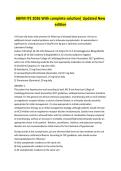
ISYE6644 Simulation Midterm 2 Exam (2026/2027)
Simulation Modeling & Analysis | Key Domains: Input Modeling & Distribution Fitting, Random
Variate Generation (Inverse Transform, Acceptance-Rejection), Output Analysis (Terminating vs.
Non-Terminating Simulations, Confidence Intervals), Variance Reduction Techniques (Antithetic
Variates, Common Random Numbers), and Verification & Validation of Simulation Models |
Expert-Aligned Structure | Multiple-Choice Midterm Exam Format
Introduction
This structured ISYE6644 Simulation Midterm 2 Exam for 2026/2027 provides 40 multiple-choice
questions with correct answers and rationales. It assesses mastery of the core statistical and
methodological concepts for building, running, and analyzing discrete-event simulation models, a
critical tool in operations research and industrial engineering.
Exam Structure:
• Midterm 2 Exam: (40 MULTIPLE-CHOICE QUESTIONS)
Answer Format
All correct answers and simulation concepts must appear in bold and cyan blue, accompanied by
concise rationales explaining the application of a statistical method (e.g., using the
Kolmogorov-Smirnov test for goodness-of-fit), the steps of a variate generation algorithm, the
correct formula for a confidence interval on a mean from simulation output, the purpose of a
variance reduction technique, the distinction between model verification and validation, and why
the alternative multiple-choice options contain statistical errors, misapply simulation theory, or
represent incorrect modeling practices.
1. Which of the following is the primary purpose of input modeling in simulation?
A. To reduce the number of replications needed
, B. To generate random numbers for the simulation clock
C. To select appropriate probability distributions that represent real-world data
D. To validate the simulation against historical output
Input modeling involves collecting real-world data and fitting it to theoretical probability distributions
(e.g., exponential, normal) so the simulation accurately reflects system behavior. Option A relates to
variance reduction; B is part of random number generation; D is validation, not input modeling.
2. When performing a goodness-of-fit test for input modeling, which test is most appropriate
for small sample sizes and continuous distributions?
A. Chi-square test
B. Kolmogorov-Smirnov test
C. Anderson-Darling test
D. t-test
The Kolmogorov-Smirnov (K-S) test is nonparametric and works well for small samples and continuous
distributions. The chi-square test (A) requires binning and larger samples. Anderson-Darling (C) is
powerful but less commonly emphasized in introductory courses. A t-test (D) compares means, not
distribution fit.
, 3. Using the inverse transform method, how would you generate an exponential random
variate with rate λ = 2 given a uniform(0,1) random number U = 0.3?
A. −2 ln(0.3)
B. −(1/2) ln(0.3)
C. 2 × 0.3
D. e−2×0.3
For an exponential distribution with rate λ, the inverse CDF is X = −(1/λ) ln(U). With λ = 2 and U = 0.3,
X = −(1/2) ln(0.3). Option A uses λ instead of 1/λ; C and D are incorrect transformations.
4. In the acceptance-rejection method, what is the role of the majorizing function g(x)?
A. It defines the target distribution f(x)
B. It is the final output of the algorithm
C. It is a proposal density that satisfies f(x) ≤ c·g(x) for all x and some c ≥ 1
D. It replaces the need for uniform random numbers
Simulation Modeling & Analysis | Key Domains: Input Modeling & Distribution Fitting, Random
Variate Generation (Inverse Transform, Acceptance-Rejection), Output Analysis (Terminating vs.
Non-Terminating Simulations, Confidence Intervals), Variance Reduction Techniques (Antithetic
Variates, Common Random Numbers), and Verification & Validation of Simulation Models |
Expert-Aligned Structure | Multiple-Choice Midterm Exam Format
Introduction
This structured ISYE6644 Simulation Midterm 2 Exam for 2026/2027 provides 40 multiple-choice
questions with correct answers and rationales. It assesses mastery of the core statistical and
methodological concepts for building, running, and analyzing discrete-event simulation models, a
critical tool in operations research and industrial engineering.
Exam Structure:
• Midterm 2 Exam: (40 MULTIPLE-CHOICE QUESTIONS)
Answer Format
All correct answers and simulation concepts must appear in bold and cyan blue, accompanied by
concise rationales explaining the application of a statistical method (e.g., using the
Kolmogorov-Smirnov test for goodness-of-fit), the steps of a variate generation algorithm, the
correct formula for a confidence interval on a mean from simulation output, the purpose of a
variance reduction technique, the distinction between model verification and validation, and why
the alternative multiple-choice options contain statistical errors, misapply simulation theory, or
represent incorrect modeling practices.
1. Which of the following is the primary purpose of input modeling in simulation?
A. To reduce the number of replications needed
, B. To generate random numbers for the simulation clock
C. To select appropriate probability distributions that represent real-world data
D. To validate the simulation against historical output
Input modeling involves collecting real-world data and fitting it to theoretical probability distributions
(e.g., exponential, normal) so the simulation accurately reflects system behavior. Option A relates to
variance reduction; B is part of random number generation; D is validation, not input modeling.
2. When performing a goodness-of-fit test for input modeling, which test is most appropriate
for small sample sizes and continuous distributions?
A. Chi-square test
B. Kolmogorov-Smirnov test
C. Anderson-Darling test
D. t-test
The Kolmogorov-Smirnov (K-S) test is nonparametric and works well for small samples and continuous
distributions. The chi-square test (A) requires binning and larger samples. Anderson-Darling (C) is
powerful but less commonly emphasized in introductory courses. A t-test (D) compares means, not
distribution fit.
, 3. Using the inverse transform method, how would you generate an exponential random
variate with rate λ = 2 given a uniform(0,1) random number U = 0.3?
A. −2 ln(0.3)
B. −(1/2) ln(0.3)
C. 2 × 0.3
D. e−2×0.3
For an exponential distribution with rate λ, the inverse CDF is X = −(1/λ) ln(U). With λ = 2 and U = 0.3,
X = −(1/2) ln(0.3). Option A uses λ instead of 1/λ; C and D are incorrect transformations.
4. In the acceptance-rejection method, what is the role of the majorizing function g(x)?
A. It defines the target distribution f(x)
B. It is the final output of the algorithm
C. It is a proposal density that satisfies f(x) ≤ c·g(x) for all x and some c ≥ 1
D. It replaces the need for uniform random numbers