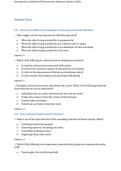
Introduction to Behavioral Neuroscience Instructor Answer Guide
Multiple Choice
19.1 What are the Different Psychological Processes Associated with Attention?
1. When might a visual search process be effortless and quick?
a. When the object being searched for is asymmetrical
b. When the object being searched for has a distinct color or shape
c. When the object being searched for is a combination of color and shape
d. When the object being searched for is far away
Answer: b
2. Which of the following is a characteristic of endogenous attention?
a. It requires conscious awareness and deliberation
b. It involves the automatic capture of attention by novel stimuli
c. It refers to the phenomenon of bottom-up attentional control
d. It is the process of focusing on external stimuli effortlessly
Answer: a
3. Normally, consciousness varies with sleep-wake cycles. Which of the following situations
shows that the two can be dissociated?
a. Individuals who are under anesthesia but who are not awake
b. People who cannot control the content of their dreams
c. Patients with narcolepsy
d. Patients in a persistent vegetative state
Answer: d
19.2 How is Attention Implemented in the Brain?
4. What is one of the main functions of the ascending reticular activation system (ARAS)?
a. Activating retinal neurogenesis
b. Generating upward (ascending) saccades
c. Controlling working memory
d. Regulating sleep/wake cycles
Answer: d
5. Which of the following is an impairment associated with progressive supranuclear palsy
(PSP)
a. Visual neglect for the left visual field
, b. Hemianopia for the left visual field
c. Deficits in shifting attention from one location to another
d. Representational neglect
Answer: c
6. Which of the following tasks would be most impacted by temporarily disrupting activity
in the monkey superior colliculus?
a. Deciding whether a banana is ripe based on a conjunction search involving color
and texture
b. Maintaining arousal during portions of the day normally associated with sleep
c. Deciding whether a predator in peripheral vision is moving towards or away from
them
d. Recognizing places in their local visual environment
Answer: c
7. If someone scanned your brain while you were daydreaming, without any specific task or
goal in mind, which brain network would be mostly likely engaged?
a. The default mode network
b. The dorsal attentional network
c. The representational neglect network
d. The error monitoring network
Answer: a
8. Imagine that you are closely watching a computer monitor at the Department of Motor
Vehicles that will cue you whether you should go to the customer service agent just to the
left or to the right of the monitor for your appointment. Which brain network would most
likely be engaged by the computer monitor in this situation?
a. The default mode network
b. The fusiform face area
c. The dorsal attentional network
d. The ventral attentional network
Answer: c
19.3 What Happens to Unattended Information?
9. What does the phenomenon of inattentional blindness suggest about the influence of
top-down attentional goals on our perception?
a. Top-down attentional goals have no impact on blindness
b. Little of the sensory information in our visual world escapes our conscious
awareness
c. Bottom-up information is immune to intentional blindness
2
Updated October 2024
Multiple Choice
19.1 What are the Different Psychological Processes Associated with Attention?
1. When might a visual search process be effortless and quick?
a. When the object being searched for is asymmetrical
b. When the object being searched for has a distinct color or shape
c. When the object being searched for is a combination of color and shape
d. When the object being searched for is far away
Answer: b
2. Which of the following is a characteristic of endogenous attention?
a. It requires conscious awareness and deliberation
b. It involves the automatic capture of attention by novel stimuli
c. It refers to the phenomenon of bottom-up attentional control
d. It is the process of focusing on external stimuli effortlessly
Answer: a
3. Normally, consciousness varies with sleep-wake cycles. Which of the following situations
shows that the two can be dissociated?
a. Individuals who are under anesthesia but who are not awake
b. People who cannot control the content of their dreams
c. Patients with narcolepsy
d. Patients in a persistent vegetative state
Answer: d
19.2 How is Attention Implemented in the Brain?
4. What is one of the main functions of the ascending reticular activation system (ARAS)?
a. Activating retinal neurogenesis
b. Generating upward (ascending) saccades
c. Controlling working memory
d. Regulating sleep/wake cycles
Answer: d
5. Which of the following is an impairment associated with progressive supranuclear palsy
(PSP)
a. Visual neglect for the left visual field
, b. Hemianopia for the left visual field
c. Deficits in shifting attention from one location to another
d. Representational neglect
Answer: c
6. Which of the following tasks would be most impacted by temporarily disrupting activity
in the monkey superior colliculus?
a. Deciding whether a banana is ripe based on a conjunction search involving color
and texture
b. Maintaining arousal during portions of the day normally associated with sleep
c. Deciding whether a predator in peripheral vision is moving towards or away from
them
d. Recognizing places in their local visual environment
Answer: c
7. If someone scanned your brain while you were daydreaming, without any specific task or
goal in mind, which brain network would be mostly likely engaged?
a. The default mode network
b. The dorsal attentional network
c. The representational neglect network
d. The error monitoring network
Answer: a
8. Imagine that you are closely watching a computer monitor at the Department of Motor
Vehicles that will cue you whether you should go to the customer service agent just to the
left or to the right of the monitor for your appointment. Which brain network would most
likely be engaged by the computer monitor in this situation?
a. The default mode network
b. The fusiform face area
c. The dorsal attentional network
d. The ventral attentional network
Answer: c
19.3 What Happens to Unattended Information?
9. What does the phenomenon of inattentional blindness suggest about the influence of
top-down attentional goals on our perception?
a. Top-down attentional goals have no impact on blindness
b. Little of the sensory information in our visual world escapes our conscious
awareness
c. Bottom-up information is immune to intentional blindness
2
Updated October 2024