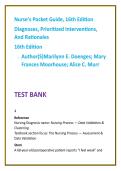
Nurse's Pocket Guide, 16th Edition
Diagnoses, Prioritized Interventions,
And Rationales
16th Edition
• Author(S)Marilynn E. Doenges; Mary
Frances Moorhouse; Alice C. Murr
TEST BANK
1
Reference
Nursing Diagnosis name: Nursing Process — Data Validation &
Clustering
Textbook section focus: The Nursing Process — Assessment &
Data Validation
Stem
A 68-year-old postoperative patient reports “I feel weak” and
,has a heart rate of 122 bpm, blood pressure 86/54 mmHg, urine
output 10 mL/hr for 2 hours, and skin that is cool and clammy.
Before writing a nursing diagnosis, the nurse’s best next action
is to:
A. Cluster these findings and write “Decreased Cardiac Output.”
B. Validate the data by rechecking vital signs and asking about
recent fluid intake.
C. Start an IV bolus immediately and document the nursing
diagnosis later.
D. Notify the physician and request an order for a fluid
challenge before further nursing steps.
Correct answer: B
Rationales
Correct (B): Chapter 1 emphasizes validating abnormal
assessment data before formulating diagnoses. Rechecking
vitals and confirming intake/output prevents diagnostic errors
and ensures accurate data clustering for priority diagnoses.
Incorrect (A): Clustering is appropriate but premature without
validating abnormal data; jumping to a diagnosis risks error.
Incorrect (C): Initiating treatment without validating data or
following institutional protocols bypasses the nursing process;
interventions should be based on validated assessment.
Incorrect (D): Notifying the physician may be appropriate after
validation; immediate physician notification without validation
may produce unnecessary orders.
,Teaching Point: Always validate abnormal assessment data
before diagnosing or clustering.
Citation: Doenges, M. E., Moorhouse, M. F., & Murr, A. C.
(2022). Nurse’s Pocket Guide (16th ed.). Nursing process and
planning client care section.
2
Reference
Nursing Diagnosis name: Nursing Process — Actual vs Risk
Diagnosis
Textbook section focus: Formulating Nursing Diagnoses
Stem
A 52-year-old patient scheduled for elective surgery has shallow
respirations and a cough but normal oxygen saturation and no
abnormal breath sounds. The nurse is planning care. Which
diagnosis type best fits these findings?
A. Actual nursing diagnosis related to ineffective airway
clearance.
B. Risk nursing diagnosis for ineffective airway clearance.
C. Health-promotion diagnosis for readiness for enhanced
respiratory function.
D. Collaborative problem requiring immediate physician
prescription.
Correct answer: B
, Rationales
Correct (B): Chapter 1 describes that when risk factors or early
signs exist but defining characteristics (objective evidence) are
absent, a risk diagnosis is appropriate to guide preventive
interventions. Shallow respirations and cough without objective
impairment indicate risk.
Incorrect (A): An actual diagnosis requires defining
characteristics such as abnormal breath sounds or decreased
oxygenation, which are absent.
Incorrect (C): A health-promotion diagnosis is used when the
patient expresses readiness to enhance health, not for possible
respiratory compromise.
Incorrect (D): Collaborative problems are physiologic
complications that nurses monitor; this situation is best
addressed by nursing preventive interventions as a risk
diagnosis.
Teaching Point: Use a risk diagnosis for potential problems with
risk factors but no defining characteristics.
Citation: Doenges et al. (2022). Nurse’s Pocket Guide (16th ed.).
Nursing process and planning client care section.
3
Reference
Nursing Diagnosis name: Nursing Process — Outcome/Goal
Writing
Diagnoses, Prioritized Interventions,
And Rationales
16th Edition
• Author(S)Marilynn E. Doenges; Mary
Frances Moorhouse; Alice C. Murr
TEST BANK
1
Reference
Nursing Diagnosis name: Nursing Process — Data Validation &
Clustering
Textbook section focus: The Nursing Process — Assessment &
Data Validation
Stem
A 68-year-old postoperative patient reports “I feel weak” and
,has a heart rate of 122 bpm, blood pressure 86/54 mmHg, urine
output 10 mL/hr for 2 hours, and skin that is cool and clammy.
Before writing a nursing diagnosis, the nurse’s best next action
is to:
A. Cluster these findings and write “Decreased Cardiac Output.”
B. Validate the data by rechecking vital signs and asking about
recent fluid intake.
C. Start an IV bolus immediately and document the nursing
diagnosis later.
D. Notify the physician and request an order for a fluid
challenge before further nursing steps.
Correct answer: B
Rationales
Correct (B): Chapter 1 emphasizes validating abnormal
assessment data before formulating diagnoses. Rechecking
vitals and confirming intake/output prevents diagnostic errors
and ensures accurate data clustering for priority diagnoses.
Incorrect (A): Clustering is appropriate but premature without
validating abnormal data; jumping to a diagnosis risks error.
Incorrect (C): Initiating treatment without validating data or
following institutional protocols bypasses the nursing process;
interventions should be based on validated assessment.
Incorrect (D): Notifying the physician may be appropriate after
validation; immediate physician notification without validation
may produce unnecessary orders.
,Teaching Point: Always validate abnormal assessment data
before diagnosing or clustering.
Citation: Doenges, M. E., Moorhouse, M. F., & Murr, A. C.
(2022). Nurse’s Pocket Guide (16th ed.). Nursing process and
planning client care section.
2
Reference
Nursing Diagnosis name: Nursing Process — Actual vs Risk
Diagnosis
Textbook section focus: Formulating Nursing Diagnoses
Stem
A 52-year-old patient scheduled for elective surgery has shallow
respirations and a cough but normal oxygen saturation and no
abnormal breath sounds. The nurse is planning care. Which
diagnosis type best fits these findings?
A. Actual nursing diagnosis related to ineffective airway
clearance.
B. Risk nursing diagnosis for ineffective airway clearance.
C. Health-promotion diagnosis for readiness for enhanced
respiratory function.
D. Collaborative problem requiring immediate physician
prescription.
Correct answer: B
, Rationales
Correct (B): Chapter 1 describes that when risk factors or early
signs exist but defining characteristics (objective evidence) are
absent, a risk diagnosis is appropriate to guide preventive
interventions. Shallow respirations and cough without objective
impairment indicate risk.
Incorrect (A): An actual diagnosis requires defining
characteristics such as abnormal breath sounds or decreased
oxygenation, which are absent.
Incorrect (C): A health-promotion diagnosis is used when the
patient expresses readiness to enhance health, not for possible
respiratory compromise.
Incorrect (D): Collaborative problems are physiologic
complications that nurses monitor; this situation is best
addressed by nursing preventive interventions as a risk
diagnosis.
Teaching Point: Use a risk diagnosis for potential problems with
risk factors but no defining characteristics.
Citation: Doenges et al. (2022). Nurse’s Pocket Guide (16th ed.).
Nursing process and planning client care section.
3
Reference
Nursing Diagnosis name: Nursing Process — Outcome/Goal
Writing