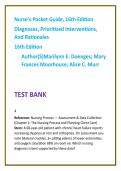
Nurse's Pocket Guide, 16th Edition
Diagnoses, Prioritized Interventions,
And Rationales
16th Edition
• Author(S)Marilynn E. Doenges; Mary
Frances Moorhouse; Alice C. Murr
TEST BANK
1
Reference: Nursing Process — Five Steps; Assessment &
Prioritization.
Stem: A 68-year-old postoperative client is drowsy but
arousable, has shallow respirations 8/min, oxygen saturation
88% on room air, and a patent IV. Using the nursing process,
which action should the nurse perform first?
,A. Document vital signs and notify the provider.
B. Increase the supplemental oxygen and reposition to open
airway.
C. Offer oral fluids to improve level of consciousness.
D. Complete the admission nursing history and medication
reconciliation.
Correct answer: B
Rationales:
• Correct (B): Chapter 1 emphasizes assessment and
immediate prioritization (ABCs). Shallow respirations and
SpO₂ 88% indicate compromised airway/oxygenation
requiring immediate intervention (positioning, oxygen)
before documentation or nonurgent tasks.
• A (incorrect): Documentation and notification are
important but come after stabilizing airway/oxygenation.
Waiting to intervene could harm the client.
• C (incorrect): Offering oral fluids is unsafe when
respirations are depressed—risk for aspiration.
• D (incorrect): Completing history is lower priority than
addressing an immediate respiratory compromise.
Teaching point: Always treat airway/oxygenation before
documentation or nonurgent assessments.
,Citation (Simplified APA): Doenges, M. E., Moorhouse, M. F., &
Murr, A. C. (2022). Nurse’s Pocket Guide (16th ed.). Nursing
process section.
2
Reference: Diagnostic Statement (PES format) — Problem,
Etiology, Signs/Symptoms.
Stem: A client has poor wound healing after abdominal surgery.
Chart shows malnutrition, low serum albumin, and wound
edges separated. Which diagnostic statement follows the PES
format taught in Chapter 1?
A. Impaired tissue integrity related to surgery as evidenced by
wound edges separated.
B. Impaired tissue integrity related to malnutrition as evidenced
by low albumin and delayed wound healing.
C. Risk for infection related to wound separation and low
albumin.
D. Impaired skin integrity as evidenced by surgical incision.
Correct answer: B
Rationales:
• Correct (B): Chapter 1 endorses PES: problem (Impaired
tissue integrity), etiology (malnutrition), and defining
characteristics (low albumin, delayed healing). This
individualized statement guides interventions.
, • A (incorrect): Etiology “surgery” is too nonspecific and
does not incorporate the contributing factor (malnutrition)
driving delayed healing.
• C (incorrect): “Risk for infection” omits actual current
problem cues (wound separation, low albumin); risk
diagnoses lack defining characteristics.
• D (incorrect): Vague; lacks etiology and specific
signs/symptoms required by PES format.
Teaching point: Use PES: Problem + Etiology + Signs/symptoms
to make individualized diagnostic statements.
Citation (Simplified APA): Doenges, M. E., Moorhouse, M. F., &
Murr, A. C. (2022). Nurse’s Pocket Guide (16th ed.). Nursing
process section.
3
Reference: Assessment — Systematic Data Collection &
Documentation.
Stem: During shift assessment a nurse finds a client’s blood
glucose 360 mg/dL, dry mucous membranes, and fruity breath.
Which nursing action best reflects the assessment priority
described in Chapter 1?
A. Record findings and schedule teaching on diet later this
week.
B. Notify the provider and initiate orders per protocol if
Diagnoses, Prioritized Interventions,
And Rationales
16th Edition
• Author(S)Marilynn E. Doenges; Mary
Frances Moorhouse; Alice C. Murr
TEST BANK
1
Reference: Nursing Process — Five Steps; Assessment &
Prioritization.
Stem: A 68-year-old postoperative client is drowsy but
arousable, has shallow respirations 8/min, oxygen saturation
88% on room air, and a patent IV. Using the nursing process,
which action should the nurse perform first?
,A. Document vital signs and notify the provider.
B. Increase the supplemental oxygen and reposition to open
airway.
C. Offer oral fluids to improve level of consciousness.
D. Complete the admission nursing history and medication
reconciliation.
Correct answer: B
Rationales:
• Correct (B): Chapter 1 emphasizes assessment and
immediate prioritization (ABCs). Shallow respirations and
SpO₂ 88% indicate compromised airway/oxygenation
requiring immediate intervention (positioning, oxygen)
before documentation or nonurgent tasks.
• A (incorrect): Documentation and notification are
important but come after stabilizing airway/oxygenation.
Waiting to intervene could harm the client.
• C (incorrect): Offering oral fluids is unsafe when
respirations are depressed—risk for aspiration.
• D (incorrect): Completing history is lower priority than
addressing an immediate respiratory compromise.
Teaching point: Always treat airway/oxygenation before
documentation or nonurgent assessments.
,Citation (Simplified APA): Doenges, M. E., Moorhouse, M. F., &
Murr, A. C. (2022). Nurse’s Pocket Guide (16th ed.). Nursing
process section.
2
Reference: Diagnostic Statement (PES format) — Problem,
Etiology, Signs/Symptoms.
Stem: A client has poor wound healing after abdominal surgery.
Chart shows malnutrition, low serum albumin, and wound
edges separated. Which diagnostic statement follows the PES
format taught in Chapter 1?
A. Impaired tissue integrity related to surgery as evidenced by
wound edges separated.
B. Impaired tissue integrity related to malnutrition as evidenced
by low albumin and delayed wound healing.
C. Risk for infection related to wound separation and low
albumin.
D. Impaired skin integrity as evidenced by surgical incision.
Correct answer: B
Rationales:
• Correct (B): Chapter 1 endorses PES: problem (Impaired
tissue integrity), etiology (malnutrition), and defining
characteristics (low albumin, delayed healing). This
individualized statement guides interventions.
, • A (incorrect): Etiology “surgery” is too nonspecific and
does not incorporate the contributing factor (malnutrition)
driving delayed healing.
• C (incorrect): “Risk for infection” omits actual current
problem cues (wound separation, low albumin); risk
diagnoses lack defining characteristics.
• D (incorrect): Vague; lacks etiology and specific
signs/symptoms required by PES format.
Teaching point: Use PES: Problem + Etiology + Signs/symptoms
to make individualized diagnostic statements.
Citation (Simplified APA): Doenges, M. E., Moorhouse, M. F., &
Murr, A. C. (2022). Nurse’s Pocket Guide (16th ed.). Nursing
process section.
3
Reference: Assessment — Systematic Data Collection &
Documentation.
Stem: During shift assessment a nurse finds a client’s blood
glucose 360 mg/dL, dry mucous membranes, and fruity breath.
Which nursing action best reflects the assessment priority
described in Chapter 1?
A. Record findings and schedule teaching on diet later this
week.
B. Notify the provider and initiate orders per protocol if