NSG EXAM 3
Study online at https://quizlet.com/_9huuzf
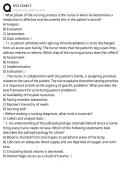
1. What phase of the nursing process is the nurse in when he determines a
medication is effective and documents this in the patient's record?
A) Analysis
B) Evaluation
C) Assessment
D) Data collection: B
2. 11. A patient admitted with right leg thrombophlebitis is to be discharged
from an acute-care facility. The nurse notes that the patient's leg is pain-free,
without redness or edema. Which step of the nursing process does this reflect?
A) Assessment
B) Analysis
C) Implementation
D) Evaluation: D
3. . The nurse, in collaboration with the patient's family, is assigning priorities
related to the care of the patient. The nurse explains that when setting priorities
it is important to look at the urgency of specific problems. What provides the
best framework for prioritizing patient problems?
A) Availability of hospital resources
B) Family member statements
C) Maslow's hierarchy of needs
D) Nursing skill: C
4. Before making a nursing diagnosis, what must a nurse do?
C) Collect and analyze data: C
5. 1. An understanding of the pathophysiologic rationale behind shock is some-
thing every nurse needs to have. Which of the following statements best
describes the pathophysiology for shock?
A) Blood is shunted from vital organs to peripheral areas of the body.
B) Cells lack an adequate blood supply and are deprived of oxygen and nutri-
ents.
C) Circulating blood volume is decreased.
D) Hemorrhage occurs as a result of trauma.: B
, NSG EXAM 3
Study online at https://quizlet.com/_9huuzf
6. 2. You are assessing your patient. When prioritizing the patient's care, you
recognize that your patient is at risk for hypovolemic shock when
A) fluid circulating in the blood vessels decreases.
B) cardiac output is increased.
C) blood pressure increases.
D)pulse is fast and bounding: A
7. 3. You are admitting a patient with a diagnosis of a gastrointestinal bleed
who is in the compensatory stage of shock. You know that an early sign that
accompanies initial shock is what?
A) Increased urine output
B) Decreased heart rate
C) Hyperactive bowel sounds
D) Cool, clammy skin: D
8. 4. You are caring for a patient in liver failure who is exhibiting signs and
symptoms of hypovolemic shock. You anticipate that the physician will order
the administration of a crystalloid for the management of this patient. Which
crystalloid fluid is most commonly used to treat hypovolemic shock?
A) Lactated Ringer's
B) Albumin
C) Dextran
D) 3% NaCl: A
9. 5. A patient is receiving dopamine, a vasoactive drug used for shock, to in-
crease her stroke volume. What should the nurse be aware of when monitoring
a vasoactive drug?
A) The drug should be discontinued immediately after blood pressure increas-
es.
B) The drug dose should be weaned down prior to discontinuing.
C) The drug may cause respiratory alkalosis.
D) The drug reduces oxygen demands of the heart.: B
10. 6. A nurse in the ICU receives report from the nurse in the emergency
department about a new patient being admitted with a neck injury he received
while diving into a lake. The emergency-department nurse reports that his
, NSG EXAM 3
Study online at https://quizlet.com/_9huuzf
blood pressure is 85/54, heart rate is 53 beats per minute, and his skin is
warm and dry. What does the ICU nurse recognize that that patient is probably
experiencing?
A) Anaphylactic shock
B) Neurogenic shock
C) Septic shock
D) Hypovolemic shock: B
11. 8. You are transferring a patient who is in the progressive stage of shock
into ICU from your medical-surgical unit. You are aware that the shock affects
many organ systems and that nursing management of the patient will focus
on what?
A) Reviewing the cause of shock and trying to limit the progression
B) Assessing and understanding shock and the significant changes in assess-
ment data to guide the plan of care
C) Giving the prescribed treatment but shifting focus to providing family time
as the patient is unlikely to survive
D) Giving progressive care to the patient and family using critical pathways for
shock therapy: B
12. 9. When caring for a patient in shock, one of the major nursing goals is to
reduce the risk that the patient will develop complications from shock. What
does this require the nurse to do?
A) Provide an accurate diagnosis, plan of care, and appropriate interventions
to allow the patient the best chance for survival
B) Keep the physician updated with the most accurate information; in shock the
nurse is often powerless to help.
C) Monitor for significant changes and evaluate patient outcomes on a sched-
uled basis focusing on blood pressure and skin temperature
D) Understand the underlying mechanisms of shock, recognize the subtle and
more obvious signs, and then provide rapid assessment and response: D
13. 10. You are caring for a patient in the ICU who is suffering from multiple
organ dysfunction syndrome (MODS). What should your plan of care focus on?
A) Encouraging the family to stay hopeful and educating the family to the fact
, NSG EXAM 3
Study online at https://quizlet.com/_9huuzf
that, in most cases, the prognosis is good
B) Encouraging the family to leave the hospital and to take time for themselves
as care of MODS patients may last for years
C) Promoting communication with the patient and family along with addressing
end-of-life issues
D) Discussing organ donation on a number of different occasions to allow the
family time to adjust to the idea: C
14. 11. Your patient is in hypovolemic shock. You know that antidiuretic hormone
(ADH) plays a role during hypovolemic shock. What assessment finding will
you likely observe related to the role of the antidiuretic hormone (ADH) during
hypovolemic shock?
A) Increased hunger
B) Decreased thirst
C) Decreased urinary output
D) Increased capillary perfusion: C
15. 12. When caring for a patient at risk for shock, what assessment finding
would the nurse consider a potential sign of shock?
A) Elevated systolic blood pressure
B) Elevated mean arterial pressure
C) Shallow, rapid respirations
D) Bradycardia: C
16. 13. You are precepting a new graduate nurse in the ICU. The two of you
are caring for a patient who is receiving large volumes of crystalloid fluid as
a result of shock. What would you teach the new nurse to monitor the patient
for symptoms of?
A) Hypothermia
B) Bradycardia
C) Coffee ground emesis
D) Pain: A
17. 14. You are caring for a patient in the ICU whose condition is deteriorating.
You receive orders for dopamine, which is an intravenous vasoactive drug.
What would be your priority assessment and interventions specific to the
Study online at https://quizlet.com/_9huuzf
1. What phase of the nursing process is the nurse in when he determines a
medication is effective and documents this in the patient's record?
A) Analysis
B) Evaluation
C) Assessment
D) Data collection: B
2. 11. A patient admitted with right leg thrombophlebitis is to be discharged
from an acute-care facility. The nurse notes that the patient's leg is pain-free,
without redness or edema. Which step of the nursing process does this reflect?
A) Assessment
B) Analysis
C) Implementation
D) Evaluation: D
3. . The nurse, in collaboration with the patient's family, is assigning priorities
related to the care of the patient. The nurse explains that when setting priorities
it is important to look at the urgency of specific problems. What provides the
best framework for prioritizing patient problems?
A) Availability of hospital resources
B) Family member statements
C) Maslow's hierarchy of needs
D) Nursing skill: C
4. Before making a nursing diagnosis, what must a nurse do?
C) Collect and analyze data: C
5. 1. An understanding of the pathophysiologic rationale behind shock is some-
thing every nurse needs to have. Which of the following statements best
describes the pathophysiology for shock?
A) Blood is shunted from vital organs to peripheral areas of the body.
B) Cells lack an adequate blood supply and are deprived of oxygen and nutri-
ents.
C) Circulating blood volume is decreased.
D) Hemorrhage occurs as a result of trauma.: B
, NSG EXAM 3
Study online at https://quizlet.com/_9huuzf
6. 2. You are assessing your patient. When prioritizing the patient's care, you
recognize that your patient is at risk for hypovolemic shock when
A) fluid circulating in the blood vessels decreases.
B) cardiac output is increased.
C) blood pressure increases.
D)pulse is fast and bounding: A
7. 3. You are admitting a patient with a diagnosis of a gastrointestinal bleed
who is in the compensatory stage of shock. You know that an early sign that
accompanies initial shock is what?
A) Increased urine output
B) Decreased heart rate
C) Hyperactive bowel sounds
D) Cool, clammy skin: D
8. 4. You are caring for a patient in liver failure who is exhibiting signs and
symptoms of hypovolemic shock. You anticipate that the physician will order
the administration of a crystalloid for the management of this patient. Which
crystalloid fluid is most commonly used to treat hypovolemic shock?
A) Lactated Ringer's
B) Albumin
C) Dextran
D) 3% NaCl: A
9. 5. A patient is receiving dopamine, a vasoactive drug used for shock, to in-
crease her stroke volume. What should the nurse be aware of when monitoring
a vasoactive drug?
A) The drug should be discontinued immediately after blood pressure increas-
es.
B) The drug dose should be weaned down prior to discontinuing.
C) The drug may cause respiratory alkalosis.
D) The drug reduces oxygen demands of the heart.: B
10. 6. A nurse in the ICU receives report from the nurse in the emergency
department about a new patient being admitted with a neck injury he received
while diving into a lake. The emergency-department nurse reports that his
, NSG EXAM 3
Study online at https://quizlet.com/_9huuzf
blood pressure is 85/54, heart rate is 53 beats per minute, and his skin is
warm and dry. What does the ICU nurse recognize that that patient is probably
experiencing?
A) Anaphylactic shock
B) Neurogenic shock
C) Septic shock
D) Hypovolemic shock: B
11. 8. You are transferring a patient who is in the progressive stage of shock
into ICU from your medical-surgical unit. You are aware that the shock affects
many organ systems and that nursing management of the patient will focus
on what?
A) Reviewing the cause of shock and trying to limit the progression
B) Assessing and understanding shock and the significant changes in assess-
ment data to guide the plan of care
C) Giving the prescribed treatment but shifting focus to providing family time
as the patient is unlikely to survive
D) Giving progressive care to the patient and family using critical pathways for
shock therapy: B
12. 9. When caring for a patient in shock, one of the major nursing goals is to
reduce the risk that the patient will develop complications from shock. What
does this require the nurse to do?
A) Provide an accurate diagnosis, plan of care, and appropriate interventions
to allow the patient the best chance for survival
B) Keep the physician updated with the most accurate information; in shock the
nurse is often powerless to help.
C) Monitor for significant changes and evaluate patient outcomes on a sched-
uled basis focusing on blood pressure and skin temperature
D) Understand the underlying mechanisms of shock, recognize the subtle and
more obvious signs, and then provide rapid assessment and response: D
13. 10. You are caring for a patient in the ICU who is suffering from multiple
organ dysfunction syndrome (MODS). What should your plan of care focus on?
A) Encouraging the family to stay hopeful and educating the family to the fact
, NSG EXAM 3
Study online at https://quizlet.com/_9huuzf
that, in most cases, the prognosis is good
B) Encouraging the family to leave the hospital and to take time for themselves
as care of MODS patients may last for years
C) Promoting communication with the patient and family along with addressing
end-of-life issues
D) Discussing organ donation on a number of different occasions to allow the
family time to adjust to the idea: C
14. 11. Your patient is in hypovolemic shock. You know that antidiuretic hormone
(ADH) plays a role during hypovolemic shock. What assessment finding will
you likely observe related to the role of the antidiuretic hormone (ADH) during
hypovolemic shock?
A) Increased hunger
B) Decreased thirst
C) Decreased urinary output
D) Increased capillary perfusion: C
15. 12. When caring for a patient at risk for shock, what assessment finding
would the nurse consider a potential sign of shock?
A) Elevated systolic blood pressure
B) Elevated mean arterial pressure
C) Shallow, rapid respirations
D) Bradycardia: C
16. 13. You are precepting a new graduate nurse in the ICU. The two of you
are caring for a patient who is receiving large volumes of crystalloid fluid as
a result of shock. What would you teach the new nurse to monitor the patient
for symptoms of?
A) Hypothermia
B) Bradycardia
C) Coffee ground emesis
D) Pain: A
17. 14. You are caring for a patient in the ICU whose condition is deteriorating.
You receive orders for dopamine, which is an intravenous vasoactive drug.
What would be your priority assessment and interventions specific to the