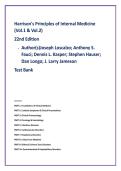
Harrison's Principles of Internal Medicine
(Vol.1 & Vol.2)
22nd Edition
• Author(s)Joseph Loscalzo; Anthony S.
Fauci; Dennis L. Kasper; Stephen Hauser;
Dan Longo; J. Larry Jameson
Test Bank
Covered
PART 1: Foundations of Clinical Medicine
PART 2: Cardinal Symptoms & Clinical Presentations
PART 3: Clinical Pharmacology
PART 4: Oncology & Hematology
PART 5: Infectious Diseases
PART 6: Cardiovascular Disorders
PART 7: Respiratory Disorders
PART 8: Critical Care Medicine
PART 9: Kidney & Urinary Tract Disorders
PART 10: Gastrointestinal & Hepatobiliary Disorders
,PART 11: Immune-Mediated & Rheumatologic Disorders
PART 12: Endocrinology & Metabolism
PART 13: Neurologic & Psychiatric Disorders
PART 14: Toxicology & Environmental Injury
PART 15: Environmental & Occupational Medicine
PART 16: Genetics, Precision & Systems Medicine
PART 17–20: Special & Emerging Topics
Questions emphasize clinical judgment, safety, diagnostic
reasoning, prevention, ethics, and nursing implications,
appropriate for ADN/BSN medical-surgical nursing exams.
1. The Practice of Medicine
Q1. Which principle best defines modern internal medicine
practice as described in Harrison’s?
A. Disease-centered decision making
B. Population-level protocol adherence only
C. Integration of biomedical science with patient values
D. Technology-driven diagnosis without examination
Correct Answer: C
Rationale: Harrison’s emphasizes combining scientific evidence
with patient preferences and values to guide care.
Citation: Harrison’s 22e, Ch. 1 – The Practice of Medicine
,2. Promoting Good Health
Q2. Which nursing intervention best aligns with health
promotion principles outlined in Harrison’s?
A. Focusing solely on disease treatment
B. Addressing social and behavioral determinants of health
C. Limiting education to acute care settings
D. Emphasizing genetic risk over lifestyle factors
Correct Answer: B
Rationale: Health promotion includes behavioral, social, and
environmental determinants.
Citation: Harrison’s 22e, Ch. 2 – Promoting Good Health
3. Vaccine Opposition and Hesitancy
Q3. The most effective strategy to address vaccine hesitancy is:
A. Providing statistics only
B. Mandating vaccination without discussion
C. Respectful dialogue addressing patient concerns
D. Avoiding the topic unless asked
Correct Answer: C
Rationale: Trust-based communication and addressing
misconceptions improve vaccine acceptance.
Citation: Harrison’s 22e, Ch. 3 – Vaccine Opposition and
Hesitancy
, 4. Decision-Making in Clinical Medicine
Q4. Shared decision-making requires the nurse to prioritize:
A. Physician preference
B. Patient autonomy and informed consent
C. Cost reduction
D. Institutional policy
Correct Answer: B
Rationale: Harrison’s highlights shared decision-making as
central to ethical, patient-centered care.
Citation: Harrison’s 22e, Ch. 4 – Decision-Making in Clinical
Medicine
5. Precision Medicine and Clinical Care
Q5. Precision medicine primarily aims to:
A. Replace clinical judgment
B. Individualize care using genetic and molecular data
C. Eliminate population-based guidelines
D. Reduce preventive care
Correct Answer: B
Rationale: Precision medicine tailors care based on individual
biological variability.
Citation: Harrison’s 22e, Ch. 5 – Precision Medicine and Clinical
Care
(Vol.1 & Vol.2)
22nd Edition
• Author(s)Joseph Loscalzo; Anthony S.
Fauci; Dennis L. Kasper; Stephen Hauser;
Dan Longo; J. Larry Jameson
Test Bank
Covered
PART 1: Foundations of Clinical Medicine
PART 2: Cardinal Symptoms & Clinical Presentations
PART 3: Clinical Pharmacology
PART 4: Oncology & Hematology
PART 5: Infectious Diseases
PART 6: Cardiovascular Disorders
PART 7: Respiratory Disorders
PART 8: Critical Care Medicine
PART 9: Kidney & Urinary Tract Disorders
PART 10: Gastrointestinal & Hepatobiliary Disorders
,PART 11: Immune-Mediated & Rheumatologic Disorders
PART 12: Endocrinology & Metabolism
PART 13: Neurologic & Psychiatric Disorders
PART 14: Toxicology & Environmental Injury
PART 15: Environmental & Occupational Medicine
PART 16: Genetics, Precision & Systems Medicine
PART 17–20: Special & Emerging Topics
Questions emphasize clinical judgment, safety, diagnostic
reasoning, prevention, ethics, and nursing implications,
appropriate for ADN/BSN medical-surgical nursing exams.
1. The Practice of Medicine
Q1. Which principle best defines modern internal medicine
practice as described in Harrison’s?
A. Disease-centered decision making
B. Population-level protocol adherence only
C. Integration of biomedical science with patient values
D. Technology-driven diagnosis without examination
Correct Answer: C
Rationale: Harrison’s emphasizes combining scientific evidence
with patient preferences and values to guide care.
Citation: Harrison’s 22e, Ch. 1 – The Practice of Medicine
,2. Promoting Good Health
Q2. Which nursing intervention best aligns with health
promotion principles outlined in Harrison’s?
A. Focusing solely on disease treatment
B. Addressing social and behavioral determinants of health
C. Limiting education to acute care settings
D. Emphasizing genetic risk over lifestyle factors
Correct Answer: B
Rationale: Health promotion includes behavioral, social, and
environmental determinants.
Citation: Harrison’s 22e, Ch. 2 – Promoting Good Health
3. Vaccine Opposition and Hesitancy
Q3. The most effective strategy to address vaccine hesitancy is:
A. Providing statistics only
B. Mandating vaccination without discussion
C. Respectful dialogue addressing patient concerns
D. Avoiding the topic unless asked
Correct Answer: C
Rationale: Trust-based communication and addressing
misconceptions improve vaccine acceptance.
Citation: Harrison’s 22e, Ch. 3 – Vaccine Opposition and
Hesitancy
, 4. Decision-Making in Clinical Medicine
Q4. Shared decision-making requires the nurse to prioritize:
A. Physician preference
B. Patient autonomy and informed consent
C. Cost reduction
D. Institutional policy
Correct Answer: B
Rationale: Harrison’s highlights shared decision-making as
central to ethical, patient-centered care.
Citation: Harrison’s 22e, Ch. 4 – Decision-Making in Clinical
Medicine
5. Precision Medicine and Clinical Care
Q5. Precision medicine primarily aims to:
A. Replace clinical judgment
B. Individualize care using genetic and molecular data
C. Eliminate population-based guidelines
D. Reduce preventive care
Correct Answer: B
Rationale: Precision medicine tailors care based on individual
biological variability.
Citation: Harrison’s 22e, Ch. 5 – Precision Medicine and Clinical
Care