1|Page
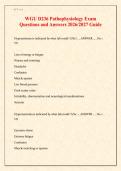
WGU D236 Pathophysiology Exam
Questions and Answers 2026/2027 Guide
Hyponatremia is indicated by what lab result? S/Sx?......ANSWER.......Na <
135
Loss of energy or fatigue
Nausea and vomiting
Headache
Confusion
Muscle spasms
Low blood pressure
Dark scanty urine
Irritability, disorientation and neurological manifestations
Seizures
Hypernatremia is indicated by what lab result? S/Sx......ANSWER.......Na >
145
Excessive thirst
Extreme fatigue
Confusion
Muscle twitching or spasms
,2|Page
Restlessness
Seizures
Normal potassium level......ANSWER.......3.5-5.0
Hypokalemia is indicated by what lab result? S/Sx......ANSWER.......K < 3.5
#Muscle fatigue/cramping
#Nausea, vomiting, constipation
#Cardiac dysrhythmias
#Paresthesia (numbness/tingling)
Hyperkalemia is indicated by what lab result? S/Sx?......ANSWER.......K > 5.0
Muscle weakness/paralysis
Paresthesia (numbness/tingling)
Cardiac dysrhythmias
Cardiac arrest/MI
Normal calcium level......ANSWER.......8.5-10.5
Hypocalcemia is indicated by what lab result?
S/Sx?......ANSWER.......Calcium < 8.5
,3|Page
Overexcitability of the muscles
Muscle twitching
Paresthesia (numbness/tingling)
Chvostek and Trousseau sign (twitching on the cheek when touched)
Cardiac dysrhythmias
Hypercalcemia is indicated by what lab result?
S/Sx?......ANSWER.......Calcium > 10.5
Muscle weakness
Loss of muscle tone
Spontaneous fractures
Kidney stones
Cardiac dysrhythmias
Normal magnesium level......ANSWER.......1.6-2.6
Hypomagnesemia is indicated by what lab result?
S/Sx?......ANSWER.......Magnesium level < 1.6
Tremors
Hyperreflexia
Insomnia
Muscle cramps
, 4|Page
Irregular heart beat
Hypermagnesemia is indicated by what lab result?
S/Sx?......ANSWER.......Magnesium level > 2.6
Hyporeflexia
Lethargy
Respiratory depression
N/V
Slow/Irregular heart beat
Tay-Sachs Disease......ANSWER.......An autosomal recessive inherited genetic
disorder caused by a recessive allele (chromosome 15) that leads to the
accumulation of certain lipids in the brain. Seizures, blindness, and
degeneration of motor and mental performance usually become manifest a
few months after birth, followed by death within a few years.
Marfan Syndrome......ANSWER.......Inherited autosomal dominant trait (only
one abnormal copy of the Marfan gene inherited from one parent) FBN1
gene. Genetic connective tissue disorder that can affect aorta and heart valve
structures.
**If one parent has Marfan syndrome, each child has a 50% chance of
inheriting the abnormal gene and developing the condition. If both parents
have the condition, the risk of their child inheriting the abnormal gene and
developing Marfan syndrome increases to 75%.
WGU D236 Pathophysiology Exam
Questions and Answers 2026/2027 Guide
Hyponatremia is indicated by what lab result? S/Sx?......ANSWER.......Na <
135
Loss of energy or fatigue
Nausea and vomiting
Headache
Confusion
Muscle spasms
Low blood pressure
Dark scanty urine
Irritability, disorientation and neurological manifestations
Seizures
Hypernatremia is indicated by what lab result? S/Sx......ANSWER.......Na >
145
Excessive thirst
Extreme fatigue
Confusion
Muscle twitching or spasms
,2|Page
Restlessness
Seizures
Normal potassium level......ANSWER.......3.5-5.0
Hypokalemia is indicated by what lab result? S/Sx......ANSWER.......K < 3.5
#Muscle fatigue/cramping
#Nausea, vomiting, constipation
#Cardiac dysrhythmias
#Paresthesia (numbness/tingling)
Hyperkalemia is indicated by what lab result? S/Sx?......ANSWER.......K > 5.0
Muscle weakness/paralysis
Paresthesia (numbness/tingling)
Cardiac dysrhythmias
Cardiac arrest/MI
Normal calcium level......ANSWER.......8.5-10.5
Hypocalcemia is indicated by what lab result?
S/Sx?......ANSWER.......Calcium < 8.5
,3|Page
Overexcitability of the muscles
Muscle twitching
Paresthesia (numbness/tingling)
Chvostek and Trousseau sign (twitching on the cheek when touched)
Cardiac dysrhythmias
Hypercalcemia is indicated by what lab result?
S/Sx?......ANSWER.......Calcium > 10.5
Muscle weakness
Loss of muscle tone
Spontaneous fractures
Kidney stones
Cardiac dysrhythmias
Normal magnesium level......ANSWER.......1.6-2.6
Hypomagnesemia is indicated by what lab result?
S/Sx?......ANSWER.......Magnesium level < 1.6
Tremors
Hyperreflexia
Insomnia
Muscle cramps
, 4|Page
Irregular heart beat
Hypermagnesemia is indicated by what lab result?
S/Sx?......ANSWER.......Magnesium level > 2.6
Hyporeflexia
Lethargy
Respiratory depression
N/V
Slow/Irregular heart beat
Tay-Sachs Disease......ANSWER.......An autosomal recessive inherited genetic
disorder caused by a recessive allele (chromosome 15) that leads to the
accumulation of certain lipids in the brain. Seizures, blindness, and
degeneration of motor and mental performance usually become manifest a
few months after birth, followed by death within a few years.
Marfan Syndrome......ANSWER.......Inherited autosomal dominant trait (only
one abnormal copy of the Marfan gene inherited from one parent) FBN1
gene. Genetic connective tissue disorder that can affect aorta and heart valve
structures.
**If one parent has Marfan syndrome, each child has a 50% chance of
inheriting the abnormal gene and developing the condition. If both parents
have the condition, the risk of their child inheriting the abnormal gene and
developing Marfan syndrome increases to 75%.