

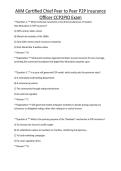
AIIM Certified Chief Peer to Peer P2P Insurance
Officer CCP2PIO Exam
**Question 1.** Which historical movement is the direct predecessor of modern
Neo‑Mutualism in P2P insurance?
A) 19th‑century labor unions
B) Mutual aid societies of the 1800s
C) Early 20th‑century stock insurance companies
D) Post‑World War II welfare states
**Answer:** B
**Explanation:** Mutual aid societies organized members to pool resources for loss coverage,
providing the communal foundation that digital Neo‑Mutualism expands upon.
**Question 2.** In a pure self‑governed P2P model, which entity sets the premium rates?
A) A centralized underwriting department
B) A reinsurance partner
C) The community through voting mechanisms
D) An external regulator
**Answer:** C
**Explanation:** Self‑governed models empower members to decide pricing, typically via
consensus or delegated voting, rather than relying on a central insurer.
**Question 3.** What is the primary purpose of the “Giveback” mechanism in P2P insurance?
A) To increase the insurer’s profit margin
B) To redistribute surplus to members or charities, reinforcing transparency
C) To fund marketing campaigns
D) To cover regulatory fines
**Answer:** B
,AIIM Certified Chief Peer to Peer P2P Insurance
Officer CCP2PIO Exam
**Explanation:** Giveback returns unused premiums to participants or charitable causes,
showcasing the pool’s transparency and aligning incentives.
**Question 4.** Which of the following best describes an affinity group in P2P insurance?
A) A random collection of policyholders
B) Individuals sharing a common risk characteristic, such as safe‑driving behavior
C) A group formed solely for tax advantages
D) A set of policyholders mandated by law to insure each other
**Answer:** B
**Explanation:** Affinity groups cluster members with shared risk profiles, enabling more
accurate risk assessment and pricing.
**Question 5.** Which consensus protocol is most suitable for voting on policy changes in a
small P2P community?
A) Proof‑of‑Work (PoW)
B) Delegated Proof‑of‑Stake (DPoS)
C) Simple majority voting with quorum
D) Byzantine Fault Tolerance (BFT) requiring 2/3 agreement
**Answer:** C
**Explanation:** For limited participants, a straightforward majority vote with a quorum is
efficient and easy to audit.
**Question 6.** How does behavioral economics help reduce fraudulent claims in P2P
insurance?
A) By imposing higher fines for fraud
B) By leveraging social pressure and peer monitoring to discourage dishonest behavior
C) By using AI to automatically reject claims
,AIIM Certified Chief Peer to Peer P2P Insurance
Officer CCP2PIO Exam
D) By requiring a notary for each claim submission
**Answer:** B
**Explanation:** Social norms and peer accountability create a deterrent effect, making
members less likely to file false claims.
**Question 7.** Which component is essential in a “Constitution‑like” governance framework
for a P2P pool?
A) Fixed premium rates for life
B) Immutable rules on claim approval processes and member rights
C) Unlimited reinsurance capacity
D) Mandatory profit distribution to shareholders
**Answer:** B
**Explanation:** A governing charter defines how the pool operates, including claim
procedures and member obligations, ensuring predictability.
**Question 8.** In algorithmic risk assessment for P2P, which data source provides the most
granular individual risk signal?
A) Credit score
B) Telemetry from vehicle IoT devices
C) Age and gender
D) Geographic ZIP code
**Answer:** B
**Explanation:** Real‑time telematics deliver detailed driving behavior, allowing precise
individual risk modeling.
**Question 9.** What is the primary mathematical goal when modeling “P2P contributions”
instead of traditional premiums?
, AIIM Certified Chief Peer to Peer P2P Insurance
Officer CCP2PIO Exam
A) Maximizing insurer profit
B) Equalizing expected loss across all members while covering administrative costs
C) Minimizing policyholder cash flow
D) Aligning contributions with market index returns
**Answer:** B
**Explanation:** Contributions aim to collect enough to cover anticipated claims and expenses,
distributing risk fairly among participants.
**Question 10.** Which strategy best mitigates adverse selection in an affinity‑based P2P pool?
A) Open enrollment to all applicants
B) Mandatory participation for all employees of a company
| C) Screening and onboarding criteria that filter high‑risk individuals
D) Offering discounts for high‑risk behaviors
**Answer:** C
**Explanation:** Targeted screening ensures that the pool does not become disproportionately
populated by high‑risk members.
**Question 11.** Which of the following is NOT a typical source of data for P2P underwriting?
A) Wearable health sensor data
B) Social media activity unrelated to risk
C) Vehicle telematics
D) Property IoT sensors
**Answer:** B
**Explanation:** Irrelevant social media data can introduce bias without contributing to risk
assessment, unlike sensor data that directly reflects exposure.
Officer CCP2PIO Exam
**Question 1.** Which historical movement is the direct predecessor of modern
Neo‑Mutualism in P2P insurance?
A) 19th‑century labor unions
B) Mutual aid societies of the 1800s
C) Early 20th‑century stock insurance companies
D) Post‑World War II welfare states
**Answer:** B
**Explanation:** Mutual aid societies organized members to pool resources for loss coverage,
providing the communal foundation that digital Neo‑Mutualism expands upon.
**Question 2.** In a pure self‑governed P2P model, which entity sets the premium rates?
A) A centralized underwriting department
B) A reinsurance partner
C) The community through voting mechanisms
D) An external regulator
**Answer:** C
**Explanation:** Self‑governed models empower members to decide pricing, typically via
consensus or delegated voting, rather than relying on a central insurer.
**Question 3.** What is the primary purpose of the “Giveback” mechanism in P2P insurance?
A) To increase the insurer’s profit margin
B) To redistribute surplus to members or charities, reinforcing transparency
C) To fund marketing campaigns
D) To cover regulatory fines
**Answer:** B
,AIIM Certified Chief Peer to Peer P2P Insurance
Officer CCP2PIO Exam
**Explanation:** Giveback returns unused premiums to participants or charitable causes,
showcasing the pool’s transparency and aligning incentives.
**Question 4.** Which of the following best describes an affinity group in P2P insurance?
A) A random collection of policyholders
B) Individuals sharing a common risk characteristic, such as safe‑driving behavior
C) A group formed solely for tax advantages
D) A set of policyholders mandated by law to insure each other
**Answer:** B
**Explanation:** Affinity groups cluster members with shared risk profiles, enabling more
accurate risk assessment and pricing.
**Question 5.** Which consensus protocol is most suitable for voting on policy changes in a
small P2P community?
A) Proof‑of‑Work (PoW)
B) Delegated Proof‑of‑Stake (DPoS)
C) Simple majority voting with quorum
D) Byzantine Fault Tolerance (BFT) requiring 2/3 agreement
**Answer:** C
**Explanation:** For limited participants, a straightforward majority vote with a quorum is
efficient and easy to audit.
**Question 6.** How does behavioral economics help reduce fraudulent claims in P2P
insurance?
A) By imposing higher fines for fraud
B) By leveraging social pressure and peer monitoring to discourage dishonest behavior
C) By using AI to automatically reject claims
,AIIM Certified Chief Peer to Peer P2P Insurance
Officer CCP2PIO Exam
D) By requiring a notary for each claim submission
**Answer:** B
**Explanation:** Social norms and peer accountability create a deterrent effect, making
members less likely to file false claims.
**Question 7.** Which component is essential in a “Constitution‑like” governance framework
for a P2P pool?
A) Fixed premium rates for life
B) Immutable rules on claim approval processes and member rights
C) Unlimited reinsurance capacity
D) Mandatory profit distribution to shareholders
**Answer:** B
**Explanation:** A governing charter defines how the pool operates, including claim
procedures and member obligations, ensuring predictability.
**Question 8.** In algorithmic risk assessment for P2P, which data source provides the most
granular individual risk signal?
A) Credit score
B) Telemetry from vehicle IoT devices
C) Age and gender
D) Geographic ZIP code
**Answer:** B
**Explanation:** Real‑time telematics deliver detailed driving behavior, allowing precise
individual risk modeling.
**Question 9.** What is the primary mathematical goal when modeling “P2P contributions”
instead of traditional premiums?
, AIIM Certified Chief Peer to Peer P2P Insurance
Officer CCP2PIO Exam
A) Maximizing insurer profit
B) Equalizing expected loss across all members while covering administrative costs
C) Minimizing policyholder cash flow
D) Aligning contributions with market index returns
**Answer:** B
**Explanation:** Contributions aim to collect enough to cover anticipated claims and expenses,
distributing risk fairly among participants.
**Question 10.** Which strategy best mitigates adverse selection in an affinity‑based P2P pool?
A) Open enrollment to all applicants
B) Mandatory participation for all employees of a company
| C) Screening and onboarding criteria that filter high‑risk individuals
D) Offering discounts for high‑risk behaviors
**Answer:** C
**Explanation:** Targeted screening ensures that the pool does not become disproportionately
populated by high‑risk members.
**Question 11.** Which of the following is NOT a typical source of data for P2P underwriting?
A) Wearable health sensor data
B) Social media activity unrelated to risk
C) Vehicle telematics
D) Property IoT sensors
**Answer:** B
**Explanation:** Irrelevant social media data can introduce bias without contributing to risk
assessment, unlike sensor data that directly reflects exposure.

