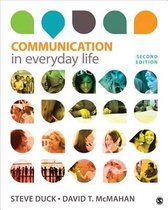
IHC: Communication in everyday life (summary)
Appendix
Relationships included in all types of communication
The Development of a Discipline
history of communication view book p.288
The Emergence of Areas of Study
rhetoric, rhetorical criticism, mass communication book p.288-291
Coming Together as Communication Studies
how everything is connected & got established (view p.291-292)
Future of Communication & the Relational Perspective
p.292
Methods of Studying Communication
table A.2 p.293
Social Scientific Approach
Also named positivist/post-positivist
Views world as objective, causal & predictable
Can involve laboratory experiments, measurements of behavior & emphasis on
statistical numerical analysis
Researchers seek to discover connections between phenomena/causal patterns
Assumptions
o Truth exists & will be discovered by researchers using the same methods
o Reality = objective & exists externally to human beings world is
experienced and humans react in the same way
o Human communication is predictable & causal connections can be
uncovered we can learn what behaviors are connected
Methods
o Experiments
Manipulation of an experience to determine how participants will
respond
o Questionnaires/Surveys
Used to gather information from people
Report data to the researcher provided by participants
3 types: asks people to respond to specific questions, asks people to
recall certain situations, provides people with a scenario and asks to
react on it
Advantages
o Studies are relatively easy to mount & can involve many people
o Social scientists often agree on how assessments can be made of behavior
o Ability to explain patterns of observations theoretically & derive new
predictions
Disadvantages
o Multiple variables
, Methodology that is used variables influence communication
impossible to consider everything
o Culturally Insensitive
Questionnaires & survey often don’t encounter cultural differences
o Restrictive
Questionnaires may impose too much restriction
o Participant Accuracy
Participants not always honest
o Convenient Samples
Convenient samples when conducting social scientific experiments
researchers tend to use nearby participants
Interpretivist Approach
Seeks to understand & describe the communication experience, often includes
observation in natural settings
Assumptions
o Rejects idea that a single reality exists & causal connections can be
discovered Truth can’t be discovered
o Communication seen as creative, uncertain, unpredictable
o Research is never value-free
Methods
o Mostly uses grounded theory to analyze data
o Data
Not quantitative, not number-based
Symbolic activity (ex. NVC)
o Direct Observation & Participant Observation
Direct observation/ethnographic research observe communication
& gather data
Participant observation researcher interacts with group
o Interviews
o Textual Analysis
Analysis of recorded communication (visual or auditory or both)
Conversation analysis or discourse analysis
Advantages
o Provides deep understanding of communication that can’t be gained through
other perspectives
o Likely to be studied in natural context
o Claims that scholars can never be 100% objective
Disadvantages
o Limited Scope of Understanding
Commits to individual levels of analysis without possibility to make
broader understandings of human communication
o Researcher Accuracy and Perspective
One has to believe researcher & always involves perspective
o Time-Consuming
,Critical Approach
Seeks to identify the hidden but formidable symbolic structures & practices that
create/uphold disadvantage, inequity, oppression of groups in favor of others
Scholars try to uncover hidden or explicit power within societal groups
Assumptions
o Built-in structure in society gives advantage to some certain members of
society have more power imposing their values
o Oppression & advantage are transacted through communication
o Only certain types of experiences are valued
Methods
o Similar to interpretivist approach
o Analysis of texts
Advantages
o Important in redirecting the thinking of communication scholars towards
awareness of inequities in society
Disadvantages
o Gives itself power & right to identify nature of inequity & how it might be
challenged
Areas in the Discipline of Communication
Communication Education & Instructional Communication
o Major area of study is devoted to improve its instruction
o Communication education = teaching of communication
o Instructional communication = study of teaching communication
Cultural Communication
o Strong interest in cultural influences
o Intracultural communication = communication within 1 culture
o Intercultural communication = communication when members of different
cultures interact
o Cross-cultural communication compares communication of different cultures
o Critical culture communication = issues of power within cultural contexts &
seeks to contest hegemony & promotes social justice
Family Communication
o Relationships = primary area of study
Group Communication & Leadership
Interpersonal Communication
o Study of relationships
o Ways in which relationships, identities & meanings are created through
interactions
Media & Technology
o Mass communication studies media studies
o Impact of technology or a particular medium
o Media content
o People’s reaction to technology & media content
Health Communication
o Involves any treatment or health-related issue
, Organizational Communication
o Communication taking place within an organization/workplace relational
enterprises through which meanings are developed & shared understandings
are created/challenged
Persuasion
o Examines ways in which people’s thinking & behavior can be modified
Political Communication
Public Relations
Rhetorical Criticism
Part I
1.An Overview of Communication
every aspect in life involves communication, it affects & influences our life
Everyday Communication & the relational Perspective
memorable events don’t make up much of a person’s life
everyday communication is not always memorable but incredibly important major
points of life
everyday communication creates, maintains, challenges & alters relationships, identities,
cultures, meaning, reality,…
relational perspective: based on belief that communication & relationships are
interconnected any type of communication has an assumed relationship
relations will influence what is communicated (e.g. people talk differently with parents
than friends) different meanings in different relations (e.g. I love you to a friend vs.
lover)
What Is Communication?
Definition
Unique study because everyone uses it since day 1 previous experience & use in
everyday life
Verbal communication: message made up of symbols (words)
Built-in expectations: frames
Communication Is Symbolic (key characteristic)
Use of symbols (verbal & non-verbal) (e.g. Words, movement, sound, logo,…)
o Verbal communication involves language vs. non-verbal: all other symbols
o No direct connection with what they represent
o STOP sign = symbol because no connection between s,t,o,p and stopping vehicle
Use of signs (ex. Wet streets it has rained)
Communication Requires Meaning
Meaning = what a symbol represents
Meanings can change based on context, other symbols, the way they are sent
Development of meaning continues as long as symbol is used
Social construction of meaning
Appendix
Relationships included in all types of communication
The Development of a Discipline
history of communication view book p.288
The Emergence of Areas of Study
rhetoric, rhetorical criticism, mass communication book p.288-291
Coming Together as Communication Studies
how everything is connected & got established (view p.291-292)
Future of Communication & the Relational Perspective
p.292
Methods of Studying Communication
table A.2 p.293
Social Scientific Approach
Also named positivist/post-positivist
Views world as objective, causal & predictable
Can involve laboratory experiments, measurements of behavior & emphasis on
statistical numerical analysis
Researchers seek to discover connections between phenomena/causal patterns
Assumptions
o Truth exists & will be discovered by researchers using the same methods
o Reality = objective & exists externally to human beings world is
experienced and humans react in the same way
o Human communication is predictable & causal connections can be
uncovered we can learn what behaviors are connected
Methods
o Experiments
Manipulation of an experience to determine how participants will
respond
o Questionnaires/Surveys
Used to gather information from people
Report data to the researcher provided by participants
3 types: asks people to respond to specific questions, asks people to
recall certain situations, provides people with a scenario and asks to
react on it
Advantages
o Studies are relatively easy to mount & can involve many people
o Social scientists often agree on how assessments can be made of behavior
o Ability to explain patterns of observations theoretically & derive new
predictions
Disadvantages
o Multiple variables
, Methodology that is used variables influence communication
impossible to consider everything
o Culturally Insensitive
Questionnaires & survey often don’t encounter cultural differences
o Restrictive
Questionnaires may impose too much restriction
o Participant Accuracy
Participants not always honest
o Convenient Samples
Convenient samples when conducting social scientific experiments
researchers tend to use nearby participants
Interpretivist Approach
Seeks to understand & describe the communication experience, often includes
observation in natural settings
Assumptions
o Rejects idea that a single reality exists & causal connections can be
discovered Truth can’t be discovered
o Communication seen as creative, uncertain, unpredictable
o Research is never value-free
Methods
o Mostly uses grounded theory to analyze data
o Data
Not quantitative, not number-based
Symbolic activity (ex. NVC)
o Direct Observation & Participant Observation
Direct observation/ethnographic research observe communication
& gather data
Participant observation researcher interacts with group
o Interviews
o Textual Analysis
Analysis of recorded communication (visual or auditory or both)
Conversation analysis or discourse analysis
Advantages
o Provides deep understanding of communication that can’t be gained through
other perspectives
o Likely to be studied in natural context
o Claims that scholars can never be 100% objective
Disadvantages
o Limited Scope of Understanding
Commits to individual levels of analysis without possibility to make
broader understandings of human communication
o Researcher Accuracy and Perspective
One has to believe researcher & always involves perspective
o Time-Consuming
,Critical Approach
Seeks to identify the hidden but formidable symbolic structures & practices that
create/uphold disadvantage, inequity, oppression of groups in favor of others
Scholars try to uncover hidden or explicit power within societal groups
Assumptions
o Built-in structure in society gives advantage to some certain members of
society have more power imposing their values
o Oppression & advantage are transacted through communication
o Only certain types of experiences are valued
Methods
o Similar to interpretivist approach
o Analysis of texts
Advantages
o Important in redirecting the thinking of communication scholars towards
awareness of inequities in society
Disadvantages
o Gives itself power & right to identify nature of inequity & how it might be
challenged
Areas in the Discipline of Communication
Communication Education & Instructional Communication
o Major area of study is devoted to improve its instruction
o Communication education = teaching of communication
o Instructional communication = study of teaching communication
Cultural Communication
o Strong interest in cultural influences
o Intracultural communication = communication within 1 culture
o Intercultural communication = communication when members of different
cultures interact
o Cross-cultural communication compares communication of different cultures
o Critical culture communication = issues of power within cultural contexts &
seeks to contest hegemony & promotes social justice
Family Communication
o Relationships = primary area of study
Group Communication & Leadership
Interpersonal Communication
o Study of relationships
o Ways in which relationships, identities & meanings are created through
interactions
Media & Technology
o Mass communication studies media studies
o Impact of technology or a particular medium
o Media content
o People’s reaction to technology & media content
Health Communication
o Involves any treatment or health-related issue
, Organizational Communication
o Communication taking place within an organization/workplace relational
enterprises through which meanings are developed & shared understandings
are created/challenged
Persuasion
o Examines ways in which people’s thinking & behavior can be modified
Political Communication
Public Relations
Rhetorical Criticism
Part I
1.An Overview of Communication
every aspect in life involves communication, it affects & influences our life
Everyday Communication & the relational Perspective
memorable events don’t make up much of a person’s life
everyday communication is not always memorable but incredibly important major
points of life
everyday communication creates, maintains, challenges & alters relationships, identities,
cultures, meaning, reality,…
relational perspective: based on belief that communication & relationships are
interconnected any type of communication has an assumed relationship
relations will influence what is communicated (e.g. people talk differently with parents
than friends) different meanings in different relations (e.g. I love you to a friend vs.
lover)
What Is Communication?
Definition
Unique study because everyone uses it since day 1 previous experience & use in
everyday life
Verbal communication: message made up of symbols (words)
Built-in expectations: frames
Communication Is Symbolic (key characteristic)
Use of symbols (verbal & non-verbal) (e.g. Words, movement, sound, logo,…)
o Verbal communication involves language vs. non-verbal: all other symbols
o No direct connection with what they represent
o STOP sign = symbol because no connection between s,t,o,p and stopping vehicle
Use of signs (ex. Wet streets it has rained)
Communication Requires Meaning
Meaning = what a symbol represents
Meanings can change based on context, other symbols, the way they are sent
Development of meaning continues as long as symbol is used
Social construction of meaning