Formulae:
● Average speed = total distance/total time, S=d/t
● Acceleration = change in velocity/time taken, a = (v-u)/t
● (final speed)2 = (initial speed)2 + (2 x acceleration x distance), v2 = u2 + 2as
● Weight = mass x gravitational field strength, W = mg
● Force applied = spring constant x extension, F = kx
● Momentum = mass x velocity, p = mv
● Force = change in momentum/time, F = (mv - mu)/t
● m1u1 + m2u2 = m1v1 + m2v2 m = mass, u = initial velocity, v = final velocity
● Moment = force x perpendicular distance from pivot, m = fd
Definitions:
● Speed (m/s): Distance travelled per unit time.
● Velocity (m/s): Speed in a given direction.
● Acceleration (m/s2): Change in velocity (or speed) per unit time.
● Force (N): Something that changes the speed, shape, or direction of an object.
● Deformation: when a force produces a change in shape and size of an object.
● Moment (Nm): The turning effect of a force around a fixed pivot.
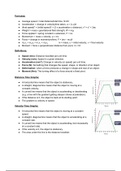
Distance-Time Graphs:
● A horizontal line means that the object is stationary.
● A straight, diagonal line means that the object is moving at a
constant velocity.
● A curved line means that the object is accelerating or decelerating
(e.g. a line with the gradient getting steeper shows acceleration).
● If the distance is 0, the object is back at its starting point.
● The gradient is velocity or speed.
Velocity-Time Graphs:
● A horizontal line means that the object is moving at a constant
speed.
● A straight, diagonal line means that the object is accelerating at a
constant rate.
● A curved line means that the object is accelerating (not necessarily
at a constant rate).
● If the velocity is 0, the object is stationary.
● The area under the line is the distance travelled.
, Vectors and Scalars:
● A scalar only has magnitude, e.g. speed, distance, time, energy.
● A vector has magnitude and direction, e.g. force, displacement, acceleration, velocity.
Forces, Weight, and Mass:
● A force (N) can change the speed, shape, or direction of an object. Friction is a force that
opposes motion.
● Forces along the same line should be added together to find the resultant force (if
they’re in different directions, subtract the forces).
○ Newton’s first law: an object has a constant velocity unless acted on by a
resultant force (an object has a constant velocity if all forces are equal).
○ Newton’s second law: force = mass x acceleration, F = ma or force = change in
momentum/time, F = Δm/T
○ Newton’s third law: for every action, there is an equal and opposite reaction;
when two objects interact, the forces acting on them are opposite and equal.
● Weight (N) is the gravitational force on an object; mass (kg) is a measure of how much
matter is in an object.
○ The gravitational field strength on Earth is 10N/kg.
Centre of Gravity/Mass:
● The weight of an object acts through its center of gravity; if an object has a big base
compared to its height it has a low center of gravity, meaning it’s stable.
● The mass of an object acts through its center of mass.
● To find the center of gravity of a regular shape, draw lines of symmetry. The center of
gravity is where all points intersect.
● To find the center of gravity of an irregular shape:
○ Take the shape and a pin, and pin the pin somewhere close to the edge.
○ Pin it to the wall and let it swing until it stops. Draw a line starting from the pin
directly downwards.
○ Take the pin and pin it somewhere else on the shape.
○ Repeat step 2.
○ The center of gravity is where the lines intersect.
● Average speed = total distance/total time, S=d/t
● Acceleration = change in velocity/time taken, a = (v-u)/t
● (final speed)2 = (initial speed)2 + (2 x acceleration x distance), v2 = u2 + 2as
● Weight = mass x gravitational field strength, W = mg
● Force applied = spring constant x extension, F = kx
● Momentum = mass x velocity, p = mv
● Force = change in momentum/time, F = (mv - mu)/t
● m1u1 + m2u2 = m1v1 + m2v2 m = mass, u = initial velocity, v = final velocity
● Moment = force x perpendicular distance from pivot, m = fd
Definitions:
● Speed (m/s): Distance travelled per unit time.
● Velocity (m/s): Speed in a given direction.
● Acceleration (m/s2): Change in velocity (or speed) per unit time.
● Force (N): Something that changes the speed, shape, or direction of an object.
● Deformation: when a force produces a change in shape and size of an object.
● Moment (Nm): The turning effect of a force around a fixed pivot.
Distance-Time Graphs:
● A horizontal line means that the object is stationary.
● A straight, diagonal line means that the object is moving at a
constant velocity.
● A curved line means that the object is accelerating or decelerating
(e.g. a line with the gradient getting steeper shows acceleration).
● If the distance is 0, the object is back at its starting point.
● The gradient is velocity or speed.
Velocity-Time Graphs:
● A horizontal line means that the object is moving at a constant
speed.
● A straight, diagonal line means that the object is accelerating at a
constant rate.
● A curved line means that the object is accelerating (not necessarily
at a constant rate).
● If the velocity is 0, the object is stationary.
● The area under the line is the distance travelled.
, Vectors and Scalars:
● A scalar only has magnitude, e.g. speed, distance, time, energy.
● A vector has magnitude and direction, e.g. force, displacement, acceleration, velocity.
Forces, Weight, and Mass:
● A force (N) can change the speed, shape, or direction of an object. Friction is a force that
opposes motion.
● Forces along the same line should be added together to find the resultant force (if
they’re in different directions, subtract the forces).
○ Newton’s first law: an object has a constant velocity unless acted on by a
resultant force (an object has a constant velocity if all forces are equal).
○ Newton’s second law: force = mass x acceleration, F = ma or force = change in
momentum/time, F = Δm/T
○ Newton’s third law: for every action, there is an equal and opposite reaction;
when two objects interact, the forces acting on them are opposite and equal.
● Weight (N) is the gravitational force on an object; mass (kg) is a measure of how much
matter is in an object.
○ The gravitational field strength on Earth is 10N/kg.
Centre of Gravity/Mass:
● The weight of an object acts through its center of gravity; if an object has a big base
compared to its height it has a low center of gravity, meaning it’s stable.
● The mass of an object acts through its center of mass.
● To find the center of gravity of a regular shape, draw lines of symmetry. The center of
gravity is where all points intersect.
● To find the center of gravity of an irregular shape:
○ Take the shape and a pin, and pin the pin somewhere close to the edge.
○ Pin it to the wall and let it swing until it stops. Draw a line starting from the pin
directly downwards.
○ Take the pin and pin it somewhere else on the shape.
○ Repeat step 2.
○ The center of gravity is where the lines intersect.