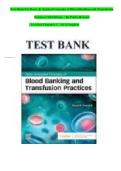
Test Bank For Basic & Applied Concepts of Blood Banking and Transfusion
Practices 5th Edition – By Paula Howard
| Verified Chapter's 1 - 16 | Complete
,Table of Contents
Part I: Quality and Safety Issues
1. Quality Assurance and Regulation of the Blood Industry: Safety Issues in the Blood Bank…………………………….3 Part II:
Foundations: Basic Sciences and Reagents
2. Immunology: Basic Principles and Applications in the Blood Bank …………………………………………………….8
3. Blood Banking Reagents: Overview and Applications……………………………………………………………………13 4. Genetic Principles
in Blood Banking……………………………………………………………………………………….18 Part III: Overview of the Major Blood Groups
5. ABO and H Blood Group Systems and Secretor Status………………………………………………………………….22 6. Rh Blood Group
System……………………………………………………………………………………………………26
7. Other Red Cell Blood Group Systems, Human Leukocyte Antigens, and Platelet Antigens………………………….30 Part IV:
Essentials of Pretransfusion Testing
8. Antibody Detection and Identification……………………………………………………………………………………34 9. Compatibility
Testing………………………………………………………………………………………………………38
10. Blood Bank Automation for Transfusion Services………………………………………………………………………44 Part V: Clinical
Considerations in Immunohematology
11. Adverse Complications of Transfusions………………………………………………………………………………….46
12. Hemolytic Disease of the Fetus and Newborn……………………………………………………………………………50 Part VI: Blood
Collecting and Testing
13. Donor Selection and Phlebotomy………………………………………………………………………………………….55 14. Testing of Donor
Blood…………………………………………………………………………………………………….60 Part VII: Blood Component Preparation and
Transfusion Therapy
15. Blood Component Preparation and Therapy…………………………………………………………………………….63
16. Transfusion Therapy in Selected Patients……………………………………………………………………………….. 66
,Chapter 01: Quality Assurance and Regulation of the Blood Industry and Safety Issues in the Blood Bank Howard:
Basic & Applied Concepts of Blood Banking and Transfusion Practices, 5th Edition
MULTIPLE CHOICE
1. Biosafety levels determine:
a. on what floor certain infectious disease testing can be performed.
b. the degree of risk for certain areas of a health care facility to exposure
to infectious diseases.
c. the amount of ventilation required in a transfusion service.
d. how many biohazardous waste containers a laboratory must have.
ANS: B
OSHA defines biosafety levels based on potential exposure to infectious material.
DIF: Level 1
2. A laboratory technologist decided she would like to bring her lab coat home for laundering because it had too many wrinkles when
it was returned by the laboratory’s laundry service. Is this practice acceptable?
a. Yes, if she uses 10% bleach
b. Yes, if she clears it with her supervisor
c. Yes, as long as she removes the coat and does not wear it home
d. No, because the laboratory is a biosafety level 2, and lab coats may not
be removed
ANS: D
Methods of transporting the lab coat and the risk of contamination do not permit health care workers to bring lab coats home for
cleaning.
DIF: Level 2
3. Personal protective equipment includes:
a. safety glasses.
b. splash barriers.
c. masks.
d. All of the above
ANS: D
Safety glasses, splash barriers, and masks are types of personal protective devices.
DIF: Level 1
4. At what point in the employment process should safety training take place?
a. During orientation and training
b. Following lab training when employees are more familiar with their
responsibilities
c. Following the employees’ first evaluation
d. Before independent work is permitted and annually thereafter
ANS: D
The Occupation Safety and Health Administration requires safety training before independent work is permitted and annually
thereafter.
DIF: Level 1
5. In safety training, employees must become familiar with all of the following except:
a. tasks that have an infectious risk.
b. limits of protective clothing and equipment.
c. the appropriate action to take if exposure occurs.
d. how to perform cardiopulmonary resuscitation on a donor or other employee.
ANS: D
The Occupational Safety and Health Administration requirements include all of those listed except cardiopulmonary resuscitation.
DIF: Level 1
6. Blood irradiators require all of the following safety procedures except:
a. proper training.
b. that the user have a degree in radiology.
c. equipment leak detection.
d. personal protective equipment.
ANS: B
Blood bank and transfusion service technologists require training but not a degree to use a blood irradiator.
DIF: Level 2
, 7. Which of the following is true regarding good manufacturing practices (GMPs)?
a. GMPs are legal requirements established by the Food and Drug Administration.
b. GMPs are optional guidelines written by the AABB.
c. GMPs are required only by pharmaceutical companies.
d. GMPs are part of the quality control requirements for blood products.
ANS: A
Good manufacturing practices are requirements established by the Food and Drug Administration.
DIF: Level 1
8. Which of the following is an example of an unacceptable record-keeping procedure?
a. Using dittos in columns to save time
b. Recording the date and initials next to a correction
c. Not deleting the original entry when making a correction
d. Always using permanent ink on all records
ANS: A
All records must be clearly written. Dittos are unacceptable.
DIF: Level 1
9. A technologist in training noticed that the person training her had not recorded the results of a test. To be helpful, she
carefully recorded the results she saw at a later time, using the technologist’s initials. Is this an acceptable procedure?
a. Yes; all results must be recorded regardless of who did the test.
b. No; she should have brought the error to the technologist’s attention.
c. Yes; because she used the other technologist’s initials.
d. Yes; as long as she records the result in pencil.
ANS: B
This is an example of poor record keeping; results must be recorded when the test is performed and by the person doing the test.
DIF: Level 3
10. Unacceptable quality control results for the antiglobulin test performed in test tubes may be noticed if:
a. preventive maintenance has not been performed on the cell washer.
b. the technologist performing the test was never trained.
c. the reagents used were improperly stored.
d. All of the above
ANS: D
Training, equipment maintenance, and reagent quality can affect quality control.
DIF: Level 2
11. All of the following are true regarding competency testing except:
a. it must be performed following training.
b. it must be performed on an annual basis.
c. it is required only if the technologist has no experience.
d. retraining is required if there is a failure in competency testing.
ANS: C
All employees must have competency testing following training and annually thereafter. If there is a failure in competency testing,
retraining is required.
DIF: Level 2
12. Which of the following organizations are involved in the regulation of blood banks?
a. The Joint Commission
b. AABB
c. College of American Pathologists
d. Food and Drug Administration
ANS: D
The Food and Drug Administration regulates blood banks, whereas the other organizations are involved in accreditation.
DIF: Level 1
13. All of the following are responsibilities of the quality assurance department of a blood bank except:
a. performing internal audits.
b. performing quality control.
c. reviewing standard operating procedures.
d. reviewing and approving training programs.
ANS: B
Quality control is performed in the laboratory, not by the quality assurance department.
DIF: Level 2
Practices 5th Edition – By Paula Howard
| Verified Chapter's 1 - 16 | Complete
,Table of Contents
Part I: Quality and Safety Issues
1. Quality Assurance and Regulation of the Blood Industry: Safety Issues in the Blood Bank…………………………….3 Part II:
Foundations: Basic Sciences and Reagents
2. Immunology: Basic Principles and Applications in the Blood Bank …………………………………………………….8
3. Blood Banking Reagents: Overview and Applications……………………………………………………………………13 4. Genetic Principles
in Blood Banking……………………………………………………………………………………….18 Part III: Overview of the Major Blood Groups
5. ABO and H Blood Group Systems and Secretor Status………………………………………………………………….22 6. Rh Blood Group
System……………………………………………………………………………………………………26
7. Other Red Cell Blood Group Systems, Human Leukocyte Antigens, and Platelet Antigens………………………….30 Part IV:
Essentials of Pretransfusion Testing
8. Antibody Detection and Identification……………………………………………………………………………………34 9. Compatibility
Testing………………………………………………………………………………………………………38
10. Blood Bank Automation for Transfusion Services………………………………………………………………………44 Part V: Clinical
Considerations in Immunohematology
11. Adverse Complications of Transfusions………………………………………………………………………………….46
12. Hemolytic Disease of the Fetus and Newborn……………………………………………………………………………50 Part VI: Blood
Collecting and Testing
13. Donor Selection and Phlebotomy………………………………………………………………………………………….55 14. Testing of Donor
Blood…………………………………………………………………………………………………….60 Part VII: Blood Component Preparation and
Transfusion Therapy
15. Blood Component Preparation and Therapy…………………………………………………………………………….63
16. Transfusion Therapy in Selected Patients……………………………………………………………………………….. 66
,Chapter 01: Quality Assurance and Regulation of the Blood Industry and Safety Issues in the Blood Bank Howard:
Basic & Applied Concepts of Blood Banking and Transfusion Practices, 5th Edition
MULTIPLE CHOICE
1. Biosafety levels determine:
a. on what floor certain infectious disease testing can be performed.
b. the degree of risk for certain areas of a health care facility to exposure
to infectious diseases.
c. the amount of ventilation required in a transfusion service.
d. how many biohazardous waste containers a laboratory must have.
ANS: B
OSHA defines biosafety levels based on potential exposure to infectious material.
DIF: Level 1
2. A laboratory technologist decided she would like to bring her lab coat home for laundering because it had too many wrinkles when
it was returned by the laboratory’s laundry service. Is this practice acceptable?
a. Yes, if she uses 10% bleach
b. Yes, if she clears it with her supervisor
c. Yes, as long as she removes the coat and does not wear it home
d. No, because the laboratory is a biosafety level 2, and lab coats may not
be removed
ANS: D
Methods of transporting the lab coat and the risk of contamination do not permit health care workers to bring lab coats home for
cleaning.
DIF: Level 2
3. Personal protective equipment includes:
a. safety glasses.
b. splash barriers.
c. masks.
d. All of the above
ANS: D
Safety glasses, splash barriers, and masks are types of personal protective devices.
DIF: Level 1
4. At what point in the employment process should safety training take place?
a. During orientation and training
b. Following lab training when employees are more familiar with their
responsibilities
c. Following the employees’ first evaluation
d. Before independent work is permitted and annually thereafter
ANS: D
The Occupation Safety and Health Administration requires safety training before independent work is permitted and annually
thereafter.
DIF: Level 1
5. In safety training, employees must become familiar with all of the following except:
a. tasks that have an infectious risk.
b. limits of protective clothing and equipment.
c. the appropriate action to take if exposure occurs.
d. how to perform cardiopulmonary resuscitation on a donor or other employee.
ANS: D
The Occupational Safety and Health Administration requirements include all of those listed except cardiopulmonary resuscitation.
DIF: Level 1
6. Blood irradiators require all of the following safety procedures except:
a. proper training.
b. that the user have a degree in radiology.
c. equipment leak detection.
d. personal protective equipment.
ANS: B
Blood bank and transfusion service technologists require training but not a degree to use a blood irradiator.
DIF: Level 2
, 7. Which of the following is true regarding good manufacturing practices (GMPs)?
a. GMPs are legal requirements established by the Food and Drug Administration.
b. GMPs are optional guidelines written by the AABB.
c. GMPs are required only by pharmaceutical companies.
d. GMPs are part of the quality control requirements for blood products.
ANS: A
Good manufacturing practices are requirements established by the Food and Drug Administration.
DIF: Level 1
8. Which of the following is an example of an unacceptable record-keeping procedure?
a. Using dittos in columns to save time
b. Recording the date and initials next to a correction
c. Not deleting the original entry when making a correction
d. Always using permanent ink on all records
ANS: A
All records must be clearly written. Dittos are unacceptable.
DIF: Level 1
9. A technologist in training noticed that the person training her had not recorded the results of a test. To be helpful, she
carefully recorded the results she saw at a later time, using the technologist’s initials. Is this an acceptable procedure?
a. Yes; all results must be recorded regardless of who did the test.
b. No; she should have brought the error to the technologist’s attention.
c. Yes; because she used the other technologist’s initials.
d. Yes; as long as she records the result in pencil.
ANS: B
This is an example of poor record keeping; results must be recorded when the test is performed and by the person doing the test.
DIF: Level 3
10. Unacceptable quality control results for the antiglobulin test performed in test tubes may be noticed if:
a. preventive maintenance has not been performed on the cell washer.
b. the technologist performing the test was never trained.
c. the reagents used were improperly stored.
d. All of the above
ANS: D
Training, equipment maintenance, and reagent quality can affect quality control.
DIF: Level 2
11. All of the following are true regarding competency testing except:
a. it must be performed following training.
b. it must be performed on an annual basis.
c. it is required only if the technologist has no experience.
d. retraining is required if there is a failure in competency testing.
ANS: C
All employees must have competency testing following training and annually thereafter. If there is a failure in competency testing,
retraining is required.
DIF: Level 2
12. Which of the following organizations are involved in the regulation of blood banks?
a. The Joint Commission
b. AABB
c. College of American Pathologists
d. Food and Drug Administration
ANS: D
The Food and Drug Administration regulates blood banks, whereas the other organizations are involved in accreditation.
DIF: Level 1
13. All of the following are responsibilities of the quality assurance department of a blood bank except:
a. performing internal audits.
b. performing quality control.
c. reviewing standard operating procedures.
d. reviewing and approving training programs.
ANS: B
Quality control is performed in the laboratory, not by the quality assurance department.
DIF: Level 2