The Assumptions of each Approach
As ALL assumptions are named in the specification, this means that you
could be asked to describe and provide an example for any of them.
Therefore, you need to learn them all.
The focus here is on the use of key terminology of each assumption and a
link to human (or animal) behaviour.
The Assumptions of the Behaviourist Approach
The behaviourist approach assumes that we are born neutral, with no inherent personality.
We learn our behaviour from the environment.
Assumption: Behaviour is learnt from the environment as humans are born a blank
slate
The philosopher John Locke described the mind as a tabula rasa. By this he meant that all
people are born as a ‘blank slate’ and that our behaviour is learnt and dependent upon our
interactions and experiences with the environment.
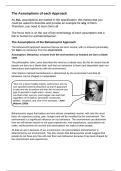
John Watson claimed that behaviour is determined by the environment and that all
behaviour can be shaped or manipulated.
"Give me a dozen healthy infants, well-formed, and my
own specified world to bring them up and I'll guarantee
to take any one at random and train him to become any
type of specialist I might select-- doctor, lawyer,
merchant-chief, and yes, even beggar man and thief,
regardless of his talents, penchants, tendencies,
abilities, vocations, and race of his ancestors." John
Watson (1930)
Behaviourists argue that babies are born almost completely neutral, with only the most
basic of responses (crying, pain, hunger) and will be moulded by the environment. The
environment is a significant influence on our behaviour. The environment can determine
how we will behave based on our past experiences, new experiences, associations we
make, reinforcement we receive and observations we make of other people.
All that we are is because of our environment. Our personalities and behaviour is
determined by our environment. This also means that behaviourists would suggest that
people do not have any free will over their own behaviour because it has been shaped by
the environment and experiences.
, For example, learning aggressive behaviour from your environment, e.g. Bandura’s
Bobo doll study
Assumption: Behaviour is learnt Conditioning Key Terms
through conditioning
Stimulus: an object or event in the environment that
We learn through two types of causes or elicits a response
conditioning: classical and operant
Response: a behaviour that results from the
Classical Conditioning- learning through presentation of a stimuli, it refers to the actual
association behaviour that takes place
Two stimuli are linked together to produce Reinforcement: something which strengthens or
a new learned response in a person or makes it more likely that a behaviour will be repeated
animal. in the future. This can be positive or negative
reinforcement
There are three stages to classical
conditioning.
Stage 1 before conditioning: The unconditioned stimulus (UCS) produces an
unconditioned response (UCR) in an organism. This means that a stimulus in the
environment has produced a behaviour/response which is unlearned
This stage also involves another stimulus which has no affect on a person and is called the
neutral stimulus (NS). The neutral stimulus (NS) in classical conditioning does not produce
a response until it is paired with the unconditioned stimulus (UCS)
Stage 2 during conditioning: During this stage the NS must be paired with the UCS on a
number of occasions for learning, i.e. association to take place
Stage 3 after conditioning: After pairing, the NS now becomes known as the conditioned
stimulus (CS). The conditioned stimulus (CS) has been associated with the unconditioned
stimulus (UCS) to create a new conditioned response (CR)
Evidence for classical conditioning: Pavlov
Pavlov discovered classical conditioning by accident when performing an unrelated
experiment on dogs. He noticed that the dogs would start salivating as soon as the lab
assistant walked in the room to feed them.
, Pavlov’s Dogs
Before Conditioning During Conditioning After Conditioning
Examples#
Further examples
Further examples
Before Conditioning During Conditioning After Conditioning
Before Conditioning During Conditioning After Conditioning
Operant Conditioning- learning through Operant Conditioning Key Terms
consequences
Positive Reinforcement:
Negative Reinforcement:
As ALL assumptions are named in the specification, this means that you
could be asked to describe and provide an example for any of them.
Therefore, you need to learn them all.
The focus here is on the use of key terminology of each assumption and a
link to human (or animal) behaviour.
The Assumptions of the Behaviourist Approach
The behaviourist approach assumes that we are born neutral, with no inherent personality.
We learn our behaviour from the environment.
Assumption: Behaviour is learnt from the environment as humans are born a blank
slate
The philosopher John Locke described the mind as a tabula rasa. By this he meant that all
people are born as a ‘blank slate’ and that our behaviour is learnt and dependent upon our
interactions and experiences with the environment.
John Watson claimed that behaviour is determined by the environment and that all
behaviour can be shaped or manipulated.
"Give me a dozen healthy infants, well-formed, and my
own specified world to bring them up and I'll guarantee
to take any one at random and train him to become any
type of specialist I might select-- doctor, lawyer,
merchant-chief, and yes, even beggar man and thief,
regardless of his talents, penchants, tendencies,
abilities, vocations, and race of his ancestors." John
Watson (1930)
Behaviourists argue that babies are born almost completely neutral, with only the most
basic of responses (crying, pain, hunger) and will be moulded by the environment. The
environment is a significant influence on our behaviour. The environment can determine
how we will behave based on our past experiences, new experiences, associations we
make, reinforcement we receive and observations we make of other people.
All that we are is because of our environment. Our personalities and behaviour is
determined by our environment. This also means that behaviourists would suggest that
people do not have any free will over their own behaviour because it has been shaped by
the environment and experiences.
, For example, learning aggressive behaviour from your environment, e.g. Bandura’s
Bobo doll study
Assumption: Behaviour is learnt Conditioning Key Terms
through conditioning
Stimulus: an object or event in the environment that
We learn through two types of causes or elicits a response
conditioning: classical and operant
Response: a behaviour that results from the
Classical Conditioning- learning through presentation of a stimuli, it refers to the actual
association behaviour that takes place
Two stimuli are linked together to produce Reinforcement: something which strengthens or
a new learned response in a person or makes it more likely that a behaviour will be repeated
animal. in the future. This can be positive or negative
reinforcement
There are three stages to classical
conditioning.
Stage 1 before conditioning: The unconditioned stimulus (UCS) produces an
unconditioned response (UCR) in an organism. This means that a stimulus in the
environment has produced a behaviour/response which is unlearned
This stage also involves another stimulus which has no affect on a person and is called the
neutral stimulus (NS). The neutral stimulus (NS) in classical conditioning does not produce
a response until it is paired with the unconditioned stimulus (UCS)
Stage 2 during conditioning: During this stage the NS must be paired with the UCS on a
number of occasions for learning, i.e. association to take place
Stage 3 after conditioning: After pairing, the NS now becomes known as the conditioned
stimulus (CS). The conditioned stimulus (CS) has been associated with the unconditioned
stimulus (UCS) to create a new conditioned response (CR)
Evidence for classical conditioning: Pavlov
Pavlov discovered classical conditioning by accident when performing an unrelated
experiment on dogs. He noticed that the dogs would start salivating as soon as the lab
assistant walked in the room to feed them.
, Pavlov’s Dogs
Before Conditioning During Conditioning After Conditioning
Examples#
Further examples
Further examples
Before Conditioning During Conditioning After Conditioning
Before Conditioning During Conditioning After Conditioning
Operant Conditioning- learning through Operant Conditioning Key Terms
consequences
Positive Reinforcement:
Negative Reinforcement: