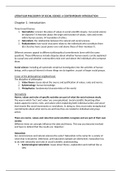
LITERATUUR PHILOSOPHY OF SOCIAL SCIENCE: A CONTEMPORARY INTRODUCTION
Chapter 1: Introduction
Three broad themes:
1. Normativity: concern the place of values in social scientific inquiry. Can social science
be objective? It theorizes about the origin and function of values, rules and norms
within human society foundation of ethics.
2. Naturalism: the relationship between the natural and social sciences.
3. Reductionism: how social structures relate to the individuals who constitute them
(do churches have causal power over and above those of their members?).
Different answers appeal to different philosophical commitments (even with the same
question). These differences include disputes about whether human events can be explained
by causal laws and whether communities exist over-and-above the individuals who compose
them.
Social science: including all systematic empirical investigation into the activities of human
beings, with a special interest in those things we do together, as part of larger social groups.
A tour of the philosophical neighborhood
The discipline of philosophy:
1. Value theory: issues about the source and justification of values, rules and norms.
2. Epistemology: human knowledge.
3. Metaphysics: fundamental characteristics of the world.
Normativity
Norms, values and rules of specific societies are part of what the social sciences study.
The way in which ‘fact’ and ‘value’ are conceptualized. Social scientific theorizing often
makes appeal to norms, rules, and values when explaining both individual action and social-
level events like social movements or revolutions. In doing so, they must make metaphysical
commitments about what norms are and how they are related to individual and group
action.
There are norms, values and rules that social scientists recognize and are part of their own
society.
Different views on concepts influence the data and theory. This way you become involved
and have to defend that the results are ‘objective’.
Naturalism
Are social sciences and natural sciences the same? Naturalism is the name for a variety of
views that is should be. Otherwise, anti-naturalism (people are distinctive). Naturalism has
to do with rationality and rules in social scientific understanding.
Epistemological naturalism: issues about theory, explanation and method (QL vs.
QN).
, Metaphysical naturalist: humans are part of the natural world and therefore must be
understood in terms of the same causes and mechanisms that animate all other
creatures.
Reductionism
Reduction is a relationship between theories. It’s possible to adopt anti-reductionism of
being one sort without being the other.
Epistemological reductionism: theories at one level can be replaced by theories at a
lower level.
Metaphysical reductionism: entities, properties, processes or events at one level are
nothing but objects at another.
Many who argue for reductionism are motivated by naturalistic commitments. Because
there is one, causally connected world and humans are part of it (metaphysical naturalism),
social and psychological properties must reduce to physical properties. But: not all
naturalists are reductionists.
Chapter 2: Objectivity, values and the possibility of a social science
Value-laden research would presumably undermine the usefulness of social scientific results
for social policy purpose. Value freedom means that scientific results cannot be contested by
those with different political interests.
The ideal of value freedom
Strong thesis of value freedom: science is objective insofar as values play no role in scientific
research.
What values are playing a role in the decisions? Epistemic value vs. moral or political value.
Epistemic value: it contributes to good science. Part of the norms and standards of good
scientific reasoning.
value freedom requires the exclusion of moral and political (non-epistemic) values.
Constitutive values: necessary for an activity. They shape the activity from the inside with
commitment to the value.
Contextual values: part of the environment, they shape the activity but can go without the
guide.
Research is objective, but this isn’t threatening if the values are epistemic.
Moderate thesis of value freedom: science is objective when only epistemic values are
constitutive of scientific practice; moral and political considerations must always remain
contextual.
Value freedom is an ideal toward which we should strive, moral and political values are
always present. Moral and political values are not necessary for science, and the goal of
objectivity requires minimizing their influence.
, 2 potential constitutive roles for values in scientific practice:
1. Moral and political values might influence the justification of theories or the
confirmation of hypotheses.
2. Moral and political values might appear in scientific practice as part of the content of
a theory.
Impartiality and theory choice
Rudner argues that non-epistemic values are a necessary part of hypothesis testing and
theory choice. If deciding whether a hypothesis should be accepted or rejected is a core
activity of science, then the values that determine whether the hypothesis is acceptable are
playing a constitutive role.
even the Moderate Thesis of Value Freedom is an unattainable goal.
2 kinds of mistake are often called Type I and Type II errors (aka ‘false positives’ and ‘false
negatives’).
The moderate thesis of value freedom tries to protect objectivity by isolating moral and
political values outside of the constitutive activities. Rudner’s arguments show that they
seep through anyway. You have to choose, which kind of error is more dangerous; politically
or morally problems.
science cannot be impartial.
Objectivity is not a univocal idea. There are 3 different senses of objectivity:
1. Objectivity as freedom from bias (with advertising)
a. Moral or political values seem to bias the results.
2. Objectivity as intersubjectivity
a. Intersubjectivity: it is open for critical scrutiny by more than one person.
Focuses on the process.
3. Objectivity as reliability
a. How well we trust our methods to be free from error.
social science can be objective in the reliability and intersubjectivity senses, even if it’s
value-laden.
Essentially contested ideas
Value-neutrality: social scientific theories should describe facts, not make policy
recommendations. Focuses on the product.
People in different social positions do not all have the same understanding of their social
world. Those in the dominant group produce and maintain a particular view of social reality.
Their privileged position means they don’t have to understand many of the social processes
that make their position possible. Their view is incomplete, but they are not likely to see the
parts of the social world that it excludes. Those who are in the oppressed group have to
understand the social world from both the dominant perspective and their own to survive.
the ideal of value freedom serves to hide the ways that power and position shape the
social sciences and their results.
Chapter 1: Introduction
Three broad themes:
1. Normativity: concern the place of values in social scientific inquiry. Can social science
be objective? It theorizes about the origin and function of values, rules and norms
within human society foundation of ethics.
2. Naturalism: the relationship between the natural and social sciences.
3. Reductionism: how social structures relate to the individuals who constitute them
(do churches have causal power over and above those of their members?).
Different answers appeal to different philosophical commitments (even with the same
question). These differences include disputes about whether human events can be explained
by causal laws and whether communities exist over-and-above the individuals who compose
them.
Social science: including all systematic empirical investigation into the activities of human
beings, with a special interest in those things we do together, as part of larger social groups.
A tour of the philosophical neighborhood
The discipline of philosophy:
1. Value theory: issues about the source and justification of values, rules and norms.
2. Epistemology: human knowledge.
3. Metaphysics: fundamental characteristics of the world.
Normativity
Norms, values and rules of specific societies are part of what the social sciences study.
The way in which ‘fact’ and ‘value’ are conceptualized. Social scientific theorizing often
makes appeal to norms, rules, and values when explaining both individual action and social-
level events like social movements or revolutions. In doing so, they must make metaphysical
commitments about what norms are and how they are related to individual and group
action.
There are norms, values and rules that social scientists recognize and are part of their own
society.
Different views on concepts influence the data and theory. This way you become involved
and have to defend that the results are ‘objective’.
Naturalism
Are social sciences and natural sciences the same? Naturalism is the name for a variety of
views that is should be. Otherwise, anti-naturalism (people are distinctive). Naturalism has
to do with rationality and rules in social scientific understanding.
Epistemological naturalism: issues about theory, explanation and method (QL vs.
QN).
, Metaphysical naturalist: humans are part of the natural world and therefore must be
understood in terms of the same causes and mechanisms that animate all other
creatures.
Reductionism
Reduction is a relationship between theories. It’s possible to adopt anti-reductionism of
being one sort without being the other.
Epistemological reductionism: theories at one level can be replaced by theories at a
lower level.
Metaphysical reductionism: entities, properties, processes or events at one level are
nothing but objects at another.
Many who argue for reductionism are motivated by naturalistic commitments. Because
there is one, causally connected world and humans are part of it (metaphysical naturalism),
social and psychological properties must reduce to physical properties. But: not all
naturalists are reductionists.
Chapter 2: Objectivity, values and the possibility of a social science
Value-laden research would presumably undermine the usefulness of social scientific results
for social policy purpose. Value freedom means that scientific results cannot be contested by
those with different political interests.
The ideal of value freedom
Strong thesis of value freedom: science is objective insofar as values play no role in scientific
research.
What values are playing a role in the decisions? Epistemic value vs. moral or political value.
Epistemic value: it contributes to good science. Part of the norms and standards of good
scientific reasoning.
value freedom requires the exclusion of moral and political (non-epistemic) values.
Constitutive values: necessary for an activity. They shape the activity from the inside with
commitment to the value.
Contextual values: part of the environment, they shape the activity but can go without the
guide.
Research is objective, but this isn’t threatening if the values are epistemic.
Moderate thesis of value freedom: science is objective when only epistemic values are
constitutive of scientific practice; moral and political considerations must always remain
contextual.
Value freedom is an ideal toward which we should strive, moral and political values are
always present. Moral and political values are not necessary for science, and the goal of
objectivity requires minimizing their influence.
, 2 potential constitutive roles for values in scientific practice:
1. Moral and political values might influence the justification of theories or the
confirmation of hypotheses.
2. Moral and political values might appear in scientific practice as part of the content of
a theory.
Impartiality and theory choice
Rudner argues that non-epistemic values are a necessary part of hypothesis testing and
theory choice. If deciding whether a hypothesis should be accepted or rejected is a core
activity of science, then the values that determine whether the hypothesis is acceptable are
playing a constitutive role.
even the Moderate Thesis of Value Freedom is an unattainable goal.
2 kinds of mistake are often called Type I and Type II errors (aka ‘false positives’ and ‘false
negatives’).
The moderate thesis of value freedom tries to protect objectivity by isolating moral and
political values outside of the constitutive activities. Rudner’s arguments show that they
seep through anyway. You have to choose, which kind of error is more dangerous; politically
or morally problems.
science cannot be impartial.
Objectivity is not a univocal idea. There are 3 different senses of objectivity:
1. Objectivity as freedom from bias (with advertising)
a. Moral or political values seem to bias the results.
2. Objectivity as intersubjectivity
a. Intersubjectivity: it is open for critical scrutiny by more than one person.
Focuses on the process.
3. Objectivity as reliability
a. How well we trust our methods to be free from error.
social science can be objective in the reliability and intersubjectivity senses, even if it’s
value-laden.
Essentially contested ideas
Value-neutrality: social scientific theories should describe facts, not make policy
recommendations. Focuses on the product.
People in different social positions do not all have the same understanding of their social
world. Those in the dominant group produce and maintain a particular view of social reality.
Their privileged position means they don’t have to understand many of the social processes
that make their position possible. Their view is incomplete, but they are not likely to see the
parts of the social world that it excludes. Those who are in the oppressed group have to
understand the social world from both the dominant perspective and their own to survive.
the ideal of value freedom serves to hide the ways that power and position shape the
social sciences and their results.