WETENSCHAPSFILOSOFIE
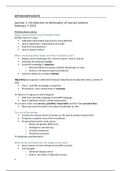
Lecture 1: Introduction to philosophy of (social) science
February 1 2021
Thinking about science
Sloppy science and the case of Diederik Stapel
Exhibits fraud in 4 ways:
Publication bias (failed experiments not published)
Lack of replication / reproduction of results
Statistical incompetence
Lack of research ethics
What’s interesting about Stapel and other fraudulent cases?
Sloppy science challenges the ‘common-sense’ view of science.
Scientists are looking for truth.
Scientific knowledge is objective
o External influences (values, politics) should play no role/
o Science is all about (empirical) evidence.
Science is based on a unique method.
Objectivity presupposes a distinction between objective and subjective claims / points of
view.
Claim: ‘scientific knowledge is objective’.
Prerequisite: clear construction of concepts.
absence of vagueness and ambiguity
Shift from everyday language to scientific language.
Ideal: establishes clarity / avoids equivocality.
concepts need to be precise, specified, measurable and free from personal bias.
Ideal: personal convictions and values should play no role.
The case of phrenology
Involves the measurement of bumps on the skull to predict mental traits.
Proposed a modular view of the mind/brain.
Perpetuated harmful myths about:
o Racial and gender differences
o Intelligence and learning
o Criminal tendencies
o Psychiatric disorders
dangerous pseudoscience.
What can be concluded from the sloppy science case?
Gives reasons to look critically at scientific research.
First thought:
o Eliminate sloppy science
o Enforce the ideals of objective science.
1
, Make publication of negative results more accepted.
Require more replication studies.
Improve quantitative / qualitative methods.
Promote ethical research standards.
Geurts’ text ‘Is what we do pointless?
identifying causes and laws in psychology and neuroscience isn’t always feasible.
objectivity can still be problematic even if science isn’t sloppy.
From natural science to social science:
Since the 16th / 17th century: successful natural sciences.
Since the 19th century: society has become the object of research.
Smith insider vs. outsider perspective research
Opposition to the insider perspective:
Biased descriptions
Defensive, protective descriptions
Opposition to the outsider perspective:
Too much emphasis on explanations
False reduction of insider perspective
Best solutions:
neutral stance
take the perspective of the stranger
Review:
Sloppy science is a threat to the common-sense ideal of science.
Sloppy science shows: reflecting on science is necessary.
Reflection on science makes clear that the common-sense concept of science is
problematic.
Scientific research is a social activity and therefore not perfect.
Philosophy of social science
Central themes of philosophy of social science:
Naturalism: the problem of understanding and explanation in the social sciences.
o E.g., is it possible to use concepts such as causality and explanation when we
speak about society?
Reductionism: the problem of the relation between holism and individualism in the
social sciences.
o E.g., is it possible to reduce social institutes to their individual members?
Normativity: the function of norms, values and rules in the social sciences.
o E.g., are subjects (researchers) and objects of research living in different
worlds?
naturalism
2
,normativity
reductionism
Systems (Marx): determines the actions of individuals.
Agents (Mill): the actions of individuals constitute the system. Social science is
grounded in the laws of nature of individual men.
Practices (Wittgenstein): social reality is determined by the ‘rules of the game’.
Actors (Elster): players construct the game of social life. Understanding social
institutions by looking at how they are shaped by meaningful actions of individuals.
Lecture 2: The standard image, popper and values
February 3 2021
The empirical-analytical method
Empirical: scientific research based on systematic observation (observation).
Analytical: decomposable into logic, elementary statements (proposition).
Results: hypothesis about empirical regularities (expresses as a law).
Inductive inference starts with basic observation. The deductive inference has already a
hypothesis.
Popper was skeptical of inductive inference and hence of the possibility of theory
confirmation.
Basic principles of the EA method:
Free of values
Third-person perspective
Focused on objective knowledge
Use of statistical analysis
this is the common-sense view of science
Logical positivism (logical empiricism)
The empirical sciences must replace theological and metaphysical world views – i.e., ‘the
unreasonable powers of church and political ideologies’.
Characteristics:
1. Classical rationality
3
, Arguments are only valid if they are the results of: logical reasoning or empirical
proof.
2. Criterion of meaning
Statements have meaning or have no meaning. Meaningful statements:
a. Analytic statements (true by the logic)
b. Synthetic statements can in principle be verified
(can possibly be tested)
all other statements have no meaning.
3. Verification and confirmation
‘We say that a sentence is actually meaningful to any
person, if and only if the person knows how to verify the proposition that is
expressed by the sentence – that is, if he knows which observations would, under
certain circumstances, lead him to accept the proposition as true of to reject is as
false’
(Ayer, 1946).
Verification: a theory is scientific if it can be ‘shown to be true’ on the basis of facts obtained
by theory-free observation. Accumulating support.
Ideal: science is composed of true statements, in particular empirical regularities and laws.
Confirmation: a theory is scientific if it can be ‘confirmed’ on the basis of facts obtained by
theory-free observation.
Adjusted ideal: science ascertains truth, via inductive logic, to practical certainty.
4. Theory-free observation
Observations should be ‘theory-free’ the facts must speak for themselves. If not,
then perhaps ‘you see what you want to see’ the facts are biased.
Testing a theory only makes sense if the facts are independent of the theory.
Karl Popper’s philosophy of science
First look at pseudoscience; Marxist theory of history, Freudian psychology and Creationism.
‘The problem of finding a criterion which would enable us to distinguish between the
empirical sciences on the one hand, and mathematics and logic as well as metaphysical
systems on the other, I call the problem of demarcation’. (LSD, p.11).
These ‘theories’ cannot be falsified!
They are not amenable to empirical testing.
They can explain-away any and all challenges.
‘Falsifiability of a system is to be taken as a criterion of demarcation… It must be possible for
an empirical scientific system to be refuted by experience’. (LSD, p.18)
The hypothetico-deductive method involves making predictions from singular statements
and universal statements.
4
Lecture 1: Introduction to philosophy of (social) science
February 1 2021
Thinking about science
Sloppy science and the case of Diederik Stapel
Exhibits fraud in 4 ways:
Publication bias (failed experiments not published)
Lack of replication / reproduction of results
Statistical incompetence
Lack of research ethics
What’s interesting about Stapel and other fraudulent cases?
Sloppy science challenges the ‘common-sense’ view of science.
Scientists are looking for truth.
Scientific knowledge is objective
o External influences (values, politics) should play no role/
o Science is all about (empirical) evidence.
Science is based on a unique method.
Objectivity presupposes a distinction between objective and subjective claims / points of
view.
Claim: ‘scientific knowledge is objective’.
Prerequisite: clear construction of concepts.
absence of vagueness and ambiguity
Shift from everyday language to scientific language.
Ideal: establishes clarity / avoids equivocality.
concepts need to be precise, specified, measurable and free from personal bias.
Ideal: personal convictions and values should play no role.
The case of phrenology
Involves the measurement of bumps on the skull to predict mental traits.
Proposed a modular view of the mind/brain.
Perpetuated harmful myths about:
o Racial and gender differences
o Intelligence and learning
o Criminal tendencies
o Psychiatric disorders
dangerous pseudoscience.
What can be concluded from the sloppy science case?
Gives reasons to look critically at scientific research.
First thought:
o Eliminate sloppy science
o Enforce the ideals of objective science.
1
, Make publication of negative results more accepted.
Require more replication studies.
Improve quantitative / qualitative methods.
Promote ethical research standards.
Geurts’ text ‘Is what we do pointless?
identifying causes and laws in psychology and neuroscience isn’t always feasible.
objectivity can still be problematic even if science isn’t sloppy.
From natural science to social science:
Since the 16th / 17th century: successful natural sciences.
Since the 19th century: society has become the object of research.
Smith insider vs. outsider perspective research
Opposition to the insider perspective:
Biased descriptions
Defensive, protective descriptions
Opposition to the outsider perspective:
Too much emphasis on explanations
False reduction of insider perspective
Best solutions:
neutral stance
take the perspective of the stranger
Review:
Sloppy science is a threat to the common-sense ideal of science.
Sloppy science shows: reflecting on science is necessary.
Reflection on science makes clear that the common-sense concept of science is
problematic.
Scientific research is a social activity and therefore not perfect.
Philosophy of social science
Central themes of philosophy of social science:
Naturalism: the problem of understanding and explanation in the social sciences.
o E.g., is it possible to use concepts such as causality and explanation when we
speak about society?
Reductionism: the problem of the relation between holism and individualism in the
social sciences.
o E.g., is it possible to reduce social institutes to their individual members?
Normativity: the function of norms, values and rules in the social sciences.
o E.g., are subjects (researchers) and objects of research living in different
worlds?
naturalism
2
,normativity
reductionism
Systems (Marx): determines the actions of individuals.
Agents (Mill): the actions of individuals constitute the system. Social science is
grounded in the laws of nature of individual men.
Practices (Wittgenstein): social reality is determined by the ‘rules of the game’.
Actors (Elster): players construct the game of social life. Understanding social
institutions by looking at how they are shaped by meaningful actions of individuals.
Lecture 2: The standard image, popper and values
February 3 2021
The empirical-analytical method
Empirical: scientific research based on systematic observation (observation).
Analytical: decomposable into logic, elementary statements (proposition).
Results: hypothesis about empirical regularities (expresses as a law).
Inductive inference starts with basic observation. The deductive inference has already a
hypothesis.
Popper was skeptical of inductive inference and hence of the possibility of theory
confirmation.
Basic principles of the EA method:
Free of values
Third-person perspective
Focused on objective knowledge
Use of statistical analysis
this is the common-sense view of science
Logical positivism (logical empiricism)
The empirical sciences must replace theological and metaphysical world views – i.e., ‘the
unreasonable powers of church and political ideologies’.
Characteristics:
1. Classical rationality
3
, Arguments are only valid if they are the results of: logical reasoning or empirical
proof.
2. Criterion of meaning
Statements have meaning or have no meaning. Meaningful statements:
a. Analytic statements (true by the logic)
b. Synthetic statements can in principle be verified
(can possibly be tested)
all other statements have no meaning.
3. Verification and confirmation
‘We say that a sentence is actually meaningful to any
person, if and only if the person knows how to verify the proposition that is
expressed by the sentence – that is, if he knows which observations would, under
certain circumstances, lead him to accept the proposition as true of to reject is as
false’
(Ayer, 1946).
Verification: a theory is scientific if it can be ‘shown to be true’ on the basis of facts obtained
by theory-free observation. Accumulating support.
Ideal: science is composed of true statements, in particular empirical regularities and laws.
Confirmation: a theory is scientific if it can be ‘confirmed’ on the basis of facts obtained by
theory-free observation.
Adjusted ideal: science ascertains truth, via inductive logic, to practical certainty.
4. Theory-free observation
Observations should be ‘theory-free’ the facts must speak for themselves. If not,
then perhaps ‘you see what you want to see’ the facts are biased.
Testing a theory only makes sense if the facts are independent of the theory.
Karl Popper’s philosophy of science
First look at pseudoscience; Marxist theory of history, Freudian psychology and Creationism.
‘The problem of finding a criterion which would enable us to distinguish between the
empirical sciences on the one hand, and mathematics and logic as well as metaphysical
systems on the other, I call the problem of demarcation’. (LSD, p.11).
These ‘theories’ cannot be falsified!
They are not amenable to empirical testing.
They can explain-away any and all challenges.
‘Falsifiability of a system is to be taken as a criterion of demarcation… It must be possible for
an empirical scientific system to be refuted by experience’. (LSD, p.18)
The hypothetico-deductive method involves making predictions from singular statements
and universal statements.
4