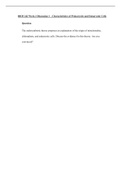
MSM 6610 Week 5 Midterm Exam |
Questions and Answers | 2026 Update |
100% Correct|| GRADED A+
Diversity -CORRECTANSWER The variety of observable and unobservable similarities
and difference among people
Surface-Level Diversity -CORRECTANSWER Observable differences in people,
including race, age, ethnicity, physical abilities, physical characteristics, and gender
Deep-Level Diversity -CORRECTANSWER Individual differences that cannot be seen
directly, including goals, values, personalities, decision-making styles, knowledge, skills,
abilities, and attitudes
Separation Diversity -CORRECTANSWER Differences in position or opinion among
group members reflecting disagreement or opposition - dissimilarity in an attitude or
value
Variety Diversity -CORRECTANSWER Differences in a certain type or category,
including group members' expertise, knowledge, or functional background
,Disparity Diversity -CORRECTANSWER Differences in the concentration of valuable
social assets or resources - dissimilarity in rank, pay, or status
The "like me" Bias -CORRECTANSWER People prefer to associate with others they
perceive to be like themselves
Stereotypes -CORRECTANSWER A belief about an individual or a group based on the
idea that everyone in a particular group will behave the same way or have the same
characteristics
Prejudice -CORRECTANSWER Outright bigotry or intolerance for other groups
Perceived threat of loss -CORRECTANSWER If some employees perceive a direct
threat to their own career opportunities, they may feel that they need to protect their
own prospects by impeding diversity efforts
Ethnocentrism -CORRECTANSWER The belief that one's own language, native
country, and cultural rules and norms are superior to all others
Unequal access to organizational networks -CORRECTANSWER Women and
minorities are often excluded from organizational networks, which can be important to
job performance, mentoring opportunities, and being seen as a candidate for promotion
, Globalization -CORRECTANSWER The internationalization of business activities and
the shift toward an integrated global economy
4 Major factors Contributing to Growth in Global Trade -CORRECTANSWER
Improvements in communication and transportation
Businesses want to increase their markets
Businesses want to control costs (especially labor)
Response to competition
Cultural Competence -CORRECTANSWER The ability to interact effectively with people
of different cultures
4 components of Cultural Competence -CORRECTANSWER 1. Awareness of our own
cultural worldview, and of our reactions to people who are different
2. Our attitude toward cultural differences
3. Knowledge of different worldviews and cultural practices
4. Cross-cultural skills
Knowledge workers -CORRECTANSWER Those employees who add value in an
organization simply because of what they know
Contingent Worker -CORRECTANSWER A person who works for an organization on
something other than a permanent or full-time basis
Questions and Answers | 2026 Update |
100% Correct|| GRADED A+
Diversity -CORRECTANSWER The variety of observable and unobservable similarities
and difference among people
Surface-Level Diversity -CORRECTANSWER Observable differences in people,
including race, age, ethnicity, physical abilities, physical characteristics, and gender
Deep-Level Diversity -CORRECTANSWER Individual differences that cannot be seen
directly, including goals, values, personalities, decision-making styles, knowledge, skills,
abilities, and attitudes
Separation Diversity -CORRECTANSWER Differences in position or opinion among
group members reflecting disagreement or opposition - dissimilarity in an attitude or
value
Variety Diversity -CORRECTANSWER Differences in a certain type or category,
including group members' expertise, knowledge, or functional background
,Disparity Diversity -CORRECTANSWER Differences in the concentration of valuable
social assets or resources - dissimilarity in rank, pay, or status
The "like me" Bias -CORRECTANSWER People prefer to associate with others they
perceive to be like themselves
Stereotypes -CORRECTANSWER A belief about an individual or a group based on the
idea that everyone in a particular group will behave the same way or have the same
characteristics
Prejudice -CORRECTANSWER Outright bigotry or intolerance for other groups
Perceived threat of loss -CORRECTANSWER If some employees perceive a direct
threat to their own career opportunities, they may feel that they need to protect their
own prospects by impeding diversity efforts
Ethnocentrism -CORRECTANSWER The belief that one's own language, native
country, and cultural rules and norms are superior to all others
Unequal access to organizational networks -CORRECTANSWER Women and
minorities are often excluded from organizational networks, which can be important to
job performance, mentoring opportunities, and being seen as a candidate for promotion
, Globalization -CORRECTANSWER The internationalization of business activities and
the shift toward an integrated global economy
4 Major factors Contributing to Growth in Global Trade -CORRECTANSWER
Improvements in communication and transportation
Businesses want to increase their markets
Businesses want to control costs (especially labor)
Response to competition
Cultural Competence -CORRECTANSWER The ability to interact effectively with people
of different cultures
4 components of Cultural Competence -CORRECTANSWER 1. Awareness of our own
cultural worldview, and of our reactions to people who are different
2. Our attitude toward cultural differences
3. Knowledge of different worldviews and cultural practices
4. Cross-cultural skills
Knowledge workers -CORRECTANSWER Those employees who add value in an
organization simply because of what they know
Contingent Worker -CORRECTANSWER A person who works for an organization on
something other than a permanent or full-time basis