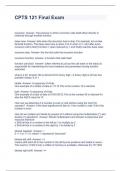
APHON CHEMO COURSE CERTIFICATION
REVIEW SET 2026 ANSWERS GUARANTEED
PASS
⫸ necrosis Answer: cell death that results from an insult, such as a lack
of blood supply, physical trauma, or cytotoxic therapy that leads to
rupture of the cell membrane and spilling of cell contents
⫸ malignant cells Answer: cells that do not have a finite number of cell
divisions as normal cells do; lost the ability to undergo apoptosis; can
keep replicating and dividing indefinitely
⫸ aberrant cell division Answer: the primary characteristic of malignant
cells
⫸ tumor suppression genes Answer: these keep normal cellular growth
in check by regulating cell division, DNA repair, and apoptosis; if
damaged or absent, cells lack the appropriate growth-inhibiting signals
and grow out of control
⫸ nadir Answer: the period of time after a course of chemotherapy in
which the patients blood counts are lowest
,⫸ physical barrier Answer: the first layer of defense that provides
protective immunity through anatomic barriers; ex. skin, mucous
membranes
⫸ innate passive immunity Answer: the second layer of defense that
provides rapid, nonspecific response to invading pathogens
⫸ adaptive acquired immunity Answer: the third layer of defense
⫸ tumor marker Answer: a characteristic feature or byproduct of a
tumor cell that serves as a useful indication of tumor cell origin or tumor
activity
⫸ risk stratification Answer: allows for tailoring therapy after
consideration of factors beyond those traditional staging systems; this
approach allows for early intensification of treatment
⫸ pharmacokinetics Answer: the movement of a drug in the body and
studies how the body affects the administered drug
⫸ pharmacogenetics Answer: the study of how a person's genetic
makeup affects that person's response to drug therapy
⫸ surgery Answer: often used as a method for treating cancer with the
primary goal being to reduce the tumor burden so that any remaining
, cancer cells can be more effectively destroyed by host immunologic
factors, chemo, or immunotherapy
⫸ resection Answer: surgical treatment of a tumor by removing it
⫸ complete resection Answer: surgical treatment that involves the
removal of all visible and microscopic evidence of the tumor
⫸ partial resection Answer: surgical debulking that involves resecting a
portion of the tumor because the entire mass cannot be completely or
safely removed
⫸ chemotherapy Answer: drug therapy aimed at reducing visible tumor
volume by cytotoxic effects and preventing tumor cell division and
spread; agents are designed to kill malignant cells during different
phases of the cell cycle
⫸ radiation therapy Answer: the goal of treatment is to target the tumor
for destruction while sparing the surrounding tissues
⫸ autologous transplant Answer: the patient is both the donor and the
recipient, often given as a "rescue" after high-dose chemo when
immunosuppression or myelosuppression would be a dose-limiting
factor; no risk of GVHD
REVIEW SET 2026 ANSWERS GUARANTEED
PASS
⫸ necrosis Answer: cell death that results from an insult, such as a lack
of blood supply, physical trauma, or cytotoxic therapy that leads to
rupture of the cell membrane and spilling of cell contents
⫸ malignant cells Answer: cells that do not have a finite number of cell
divisions as normal cells do; lost the ability to undergo apoptosis; can
keep replicating and dividing indefinitely
⫸ aberrant cell division Answer: the primary characteristic of malignant
cells
⫸ tumor suppression genes Answer: these keep normal cellular growth
in check by regulating cell division, DNA repair, and apoptosis; if
damaged or absent, cells lack the appropriate growth-inhibiting signals
and grow out of control
⫸ nadir Answer: the period of time after a course of chemotherapy in
which the patients blood counts are lowest
,⫸ physical barrier Answer: the first layer of defense that provides
protective immunity through anatomic barriers; ex. skin, mucous
membranes
⫸ innate passive immunity Answer: the second layer of defense that
provides rapid, nonspecific response to invading pathogens
⫸ adaptive acquired immunity Answer: the third layer of defense
⫸ tumor marker Answer: a characteristic feature or byproduct of a
tumor cell that serves as a useful indication of tumor cell origin or tumor
activity
⫸ risk stratification Answer: allows for tailoring therapy after
consideration of factors beyond those traditional staging systems; this
approach allows for early intensification of treatment
⫸ pharmacokinetics Answer: the movement of a drug in the body and
studies how the body affects the administered drug
⫸ pharmacogenetics Answer: the study of how a person's genetic
makeup affects that person's response to drug therapy
⫸ surgery Answer: often used as a method for treating cancer with the
primary goal being to reduce the tumor burden so that any remaining
, cancer cells can be more effectively destroyed by host immunologic
factors, chemo, or immunotherapy
⫸ resection Answer: surgical treatment of a tumor by removing it
⫸ complete resection Answer: surgical treatment that involves the
removal of all visible and microscopic evidence of the tumor
⫸ partial resection Answer: surgical debulking that involves resecting a
portion of the tumor because the entire mass cannot be completely or
safely removed
⫸ chemotherapy Answer: drug therapy aimed at reducing visible tumor
volume by cytotoxic effects and preventing tumor cell division and
spread; agents are designed to kill malignant cells during different
phases of the cell cycle
⫸ radiation therapy Answer: the goal of treatment is to target the tumor
for destruction while sparing the surrounding tissues
⫸ autologous transplant Answer: the patient is both the donor and the
recipient, often given as a "rescue" after high-dose chemo when
immunosuppression or myelosuppression would be a dose-limiting
factor; no risk of GVHD