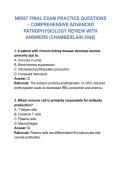
NR507 Advanced Pathophysiology Final Exam -
Chamberlain University 2026/2027 | Complete Guide |
Grade A | Disease Mechanism Mastery
Time Limit: 3 h Pass Mark: 80 % (60/75)
DOMAIN 1 – CELLULAR, GENETIC & IMMUNOLOGIC INTEGRATION (19 Qs)
Q1
A 58-year-old female presents with symmetric joint pain, malar rash, photosensitivity,
and pleuritic chest pain. Lab work reveals positive ANA with anti-dsDNA antibodies,
leukopenia, and proteinuria. A kidney biopsy shows immune complex deposition in the
glomeruli. The primary, interconnected pathophysiologic processes driving this
multi-system presentation are:
A. Type II cytotoxic hypersensitivity targeting renal and dermal basement membranes.
B. Systemic dysregulation of B-cell tolerance with autoantibody production and immune
complex-mediated tissue injury.
C. Isolated overproduction of inflammatory cytokines (e.g., TNF-α) leading to synovitis
and vasculitis.
D. A genetic defect in complement C1 inhibitor leading to uncontrolled inflammatory
pathway activation.
Correct: B
,Rationale: Classic SLE. Core defect = loss of B-cell tolerance → autoantibodies
(anti-dsDNA) → immune complexes (Type III) deposit in skin, kidneys, pleura →
complement activation → inflammation. A = Type II (antibody-mediated) – incorrect
pattern. C = cytokine overproduction is secondary, not primary. D = hereditary
angioedema.
Q2
A 45-year-old man with chronic HBV infection develops hepatocellular carcinoma. Serial
imaging shows a 3 cm hypodense lesion with arterial enhancement and venous
wash-out. Which interconnected molecular pathways best explain the oncogenic
transformation in this setting?
A. HBV DNA integration → insertional mutagenesis of TERT + chronic
inflammation-driven IL-6/STAT3 activation → hepatocyte proliferation and apoptosis
evasion.
B. Single-base substitution in p53 only, without inflammatory contribution.
C. Defective DNA mismatch-repair system causing microsatellite instability.
D. Telomere lengthening via hTERT amplification independent of viral integration.
Correct: A
Rationale: HBV integrates into host genome, commonly near TERT (telomerase),
up-regulating it, while chronic inflammation (IL-6/STAT3) promotes proliferation and
survival. B ignores inflammation. C = mismatch repair defect is characteristic of Lynch
syndrome, not HBV-HCC. D is incomplete – viral integration is key.
Q3
,A 6-year-old boy has recurrent severe bacterial infections (S. pneumoniae, H.
influenzae). Flow cytometry shows absent B cells, low IgG, IgA, and IgM, but normal
T-cell numbers and function. Genetic testing reveals a BTK nonsense mutation. Which
defective cellular signaling pathway underlies his immunodeficiency?
A. IL-12/IFN-γ pathway → impaired intracellular killing.
B. BTK-dependent B-cell receptor signaling → failure of B-cell maturation beyond pre-B
stage.
C. ZAP-70 deficiency → T-cell anergy.
D. Complement C3 deficiency → impaired opsonization.
Correct: B
Rationale: X-linked agammaglobulinemia (XLA) – BTK mutation blocks BCR signaling →
maturation arrest at pre-B → absent B cells and antibodies. A = IL-12/IFN-γ defect (e.g.,
MSMD). C = ZAP-70 defect affects T cells. D = complement defect → extracellular
bacterial infections, but B cells would be present.
Q4
A 35-year-old woman with Crohn’s disease on infliximab develops new-onset psoriasis.
Which immunologic paradox best explains this reaction?
A. Anti-TNF therapy shifts cytokine balance toward IL-23/Th17 axis → psoriatic skin
inflammation.
B. Type I hypersensitivity to infliximab.
C. Neutralizing antibodies leading to loss of mucosal healing.
, D. Direct toxic effect of infliximab on keratinocytes.
Correct: A
Rationale: TNF blockade removes inhibition of IL-23 → Th17 expansion → psoriasis
(paradoxical ADR). B = type I hypersensitivity would present as anaphylaxis/serum
sickness, not psoriasis. C = neutralizing antibodies reduce drug efficacy but don’t cause
psoriasis. D is not a recognized mechanism.
Q5
A 65-year-old male smoker presents with fatigue, weight loss, and splenomegaly. CBC
shows WBC 50,000 with 85 % mature-appearing lymphocytes, anemia, and
thrombocytopenia. Flow cytometry reveals CD5+, CD23+ B cells. Cytogenetics show
del(13q). Which interconnected pathophysiologic mechanisms drive the cytopenias?
A. Autoimmune hemolysis due to warm IgG antibodies.
B. Bone-marrow replacement by clonal B cells + cytokine-mediated suppression of
normal hematopoiesis.
C. Megaloblastic anemia from folate deficiency.
D. Hypersplenism only, without marrow involvement.
Correct: B
Rationale: CLL – mature clonal B cells infiltrate marrow → space-occupying + cytokine
milieu (e.g., IL-10, TGF-β) suppresses normal progenitors → cytopenias. A =
autoimmune hemolysis can occur, but is not primary. C = not megaloblastic. D =
hypersplenism contributes, but marrow infiltration is central.
Chamberlain University 2026/2027 | Complete Guide |
Grade A | Disease Mechanism Mastery
Time Limit: 3 h Pass Mark: 80 % (60/75)
DOMAIN 1 – CELLULAR, GENETIC & IMMUNOLOGIC INTEGRATION (19 Qs)
Q1
A 58-year-old female presents with symmetric joint pain, malar rash, photosensitivity,
and pleuritic chest pain. Lab work reveals positive ANA with anti-dsDNA antibodies,
leukopenia, and proteinuria. A kidney biopsy shows immune complex deposition in the
glomeruli. The primary, interconnected pathophysiologic processes driving this
multi-system presentation are:
A. Type II cytotoxic hypersensitivity targeting renal and dermal basement membranes.
B. Systemic dysregulation of B-cell tolerance with autoantibody production and immune
complex-mediated tissue injury.
C. Isolated overproduction of inflammatory cytokines (e.g., TNF-α) leading to synovitis
and vasculitis.
D. A genetic defect in complement C1 inhibitor leading to uncontrolled inflammatory
pathway activation.
Correct: B
,Rationale: Classic SLE. Core defect = loss of B-cell tolerance → autoantibodies
(anti-dsDNA) → immune complexes (Type III) deposit in skin, kidneys, pleura →
complement activation → inflammation. A = Type II (antibody-mediated) – incorrect
pattern. C = cytokine overproduction is secondary, not primary. D = hereditary
angioedema.
Q2
A 45-year-old man with chronic HBV infection develops hepatocellular carcinoma. Serial
imaging shows a 3 cm hypodense lesion with arterial enhancement and venous
wash-out. Which interconnected molecular pathways best explain the oncogenic
transformation in this setting?
A. HBV DNA integration → insertional mutagenesis of TERT + chronic
inflammation-driven IL-6/STAT3 activation → hepatocyte proliferation and apoptosis
evasion.
B. Single-base substitution in p53 only, without inflammatory contribution.
C. Defective DNA mismatch-repair system causing microsatellite instability.
D. Telomere lengthening via hTERT amplification independent of viral integration.
Correct: A
Rationale: HBV integrates into host genome, commonly near TERT (telomerase),
up-regulating it, while chronic inflammation (IL-6/STAT3) promotes proliferation and
survival. B ignores inflammation. C = mismatch repair defect is characteristic of Lynch
syndrome, not HBV-HCC. D is incomplete – viral integration is key.
Q3
,A 6-year-old boy has recurrent severe bacterial infections (S. pneumoniae, H.
influenzae). Flow cytometry shows absent B cells, low IgG, IgA, and IgM, but normal
T-cell numbers and function. Genetic testing reveals a BTK nonsense mutation. Which
defective cellular signaling pathway underlies his immunodeficiency?
A. IL-12/IFN-γ pathway → impaired intracellular killing.
B. BTK-dependent B-cell receptor signaling → failure of B-cell maturation beyond pre-B
stage.
C. ZAP-70 deficiency → T-cell anergy.
D. Complement C3 deficiency → impaired opsonization.
Correct: B
Rationale: X-linked agammaglobulinemia (XLA) – BTK mutation blocks BCR signaling →
maturation arrest at pre-B → absent B cells and antibodies. A = IL-12/IFN-γ defect (e.g.,
MSMD). C = ZAP-70 defect affects T cells. D = complement defect → extracellular
bacterial infections, but B cells would be present.
Q4
A 35-year-old woman with Crohn’s disease on infliximab develops new-onset psoriasis.
Which immunologic paradox best explains this reaction?
A. Anti-TNF therapy shifts cytokine balance toward IL-23/Th17 axis → psoriatic skin
inflammation.
B. Type I hypersensitivity to infliximab.
C. Neutralizing antibodies leading to loss of mucosal healing.
, D. Direct toxic effect of infliximab on keratinocytes.
Correct: A
Rationale: TNF blockade removes inhibition of IL-23 → Th17 expansion → psoriasis
(paradoxical ADR). B = type I hypersensitivity would present as anaphylaxis/serum
sickness, not psoriasis. C = neutralizing antibodies reduce drug efficacy but don’t cause
psoriasis. D is not a recognized mechanism.
Q5
A 65-year-old male smoker presents with fatigue, weight loss, and splenomegaly. CBC
shows WBC 50,000 with 85 % mature-appearing lymphocytes, anemia, and
thrombocytopenia. Flow cytometry reveals CD5+, CD23+ B cells. Cytogenetics show
del(13q). Which interconnected pathophysiologic mechanisms drive the cytopenias?
A. Autoimmune hemolysis due to warm IgG antibodies.
B. Bone-marrow replacement by clonal B cells + cytokine-mediated suppression of
normal hematopoiesis.
C. Megaloblastic anemia from folate deficiency.
D. Hypersplenism only, without marrow involvement.
Correct: B
Rationale: CLL – mature clonal B cells infiltrate marrow → space-occupying + cytokine
milieu (e.g., IL-10, TGF-β) suppresses normal progenitors → cytopenias. A =
autoimmune hemolysis can occur, but is not primary. C = not megaloblastic. D =
hypersplenism contributes, but marrow infiltration is central.