

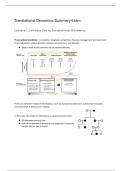
Translational Genomics: Summary Exam
Lecture 1. Introduction to Translational Genomics
Personalized medicine = prevention, diagnosis, prognosis, disease management and treatment
to an individual’s unique genetic makeup, environment, and lifestyle.
➔ Best to start at the baseline risk to prevent disease.
There are different modes of inheritance, such as autosomal dominant, autosomal recessive,
mitochondrial, X-linked and Y-linked.
In this case, the mode of inheritance is autosomal dominant.
➔ All diseases are very rare.
➔ One of the parents is probably not diagnosed, because
he/she did not see a doctor.
,Lecture 2. Genome architecture
The human genome
Humans have 23 pairs of chromosomes. Mice have 20 pairs of chromosomes. Genes don’t care
where they are, on which chromosome they are. Therefore, the fact that mice have less
chromosomes does not mean that mice have less genes.
- DNA present in the cell, is located in the nucleus and in mitochondria.
- The nucleus consists of:
o 22 pair autosomes.
o 2 sex chromosomes (XY, XX).
o ~20.000 coding genes.
o ~25.000 (known) non-coding genes, probably way more because they are hard to
find and it is hard to determine if the genes actually have a function.
Genes consist of basepairs.
- Purines = Adenine & Guanine.
- Pyrimidines = Thymine & Cytosine.
- Adenine & Thymine bind each other, with 2 hydrogen bonds.
- Guanine & Cytosine bind each other, with 3 hydrogen bonds.
- Uracil replaces Thymine in RNA.
The first exon of a gene is always hard to sequence, because it has a high G/C content (Okazaki
fragments are G/C-rich). G-C basepairs, with 3 hydrogen bonds, make DNA stable and resistant
to denaturation, which hinders DNA polymerase activity during DNA amplification in a PCR.
,Functional DNA
Functional DNA consists of protein coding genes, non-coding genes and regulatory elements.
Protein coding genes = genes that code for amino acids, forming a functional protein.
➔ The length of the promoter region is unknown.
➔ In diagnostic purposes, the promoter is not part of the gene (biologically it is).
Expressed Sequence Tags (EST) = finding genes by sequencing the expression of a gene
(sequencing exons). The result are lots of little pieces of RNA, which can be turned into DNA and
sequenced.
Alternative splicing makes the genome much more complicated: one gene can be spliced into
different proteins.
➔ 3’UTR (on the right) is much longer than 5’UTR (on the left).
➔ Thicker lines are exons, thinner lines (arrow-like) are introns.
➔ Splicing of the same gene is different in different tissues and organs.
➔ Splicing causes slightly different proteins, which can have slightly different functions.
, Non-coding genes = genes that do not code for amino acids/proteins, but do have functions.
Small non-coding RNA’s: can be hairpins ore straight pieces of RNA.
- Small interfering RNA (siRNA) = double strand, not-coding RNA → used to suppress
gene expression.
- Micro RNA (miRNA) = small, non-coding RNA → regulating gene expression by inhibiting
protein production or destabilizing proteins.
- PIWI-interacting RNA (piRNA) = small, non-coding RNA → work with PIWI proteins to
suppress the mobility of transposable elements to keep integrity of the genome.
➔ Argonaute (Ago) proteins = involved in RISC complex: enzymes binding miRNA’s and
siRNA’s to find and degrade mRNA’s → suppression of protein synthesis.
o Hairpins are transported out
of the cell.
o Complexes are recruited
(argonaute proteins + dicer)
to form the RISC complex.
o mRNA gets repressed or
cleaved, thereby silencing
the gene.
Lecture 1. Introduction to Translational Genomics
Personalized medicine = prevention, diagnosis, prognosis, disease management and treatment
to an individual’s unique genetic makeup, environment, and lifestyle.
➔ Best to start at the baseline risk to prevent disease.
There are different modes of inheritance, such as autosomal dominant, autosomal recessive,
mitochondrial, X-linked and Y-linked.
In this case, the mode of inheritance is autosomal dominant.
➔ All diseases are very rare.
➔ One of the parents is probably not diagnosed, because
he/she did not see a doctor.
,Lecture 2. Genome architecture
The human genome
Humans have 23 pairs of chromosomes. Mice have 20 pairs of chromosomes. Genes don’t care
where they are, on which chromosome they are. Therefore, the fact that mice have less
chromosomes does not mean that mice have less genes.
- DNA present in the cell, is located in the nucleus and in mitochondria.
- The nucleus consists of:
o 22 pair autosomes.
o 2 sex chromosomes (XY, XX).
o ~20.000 coding genes.
o ~25.000 (known) non-coding genes, probably way more because they are hard to
find and it is hard to determine if the genes actually have a function.
Genes consist of basepairs.
- Purines = Adenine & Guanine.
- Pyrimidines = Thymine & Cytosine.
- Adenine & Thymine bind each other, with 2 hydrogen bonds.
- Guanine & Cytosine bind each other, with 3 hydrogen bonds.
- Uracil replaces Thymine in RNA.
The first exon of a gene is always hard to sequence, because it has a high G/C content (Okazaki
fragments are G/C-rich). G-C basepairs, with 3 hydrogen bonds, make DNA stable and resistant
to denaturation, which hinders DNA polymerase activity during DNA amplification in a PCR.
,Functional DNA
Functional DNA consists of protein coding genes, non-coding genes and regulatory elements.
Protein coding genes = genes that code for amino acids, forming a functional protein.
➔ The length of the promoter region is unknown.
➔ In diagnostic purposes, the promoter is not part of the gene (biologically it is).
Expressed Sequence Tags (EST) = finding genes by sequencing the expression of a gene
(sequencing exons). The result are lots of little pieces of RNA, which can be turned into DNA and
sequenced.
Alternative splicing makes the genome much more complicated: one gene can be spliced into
different proteins.
➔ 3’UTR (on the right) is much longer than 5’UTR (on the left).
➔ Thicker lines are exons, thinner lines (arrow-like) are introns.
➔ Splicing of the same gene is different in different tissues and organs.
➔ Splicing causes slightly different proteins, which can have slightly different functions.
, Non-coding genes = genes that do not code for amino acids/proteins, but do have functions.
Small non-coding RNA’s: can be hairpins ore straight pieces of RNA.
- Small interfering RNA (siRNA) = double strand, not-coding RNA → used to suppress
gene expression.
- Micro RNA (miRNA) = small, non-coding RNA → regulating gene expression by inhibiting
protein production or destabilizing proteins.
- PIWI-interacting RNA (piRNA) = small, non-coding RNA → work with PIWI proteins to
suppress the mobility of transposable elements to keep integrity of the genome.
➔ Argonaute (Ago) proteins = involved in RISC complex: enzymes binding miRNA’s and
siRNA’s to find and degrade mRNA’s → suppression of protein synthesis.
o Hairpins are transported out
of the cell.
o Complexes are recruited
(argonaute proteins + dicer)
to form the RISC complex.
o mRNA gets repressed or
cleaved, thereby silencing
the gene.

