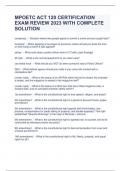
Module 3 Mba 704 Final Exam with
Complete Correct Solutions 2026
Updated.
Personality - Answer how people affect others and how they understand and view
themselves, as well as their pattern of inner and outer measurable traits and the person-
situation interaction
self-concept - Answer people's attempts to understand themselves
self-esteem - Answer people's self-perceived competence and self-image
person-situation interaction - Answer each situation is different. People are not static, acting
the same in all situations, but instead are ever changing and flexible.
organization-based self-esteem (OBSE) - Answer self perceived value that individuals have of
themselves as organization members acting within organization context
socialization process - Answer personality development consists of a continuous process and
sequence based largely on learning opportunities and the continuous impact from the social
environment
successful organizational socialization includes: - Answer challenging first job
relevant training
timely and consistent feedback
right person in charge of socialization
relaxed orientation program
work groups with high morale
"Big five" personality traits - Answer extraversion, agreeableness, conscientiousness,
emotional stability, openness to experience
extraversion - Answer sociable, outgoing, talkative, assertive
higher extraversion; more management/sales success; more absenteeism
agreeableness - Answer cooperative, warm, caring, courteous
, Higher conscientiousness; strongest positive correlation with job performance, higher goal
setting, take on more responsibility, less absent
emotional stability - Answer calm, secure, happy, unworried
high emotional stability, tied to job performance, better in stressful situation
openness to experience - Answer curious, intellectual, creative, flexible
higher openness to experience, job training proficiency, have strategic management style
Myers-Briggs Type Indicator - Answer based on four dimensions of traits:
extraversion vs. introversion
sensing vs. intuiting
thinking vs. feeling
judging vs. perceiving
Extraversion vs. Introversion - Answer how people prefer to focus their energies
sensing vs intuiting - Answer how people give attention and collect info
thinking vs. feeling - Answer how people process and evaluate information and make
decisions
judging vs. perceiving - Answer how people orient themselves to the outside world
perception - Answer unique interpretation of a situation, not exact recording of it
interpretation responsible for filtering, modifying or completely changing raw data to provide
meaning
sensation - Answer senses responsible for people's reality or the raw data about the world
around them
social perception - Answer how one individual perceives other individuals, how we get to
know each other
stereotypes - Answer tendency to perceive another person as belonging to a single class or
category
may attribute favorable or unfavorable traits to the person being perceived
Complete Correct Solutions 2026
Updated.
Personality - Answer how people affect others and how they understand and view
themselves, as well as their pattern of inner and outer measurable traits and the person-
situation interaction
self-concept - Answer people's attempts to understand themselves
self-esteem - Answer people's self-perceived competence and self-image
person-situation interaction - Answer each situation is different. People are not static, acting
the same in all situations, but instead are ever changing and flexible.
organization-based self-esteem (OBSE) - Answer self perceived value that individuals have of
themselves as organization members acting within organization context
socialization process - Answer personality development consists of a continuous process and
sequence based largely on learning opportunities and the continuous impact from the social
environment
successful organizational socialization includes: - Answer challenging first job
relevant training
timely and consistent feedback
right person in charge of socialization
relaxed orientation program
work groups with high morale
"Big five" personality traits - Answer extraversion, agreeableness, conscientiousness,
emotional stability, openness to experience
extraversion - Answer sociable, outgoing, talkative, assertive
higher extraversion; more management/sales success; more absenteeism
agreeableness - Answer cooperative, warm, caring, courteous
, Higher conscientiousness; strongest positive correlation with job performance, higher goal
setting, take on more responsibility, less absent
emotional stability - Answer calm, secure, happy, unworried
high emotional stability, tied to job performance, better in stressful situation
openness to experience - Answer curious, intellectual, creative, flexible
higher openness to experience, job training proficiency, have strategic management style
Myers-Briggs Type Indicator - Answer based on four dimensions of traits:
extraversion vs. introversion
sensing vs. intuiting
thinking vs. feeling
judging vs. perceiving
Extraversion vs. Introversion - Answer how people prefer to focus their energies
sensing vs intuiting - Answer how people give attention and collect info
thinking vs. feeling - Answer how people process and evaluate information and make
decisions
judging vs. perceiving - Answer how people orient themselves to the outside world
perception - Answer unique interpretation of a situation, not exact recording of it
interpretation responsible for filtering, modifying or completely changing raw data to provide
meaning
sensation - Answer senses responsible for people's reality or the raw data about the world
around them
social perception - Answer how one individual perceives other individuals, how we get to
know each other
stereotypes - Answer tendency to perceive another person as belonging to a single class or
category
may attribute favorable or unfavorable traits to the person being perceived