Grossman Model of the Demand for Health
20 January 2020 09:05
Key concepts
• Individual = consumer and producer of health
• Health behaviours viewed as health investment
• Health treated as human capital (depreciates over time)
• Individuals invest in human capital to increase productivity in the market
sector where they produce money earnings, and in non-market sector where
they produce commodities that enter their utility function
Introduction
• GM organises thoughts regarding health related behaviours
• Amount of health depends on decisions: eg. junk food vs healthy eating
• Trade-offs involved: eg. Gym membership vs new shoes
• Health has three roles:
○ Consumption good: we enjoy being healthy
○ Input good: affects how hard we can work (to make more money) and
how much we can relax
○ Human capital: health decisions today affect our health tomorrow
,
,Demand for health capital
• Individuals invest in themselves through education, training and health. Goal:
increase earnings.
• Two NB concepts: Cost of Capital and Marginal Efficiency of Investment (MEI)
• Cost of Capital (C)
○ C = Opportunity cost + rate at which capital good depreciates
○ C=r+∂
• MEI – rate of return vs amount of resources invested
○ If RoR on capital goods is greater (less) than cost of capital, then the
good will (not) be purchased.
○ Capital good will be purchased only up to the point where:
▪ RoR = Cost of Capital
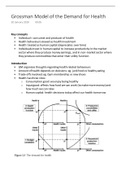
Relationship of healthy days to health stock
,
20 January 2020 09:05
Key concepts
• Individual = consumer and producer of health
• Health behaviours viewed as health investment
• Health treated as human capital (depreciates over time)
• Individuals invest in human capital to increase productivity in the market
sector where they produce money earnings, and in non-market sector where
they produce commodities that enter their utility function
Introduction
• GM organises thoughts regarding health related behaviours
• Amount of health depends on decisions: eg. junk food vs healthy eating
• Trade-offs involved: eg. Gym membership vs new shoes
• Health has three roles:
○ Consumption good: we enjoy being healthy
○ Input good: affects how hard we can work (to make more money) and
how much we can relax
○ Human capital: health decisions today affect our health tomorrow
,
,Demand for health capital
• Individuals invest in themselves through education, training and health. Goal:
increase earnings.
• Two NB concepts: Cost of Capital and Marginal Efficiency of Investment (MEI)
• Cost of Capital (C)
○ C = Opportunity cost + rate at which capital good depreciates
○ C=r+∂
• MEI – rate of return vs amount of resources invested
○ If RoR on capital goods is greater (less) than cost of capital, then the
good will (not) be purchased.
○ Capital good will be purchased only up to the point where:
▪ RoR = Cost of Capital
Relationship of healthy days to health stock
,