Market Failure in Health Care
Tuesday, 4 February 2020 12:54
Using perfectly competitive markets to allocate resources
- Conclusion of conventional theoretical economics: perfectly competitive
markets lead to an efficient allocation of resources
- Health care is an economic good
- Thus, decisions about what type of health care will be produced, how it will
be produced, and who will receive health care, will be resolved by the
competitive market
- The competitive market would find the price for health care at which the
quantity demanded equals the quantity supplied
- This would mean:
○ Health care is supplied by health care providers willing to supply at the
equilibrium price
○ Health care would be produced in a manner which is technically
efficient
○ Health care would be purchased by consumers who are willing and able
to pay the equilibrium price
- Implication - access to health care is based on the ability to pay!
The efficiency of competitive markets
- A Pareto improvement occurs if a change can be made to the health system
that benefits some people without making anyone else worse off
- When all Pareto improvements have been made, the health system would be
Pareto efficient
- Pareto efficiency, or social efficiency therefore occurs when it is not possible
to make someone else better off without making someone else worse off
- The First Fundamental Theorem of Welfare Economics: perfectly competitive
markets generate an allocation of resources that is Pareto (socially) efficient
- Example: Internet Pharmacy
○ Rational consumer and provider will continue to consume and provide
pharmaceuticals up to the point where PMB = PMC
○ Pareto efficiency occurs where SMB = SMC
, ○ Pareto efficiency occurs where SMB = SMC
Causes of market failure: Externalities
- Externalities are costs and benefits incurred in the consumption or
production of goods/services that are not borne by the consumer or
producer involved.
- Positive externalities are known as external benefits
- Negative externalities are know as external costs
- Health care markets will not lead to Pareto efficiency if there are
externalities. This is because private marginal costs and/or private marginal
benefits deviate from the social marginal costs and/or social marginal
benefits
- An example of a positive externality is vaccination that has private and
societal benefits
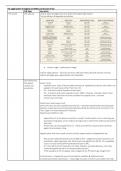
Types of externality
Source/impact External cost External benefit
of externality
Production MEC>0 MEC<0
externality that A pharma firm dumps its waste A pharma firm’s
affects other in a river and affects the research benefits other
production production of a medical pharma firms by
supplies firm down river that improving scientific
uses the river’s water. knowledge.
Production MEB<0 MEB>0
externality that Smoke from a hospital’s A pharma firm’s
affects incinerator affects local research enables people
consumption peoples’ enjoyment of their to be better informed
garden about their health
Consumption MEB<0 MEB>0
Tuesday, 4 February 2020 12:54
Using perfectly competitive markets to allocate resources
- Conclusion of conventional theoretical economics: perfectly competitive
markets lead to an efficient allocation of resources
- Health care is an economic good
- Thus, decisions about what type of health care will be produced, how it will
be produced, and who will receive health care, will be resolved by the
competitive market
- The competitive market would find the price for health care at which the
quantity demanded equals the quantity supplied
- This would mean:
○ Health care is supplied by health care providers willing to supply at the
equilibrium price
○ Health care would be produced in a manner which is technically
efficient
○ Health care would be purchased by consumers who are willing and able
to pay the equilibrium price
- Implication - access to health care is based on the ability to pay!
The efficiency of competitive markets
- A Pareto improvement occurs if a change can be made to the health system
that benefits some people without making anyone else worse off
- When all Pareto improvements have been made, the health system would be
Pareto efficient
- Pareto efficiency, or social efficiency therefore occurs when it is not possible
to make someone else better off without making someone else worse off
- The First Fundamental Theorem of Welfare Economics: perfectly competitive
markets generate an allocation of resources that is Pareto (socially) efficient
- Example: Internet Pharmacy
○ Rational consumer and provider will continue to consume and provide
pharmaceuticals up to the point where PMB = PMC
○ Pareto efficiency occurs where SMB = SMC
, ○ Pareto efficiency occurs where SMB = SMC
Causes of market failure: Externalities
- Externalities are costs and benefits incurred in the consumption or
production of goods/services that are not borne by the consumer or
producer involved.
- Positive externalities are known as external benefits
- Negative externalities are know as external costs
- Health care markets will not lead to Pareto efficiency if there are
externalities. This is because private marginal costs and/or private marginal
benefits deviate from the social marginal costs and/or social marginal
benefits
- An example of a positive externality is vaccination that has private and
societal benefits
Types of externality
Source/impact External cost External benefit
of externality
Production MEC>0 MEC<0
externality that A pharma firm dumps its waste A pharma firm’s
affects other in a river and affects the research benefits other
production production of a medical pharma firms by
supplies firm down river that improving scientific
uses the river’s water. knowledge.
Production MEB<0 MEB>0
externality that Smoke from a hospital’s A pharma firm’s
affects incinerator affects local research enables people
consumption peoples’ enjoyment of their to be better informed
garden about their health
Consumption MEB<0 MEB>0