HESI LEADERSHIP & MANAGEMENT ACTUAL EXAM
HESI LEADERSHIP & MANAGEMENT ACTUAL EXAM WITH
QUESTIONS AND CORRECT ANSWERS.
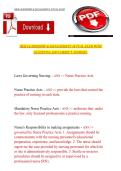
Laws Governing Nursing - ANS >> Nurse Practice Acts
Nurse Practice Acts - ANS >> provide the laws that control the
practice of nursing in each state.
Mandatory Nurse Practice Acts - ANS >> authorize that, under
the law, only licensed professionals a practice nursing.
Nurse's Responsibility in making assignments - ANS >>
governed by Nurse Practice Acts. 1. Assignments should be
commensurate with the nursing personnel's educational
preparation, experience, and knowledge. 2. The nurse should
supervise the care provided by nursing personnel for which he
or she is administratively responsible. 3. Sterile or invasive
procedures should be assigned to or supervised by a
professional nurse (RN).
,HESI LEADERSHIP & MANAGEMENT ACTUAL EXAM
Torts - ANS >> An act involving injury or damage to another
(except breach of contract) resulting in civil liability (i.e., the
victim can sue) instead of criminal liability
Unintentional Torts - ANS >> Negligence and malpractice
Negligence - ANS >> performing an act that a reasonable and
prudent person would not perform. The measure of negligence is
"reasonableness" (i.e., would a
,HESI LEADERSHIP & MANAGEMENT ACTUAL EXAM
reasonable and prudent nurse act in the same manner under the
same circumstances?)
Malpractice - ANS >> negligence by professional personnel (e.g.,
professional misconduct or unreasonable lack of skill in carrying
out professional duties)
Four elements necessary to prove negligence or malpractice -
ANS >> duty, breach of duty, injury/damages, causation
Duty - ANS >> Obligation to use due care (what a reasonable,
prudent nurse would do); failure to care for and/or to protect
others against unreasonable risk. The nurse must anticipate
foreseeable risks. Example: If a floor has water on it, the nurse
is responsible for anticipating the risk for a client's falling.
Breach of duty - ANS >> failure to perform according to the
established standard of conduct in providing nursing care
Injury/damages - ANS >> failure to meet standard of care, which
causes actual injury or damage to the client, either physical or
mental.
Causation - ANS >> a connection exists between conduct and
the resulting injury referred to as "proximate cause" or
"remoteness of damage"
, HESI LEADERSHIP & MANAGEMENT ACTUAL EXAM
Hospital policies - ANS >> provide a guide for nursing actions.
They are not laws, but courts generally rule against nurses who
have violated the employer's policies. Hospital can be liable for
poorly formulated or poorly implemented policies
HESI LEADERSHIP & MANAGEMENT ACTUAL EXAM WITH
QUESTIONS AND CORRECT ANSWERS.
Laws Governing Nursing - ANS >> Nurse Practice Acts
Nurse Practice Acts - ANS >> provide the laws that control the
practice of nursing in each state.
Mandatory Nurse Practice Acts - ANS >> authorize that, under
the law, only licensed professionals a practice nursing.
Nurse's Responsibility in making assignments - ANS >>
governed by Nurse Practice Acts. 1. Assignments should be
commensurate with the nursing personnel's educational
preparation, experience, and knowledge. 2. The nurse should
supervise the care provided by nursing personnel for which he
or she is administratively responsible. 3. Sterile or invasive
procedures should be assigned to or supervised by a
professional nurse (RN).
,HESI LEADERSHIP & MANAGEMENT ACTUAL EXAM
Torts - ANS >> An act involving injury or damage to another
(except breach of contract) resulting in civil liability (i.e., the
victim can sue) instead of criminal liability
Unintentional Torts - ANS >> Negligence and malpractice
Negligence - ANS >> performing an act that a reasonable and
prudent person would not perform. The measure of negligence is
"reasonableness" (i.e., would a
,HESI LEADERSHIP & MANAGEMENT ACTUAL EXAM
reasonable and prudent nurse act in the same manner under the
same circumstances?)
Malpractice - ANS >> negligence by professional personnel (e.g.,
professional misconduct or unreasonable lack of skill in carrying
out professional duties)
Four elements necessary to prove negligence or malpractice -
ANS >> duty, breach of duty, injury/damages, causation
Duty - ANS >> Obligation to use due care (what a reasonable,
prudent nurse would do); failure to care for and/or to protect
others against unreasonable risk. The nurse must anticipate
foreseeable risks. Example: If a floor has water on it, the nurse
is responsible for anticipating the risk for a client's falling.
Breach of duty - ANS >> failure to perform according to the
established standard of conduct in providing nursing care
Injury/damages - ANS >> failure to meet standard of care, which
causes actual injury or damage to the client, either physical or
mental.
Causation - ANS >> a connection exists between conduct and
the resulting injury referred to as "proximate cause" or
"remoteness of damage"
, HESI LEADERSHIP & MANAGEMENT ACTUAL EXAM
Hospital policies - ANS >> provide a guide for nursing actions.
They are not laws, but courts generally rule against nurses who
have violated the employer's policies. Hospital can be liable for
poorly formulated or poorly implemented policies