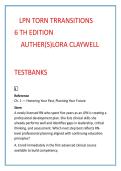
LPN TORN TRRANSITIONS
6 TH EDITION
AUTHER(S)LORA CLAYWELL
TESTBANKS
1️⃣
Reference
Ch. 1 — Honoring Your Past, Planning Your Future
Stem
A newly licensed RN who spent five years as an LPN is creating a
professional development plan. She lists clinical skills she
already performs well and identifies gaps in leadership, critical
thinking, and assessment. Which next step best reflects RN-
level professional planning aligned with continuing education
principles?
A. Enroll immediately in the first advanced clinical course
available to build competency.
,B. Prioritize measurable goals, timeline, and resources; then
select targeted continuing education.
C. Continue practicing duties identical to LPN role until a mentor
assigns formal training.
D. Focus only on passing employer-required competencies and
delay broader goals for later.
Correct Answer
B
Rationale — Correct
Prioritizing measurable goals, timelines, and resources
demonstrates RN-level planning and aligns with continuing
education components (goal-setting, targeted learning). This
approach uses self-assessment to create a structured plan that
addresses identified gaps in leadership and assessment,
reflecting accountability and professional growth.
Rationales — Incorrect
A. Enrolling immediately ignores needs analysis and may waste
time on non-targeted training. This is LPN-level reactive
learning.
C. Waiting for a mentor to assign training abdicates RN
autonomy and accountability in planning.
D. Limiting focus to mandatory competencies neglects broader
RN responsibilities such as leadership and critical thinking.
Teaching Point
Set measurable goals, timelines, and resources before selecting
continuing education.
,Citation
Claywell, L. (2025). LPN to RN Transitions (6th ed.). Ch. 1.
2️⃣
Reference
Ch. 1 — Honoring Your Past, Planning Your Future
Stem
An LPN-to-RN student reflects on past clinical strengths and
documents specific patient-care situations where outcomes
improved because of their intervention. As an RN, how should
they use this reflective review when transitioning roles?
A. Rely on the same interventions without change because they
were effective as an LPN.
B. Use reflections to identify transferable skills and gaps, then
align learning with RN expectations.
C. Dismiss past roles as irrelevant and only pursue new RN skills.
D. Share reflections only with peers for reassurance, not for
formal development planning.
Correct Answer
B
Rationale — Correct
Using reflective review to identify transferable skills and gaps
shows analytic thinking and professional accountability. It
informs an RN-level development plan that builds on prior
, experience while targeting areas (assessment, delegation,
leadership) required in RN scope of practice.
Rationales — Incorrect
A. Relying solely on prior interventions may ignore expanded
RN responsibilities and needed skill refinement.
C. Dismissing past experience wastes valuable transferable
competencies that facilitate transition.
D. Limiting reflections to peers neglects formal goal-setting and
structured continuing education.
Teaching Point
Use reflective review to map transferable skills and identify RN
competency gaps.
Citation
Claywell, L. (2025). LPN to RN Transitions (6th ed.). Ch. 1.
3️⃣
Reference
Ch. 1 — Honoring Your Past, Planning Your Future
Stem
During orientation, a nurse educator asks an LPN-to-RN novice
to write SMART goals for the first six months. The novice writes:
“Become better at charting.” Which revision best converts this
into an appropriate RN-level SMART goal?
6 TH EDITION
AUTHER(S)LORA CLAYWELL
TESTBANKS
1️⃣
Reference
Ch. 1 — Honoring Your Past, Planning Your Future
Stem
A newly licensed RN who spent five years as an LPN is creating a
professional development plan. She lists clinical skills she
already performs well and identifies gaps in leadership, critical
thinking, and assessment. Which next step best reflects RN-
level professional planning aligned with continuing education
principles?
A. Enroll immediately in the first advanced clinical course
available to build competency.
,B. Prioritize measurable goals, timeline, and resources; then
select targeted continuing education.
C. Continue practicing duties identical to LPN role until a mentor
assigns formal training.
D. Focus only on passing employer-required competencies and
delay broader goals for later.
Correct Answer
B
Rationale — Correct
Prioritizing measurable goals, timelines, and resources
demonstrates RN-level planning and aligns with continuing
education components (goal-setting, targeted learning). This
approach uses self-assessment to create a structured plan that
addresses identified gaps in leadership and assessment,
reflecting accountability and professional growth.
Rationales — Incorrect
A. Enrolling immediately ignores needs analysis and may waste
time on non-targeted training. This is LPN-level reactive
learning.
C. Waiting for a mentor to assign training abdicates RN
autonomy and accountability in planning.
D. Limiting focus to mandatory competencies neglects broader
RN responsibilities such as leadership and critical thinking.
Teaching Point
Set measurable goals, timelines, and resources before selecting
continuing education.
,Citation
Claywell, L. (2025). LPN to RN Transitions (6th ed.). Ch. 1.
2️⃣
Reference
Ch. 1 — Honoring Your Past, Planning Your Future
Stem
An LPN-to-RN student reflects on past clinical strengths and
documents specific patient-care situations where outcomes
improved because of their intervention. As an RN, how should
they use this reflective review when transitioning roles?
A. Rely on the same interventions without change because they
were effective as an LPN.
B. Use reflections to identify transferable skills and gaps, then
align learning with RN expectations.
C. Dismiss past roles as irrelevant and only pursue new RN skills.
D. Share reflections only with peers for reassurance, not for
formal development planning.
Correct Answer
B
Rationale — Correct
Using reflective review to identify transferable skills and gaps
shows analytic thinking and professional accountability. It
informs an RN-level development plan that builds on prior
, experience while targeting areas (assessment, delegation,
leadership) required in RN scope of practice.
Rationales — Incorrect
A. Relying solely on prior interventions may ignore expanded
RN responsibilities and needed skill refinement.
C. Dismissing past experience wastes valuable transferable
competencies that facilitate transition.
D. Limiting reflections to peers neglects formal goal-setting and
structured continuing education.
Teaching Point
Use reflective review to map transferable skills and identify RN
competency gaps.
Citation
Claywell, L. (2025). LPN to RN Transitions (6th ed.). Ch. 1.
3️⃣
Reference
Ch. 1 — Honoring Your Past, Planning Your Future
Stem
During orientation, a nurse educator asks an LPN-to-RN novice
to write SMART goals for the first six months. The novice writes:
“Become better at charting.” Which revision best converts this
into an appropriate RN-level SMART goal?