Page 1
Advanced Developmental Biology
Differential Gene Expression in Development:
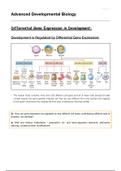
Development is Regulated by Differential Gene Expression:
- The human body contains more than 200 different cell types and all of these cells (except B-cells)
contain exactly the same genetic material, yet they are very different from one another with regards
to the types of proteins they express and the type of behaviour that they exhibit
Q: How can gene expression be regulated so that di erent cell types, synthesising di erent sets of
proteins, can develop?
A: DNA and histone methylation / acetylation; cis- and trans-regulatory elements; alternative
splicing; covalent protein modi cations
fi ff ff
, Page 2
Summary: Regulation of Gene Expression at Different Levels
DNA Differential gene transcription:
- Control at the level of chromatin
↳ Histone acetylation / methylation
- Control at the level of the gene
↳ Cis-regulation (enhancers, silencers)
↳ Trans-regulation (transcription factors)
↳ DNA methylation
RNA - Selective mRNA processing
↳ Alternative splicing
- Selective mRNA translation
↳ Differential nRNA longevity
↳ Inhibition of translation
↳ Ribosomal selectivity
↳ MicroRNAs
Protein - Di erential protein modi cation:
↳ Activation by cleavage
↳ Activation by transport to a speci c location
↳ Assembly with other proteins
↳ Covalent modi cation
Chromatin Structure:
- Chromatin is essentially DNA wound around a histone core
ff fi fi fi
, Page 3
Gene Expression Control at the Level of Chromatin:
Histone Modi cations:
➢Normally, lysine residues are positively charged, and they will thus interact electrostatically with
negatively charged DNA that is bound around them
Activated (Euchromatin):
- Acetylation of lysine residues of histone H2/H3/H4 tails (since the acetyl group is negatively
charged it neutralises the positive charge of the lysine residues, and thus the lysine is no longer
electrostatically attracted to the DNA backbone and therefore the histones are loosened)
- Methylation of lysines K4*, K38, and K79 of H3
- Methyl group is not a charged group; it is neutral and thus does not work by altering the charge of
the histone, it works by physically hindering the binding of the different factors to the histones.
Certain areas of the histones that can be methylated by the addition of one, two or three methyl
groups could end up preventing the effective interaction between the histones and the DNA such
that you end up with loose chromatin (euchromatin)
Repressed (Heterochromatin):
- Deacetylation of lysine residues of H2/H3/H4 tails causes chromatin to condense
- Methylation of K9 and K27* of H3; and K20 of H4 (blocks binding sites of speci c proteins)
- Other kinds of methylations are located in such a way that they signal to various chromatin
modifying enzymes or prevent the transcription factor from binding effectively to the chromatin
➢Methylation that causes activation or repression can both be relatively quickly erased and reinstated;
they don’t permanently activate or shut down the chromatin
fi fi
, Page 4
Structure of Human β-Globin Gene:
Key Features:
- Enhancer
- Promoter
- Transcription initiation sites
- 5’ UTR
- Translation initiation sites
- Coding exons
- Introns
- Translation termination codon 3’ UTR
- Poly-A signal
- Transcription termination sequence
Differential Expression and Regulation of Human β-Globin Gene:
Advanced Developmental Biology
Differential Gene Expression in Development:
Development is Regulated by Differential Gene Expression:
- The human body contains more than 200 different cell types and all of these cells (except B-cells)
contain exactly the same genetic material, yet they are very different from one another with regards
to the types of proteins they express and the type of behaviour that they exhibit
Q: How can gene expression be regulated so that di erent cell types, synthesising di erent sets of
proteins, can develop?
A: DNA and histone methylation / acetylation; cis- and trans-regulatory elements; alternative
splicing; covalent protein modi cations
fi ff ff
, Page 2
Summary: Regulation of Gene Expression at Different Levels
DNA Differential gene transcription:
- Control at the level of chromatin
↳ Histone acetylation / methylation
- Control at the level of the gene
↳ Cis-regulation (enhancers, silencers)
↳ Trans-regulation (transcription factors)
↳ DNA methylation
RNA - Selective mRNA processing
↳ Alternative splicing
- Selective mRNA translation
↳ Differential nRNA longevity
↳ Inhibition of translation
↳ Ribosomal selectivity
↳ MicroRNAs
Protein - Di erential protein modi cation:
↳ Activation by cleavage
↳ Activation by transport to a speci c location
↳ Assembly with other proteins
↳ Covalent modi cation
Chromatin Structure:
- Chromatin is essentially DNA wound around a histone core
ff fi fi fi
, Page 3
Gene Expression Control at the Level of Chromatin:
Histone Modi cations:
➢Normally, lysine residues are positively charged, and they will thus interact electrostatically with
negatively charged DNA that is bound around them
Activated (Euchromatin):
- Acetylation of lysine residues of histone H2/H3/H4 tails (since the acetyl group is negatively
charged it neutralises the positive charge of the lysine residues, and thus the lysine is no longer
electrostatically attracted to the DNA backbone and therefore the histones are loosened)
- Methylation of lysines K4*, K38, and K79 of H3
- Methyl group is not a charged group; it is neutral and thus does not work by altering the charge of
the histone, it works by physically hindering the binding of the different factors to the histones.
Certain areas of the histones that can be methylated by the addition of one, two or three methyl
groups could end up preventing the effective interaction between the histones and the DNA such
that you end up with loose chromatin (euchromatin)
Repressed (Heterochromatin):
- Deacetylation of lysine residues of H2/H3/H4 tails causes chromatin to condense
- Methylation of K9 and K27* of H3; and K20 of H4 (blocks binding sites of speci c proteins)
- Other kinds of methylations are located in such a way that they signal to various chromatin
modifying enzymes or prevent the transcription factor from binding effectively to the chromatin
➢Methylation that causes activation or repression can both be relatively quickly erased and reinstated;
they don’t permanently activate or shut down the chromatin
fi fi
, Page 4
Structure of Human β-Globin Gene:
Key Features:
- Enhancer
- Promoter
- Transcription initiation sites
- 5’ UTR
- Translation initiation sites
- Coding exons
- Introns
- Translation termination codon 3’ UTR
- Poly-A signal
- Transcription termination sequence
Differential Expression and Regulation of Human β-Globin Gene: