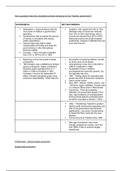
How successful were the monetarist policies introduced by the Thatcher government?
SUCCESSFUL NOT SUCCESSFUL
Monetarism = financial theory that the Taxation- VAT raised from 8% to 15%.
root cause of inflation is government Standard rate of income tax reduced
spending from 33% to 30% and the top rate of
Governments had to restrict the amount income tax reduced from 83% to 60%.
of money in circulation and reduce Reducing income tax would increase
public expenditure productivity, however it affected the poor
Interest rates kept high to deter more than the rich
irresponsible borrowing and keep the
pound strong on the international
financial market
Success → fall in the rate of inflation
from 19% in 1979 to 5% in 1983
Reducing income tax would increase Successful at reducing inflation, but did
productivity so at the price of job losses
1981 Budget- was a deflationary budget Unemployment rose from 2,244,000 in
during a recession, highly unorthodox. 1980 to 3,408,000 in 1986
Reduced public spending from £11 Acceptable if drop in inflation
billion in 1980 to £9 billion in 1981. accompanied by economic growth, but
Increase in income tax generated £4 the opposite was true
billion. Private businesses given more 1981 : Falling orders for manufactured
economic responsibility - North Sea Oil goods saw start of economic recession
Led to social unrest
April 1981 - Brixton, South London; July
- St Paul’s region of Bristol, Toxteth area
in Liverpool; Moss Side in Manchester
Caused by : Poor job prospects,
alienation of young black people (‘Sus’
law), high incidence of unemployment
among school leavers (unemployment
for ethnic minorities in Brixton = 25%)
1982 - Threatening Thatcher’s position
Opinion polls showed her popularity and
that of her government had declined
significantly ; Led some Conservatives
to doubt that they could win the next
election
Turned around by Falkland War 1982
Although monetarism was never
formally dropped as a policy, from the
mid-1980s it was in practice largely
abandoned.
Thatcherism : Second stage economics
Supply-side economics
, Keynesian policies = distorted operation of the economy by attempting to create demand
artificially
Supply-side economists argued for a return to incentives; people would work harder and more
productively if they were allowed to keep more of their earnings
Policies :
Reducing taxation so as to provide employees with a greater incentive to work
Encouraging competition in order to lower prices
Limiting the powers of the trade unions so that they could not block productivity or
prevent the modernisation of industry
Cutting wasteful welfare payments as a way of saving public money and reducing
dependency
Deregulation
Critical move towards free enterprise
Concerted effort to remove financial and legal restrictions that Thatcher believed had
prevented efficiency and profitability in many areas of social and economic activity
Chief areas :
Finance : credit and exchange controls were abolished
Transport : bus companies were deregulated to encourage competition
Education : schools were entitled to opt out of the state sector and become
responsible for their own financing
Health : Hospitals were required to operate an ‘internal market’ by taking control of
their own finance and matching needs to resources
Right-to-buy
1985 : Over 800,000 tenants had begun to purchase their properties they had previously
rented
68% of population = homeowners by 1990, an increase of 15% since 1981
Privatisation
Provided the state with large additional funds
Aimed at increasing ‘popular capitalism’ by giving a much greater number of ordinary people
the chance to become shareholders
1979-1990 : Number of shareholders in Britain rose from 3 million to 9 million
Of the 50 enterprises sold off during the Thatcher years, the largest were :
British Airways
British Steel
British Coal
Cable & Wireless
British Telecom
Regional electricity and water boards
Government revenue derived from privatisation :
1979-80 £377 million
1985-6 £2.6 billion
SUCCESSFUL NOT SUCCESSFUL
Monetarism = financial theory that the Taxation- VAT raised from 8% to 15%.
root cause of inflation is government Standard rate of income tax reduced
spending from 33% to 30% and the top rate of
Governments had to restrict the amount income tax reduced from 83% to 60%.
of money in circulation and reduce Reducing income tax would increase
public expenditure productivity, however it affected the poor
Interest rates kept high to deter more than the rich
irresponsible borrowing and keep the
pound strong on the international
financial market
Success → fall in the rate of inflation
from 19% in 1979 to 5% in 1983
Reducing income tax would increase Successful at reducing inflation, but did
productivity so at the price of job losses
1981 Budget- was a deflationary budget Unemployment rose from 2,244,000 in
during a recession, highly unorthodox. 1980 to 3,408,000 in 1986
Reduced public spending from £11 Acceptable if drop in inflation
billion in 1980 to £9 billion in 1981. accompanied by economic growth, but
Increase in income tax generated £4 the opposite was true
billion. Private businesses given more 1981 : Falling orders for manufactured
economic responsibility - North Sea Oil goods saw start of economic recession
Led to social unrest
April 1981 - Brixton, South London; July
- St Paul’s region of Bristol, Toxteth area
in Liverpool; Moss Side in Manchester
Caused by : Poor job prospects,
alienation of young black people (‘Sus’
law), high incidence of unemployment
among school leavers (unemployment
for ethnic minorities in Brixton = 25%)
1982 - Threatening Thatcher’s position
Opinion polls showed her popularity and
that of her government had declined
significantly ; Led some Conservatives
to doubt that they could win the next
election
Turned around by Falkland War 1982
Although monetarism was never
formally dropped as a policy, from the
mid-1980s it was in practice largely
abandoned.
Thatcherism : Second stage economics
Supply-side economics
, Keynesian policies = distorted operation of the economy by attempting to create demand
artificially
Supply-side economists argued for a return to incentives; people would work harder and more
productively if they were allowed to keep more of their earnings
Policies :
Reducing taxation so as to provide employees with a greater incentive to work
Encouraging competition in order to lower prices
Limiting the powers of the trade unions so that they could not block productivity or
prevent the modernisation of industry
Cutting wasteful welfare payments as a way of saving public money and reducing
dependency
Deregulation
Critical move towards free enterprise
Concerted effort to remove financial and legal restrictions that Thatcher believed had
prevented efficiency and profitability in many areas of social and economic activity
Chief areas :
Finance : credit and exchange controls were abolished
Transport : bus companies were deregulated to encourage competition
Education : schools were entitled to opt out of the state sector and become
responsible for their own financing
Health : Hospitals were required to operate an ‘internal market’ by taking control of
their own finance and matching needs to resources
Right-to-buy
1985 : Over 800,000 tenants had begun to purchase their properties they had previously
rented
68% of population = homeowners by 1990, an increase of 15% since 1981
Privatisation
Provided the state with large additional funds
Aimed at increasing ‘popular capitalism’ by giving a much greater number of ordinary people
the chance to become shareholders
1979-1990 : Number of shareholders in Britain rose from 3 million to 9 million
Of the 50 enterprises sold off during the Thatcher years, the largest were :
British Airways
British Steel
British Coal
Cable & Wireless
British Telecom
Regional electricity and water boards
Government revenue derived from privatisation :
1979-80 £377 million
1985-6 £2.6 billion