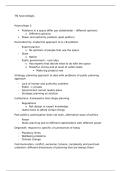
TSI hoorcolleges
Hoorcollege 1:
Problems in a space differ per stakeholder – different opinions
o Different opinions
Power and authority problem (post politics)
Ecomodernity: modernist approach to A->B problem
- Expert planner
o No opinions of people that use the space
- State
o Nation
- Public government – core idea
o Has experts that decide what to do with the space
o Powerful, strong and at level of nation state
Make big projects real
Strategy: planning approach to deal with problems of public planning
approach
- Lack of money and authority: problem
- Public -> private
- Government cannot realize plans
- Strategic planning as solution
Institutions: frameworks that shape planning
- Regulations
o Not design or expert knowledge
- Useful tools to afford certain things
Post politics: participation does not work, alternative ways of politics
- Power
- Static planning due to different stakeholders with different power
Degrowth: respond to specific circumstances of today
- Planetary limits
- Wellbeing problems
- Climate change
Communication, conflict, exclusion, futures, complexity and punctual-
urbanism: different dimensions of planning that are always there
, Spatial planning: the theory that we use to take collective decisions
and implement them directly affects the space that is produced
o Space <-> collective action
Collective action: project of organizing
Different subjects that coordinate themselves and
mobilize resources to solve problems
o Decisions based on that assumption
Hoorcollege 2:
, Modernist thinking
o The way we think: rationalism
Human rationalism
Human as center of the world
o How the space looks: functionalism
Division of functions in land
Clarification of borders (functions)
Methods of taking collective decisions and implement them
o Planning is the process by which the expert selects a course of
action (set of means) for attainment of their ends
o Good planning: these means are likely to attain the ends or
maximize the chances of their attainment (efficiency)
o It is by the process of rational choice that the best adaptation
of means to ends is likely to be achieved
The roots of modern planning
o Antropocentrism (human as center)
o Effiency and expert-led
o Nation state and government led (political power/ authority
over the economy)
o Techno-driven (state-innovation)
o Colonial roots (planning industrial politics)
Generally guided by a moral (public) imperative to
guarantee a certain ‘standard’ of livability based on
historically defined preconceptions of how people ‘want
to live’
Assumption: the expert ‘knows’ how people want to live
The modern rational plan
o 1. Analysis of a situation
Resources at disposal
Authority and power conditions
o 2. End reduction and elaboration
Images of the future
Real life goals -> wanted and unwanted effects
o 3. Design a course of action
Operational steps (investment plans)
Strategic steps (values, principles, broad directions)
o 4. Comparative evaluation of consequences
Check results, wanted and unwanted
Define acceptable risks
-
Two major critiques
, o The agreement about a goal is and should be (almost)
impossible
Politics
o The capacity and conditions to intervene are context and
situation specific and they are not given
Power and institutions
10 points in paper: Rittel & Webber
Efficiency vs. justice
o X
o X
o X
Planning
Ecology vs. equity vs. economy/ livability
o Campbell
o Godschalk
Bioregionalism
o It can be effective to visualize sustainable regions within an
interdependent world full of trade, migration, information flows
and capital flows
Hoorcollege 1:
Problems in a space differ per stakeholder – different opinions
o Different opinions
Power and authority problem (post politics)
Ecomodernity: modernist approach to A->B problem
- Expert planner
o No opinions of people that use the space
- State
o Nation
- Public government – core idea
o Has experts that decide what to do with the space
o Powerful, strong and at level of nation state
Make big projects real
Strategy: planning approach to deal with problems of public planning
approach
- Lack of money and authority: problem
- Public -> private
- Government cannot realize plans
- Strategic planning as solution
Institutions: frameworks that shape planning
- Regulations
o Not design or expert knowledge
- Useful tools to afford certain things
Post politics: participation does not work, alternative ways of politics
- Power
- Static planning due to different stakeholders with different power
Degrowth: respond to specific circumstances of today
- Planetary limits
- Wellbeing problems
- Climate change
Communication, conflict, exclusion, futures, complexity and punctual-
urbanism: different dimensions of planning that are always there
, Spatial planning: the theory that we use to take collective decisions
and implement them directly affects the space that is produced
o Space <-> collective action
Collective action: project of organizing
Different subjects that coordinate themselves and
mobilize resources to solve problems
o Decisions based on that assumption
Hoorcollege 2:
, Modernist thinking
o The way we think: rationalism
Human rationalism
Human as center of the world
o How the space looks: functionalism
Division of functions in land
Clarification of borders (functions)
Methods of taking collective decisions and implement them
o Planning is the process by which the expert selects a course of
action (set of means) for attainment of their ends
o Good planning: these means are likely to attain the ends or
maximize the chances of their attainment (efficiency)
o It is by the process of rational choice that the best adaptation
of means to ends is likely to be achieved
The roots of modern planning
o Antropocentrism (human as center)
o Effiency and expert-led
o Nation state and government led (political power/ authority
over the economy)
o Techno-driven (state-innovation)
o Colonial roots (planning industrial politics)
Generally guided by a moral (public) imperative to
guarantee a certain ‘standard’ of livability based on
historically defined preconceptions of how people ‘want
to live’
Assumption: the expert ‘knows’ how people want to live
The modern rational plan
o 1. Analysis of a situation
Resources at disposal
Authority and power conditions
o 2. End reduction and elaboration
Images of the future
Real life goals -> wanted and unwanted effects
o 3. Design a course of action
Operational steps (investment plans)
Strategic steps (values, principles, broad directions)
o 4. Comparative evaluation of consequences
Check results, wanted and unwanted
Define acceptable risks
-
Two major critiques
, o The agreement about a goal is and should be (almost)
impossible
Politics
o The capacity and conditions to intervene are context and
situation specific and they are not given
Power and institutions
10 points in paper: Rittel & Webber
Efficiency vs. justice
o X
o X
o X
Planning
Ecology vs. equity vs. economy/ livability
o Campbell
o Godschalk
Bioregionalism
o It can be effective to visualize sustainable regions within an
interdependent world full of trade, migration, information flows
and capital flows