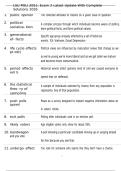
LSU POLI 2051: Exam 2 Latest Update With Complete
Solutions 2026
1. public opinion The collected attitudes of citizens on a given issue or question.
2. political A complex process through which individuals become aware of politics,
socializa- tion learn political facts, and form political values.
3. generational Specific age group uniquely attected by a set of historical
ef- fects events. EX: Vietnam, Great Depression
4. life cycle effects Political views are influenced by maturation (views that change as we
get older);
as we're young we're more liberal and as we get older we mature
and become more conservative.
5. period effects Historical events attect opinions (end of cold war caused everyone to
want to
spend less on defense).
6. the statistical A sample of individuals selected by chance from any population is
theo- ry of representa- tive of that population.
sampling
7. push polls Poses as a survey designed to implant negative information about an
opponent
in voters' minds.
8. exit polls Polling after individuals vote in an election poll.
9. likely voters Age eligible voters only show for about 50%.
10. bandwagon A poll showing a particular candidate moving up or surging ahead
and you vote
for him because you see that.
11. undergo effect You vote for someone who seems like they don't have a chance.
1/
17
, LSU POLI 2051: Exam 2 Latest Update With Complete
Solutions 2026
12. liberal Favoring reform, open to new ideas, and tolerant of the ideas and
behavior of
others; not bound by traditional thinking; broad-minded.
13. conservative Favoring traditional views and values; tending to oppose change.
2/
17
, LSU POLI 2051: Exam 2 Latest Update With Complete
Solutions 2026
14. populist A supporter of the rights and power of the people.
15. libertarian One who advocates maximizing individual rights and minimizing the
role of the
state.
16. sampling error A measuring of the accuracy of a public opinion poll; mainly a function
of sample
size and usually expressed in percentage terms.
17. agents of Those agents, such as family and the media, have significant impact on
socializa- tion citizens' political socialization.
18. so-called Consists mostly of white, evangelical Protestants
religious right
19. political Involvement in activities intended to influence public policy and
participa- tion leadership, such as voting, joining political groups, contacting
elected oflcials, demon- strating for political causes, and giving
money to political candidates.
20. conventional Relatively routine, non-threatening behavior that uses the channels of
repre-
sentative government.
21. unconventional Relatively uncommon behavior that challenges or defies government
channels
22. voting The most common and most studied form of participation.
23. voting rights Ended literacy tests.
act (1965)
24. 15th amendment Black men can vote.
3/
17
Solutions 2026
1. public opinion The collected attitudes of citizens on a given issue or question.
2. political A complex process through which individuals become aware of politics,
socializa- tion learn political facts, and form political values.
3. generational Specific age group uniquely attected by a set of historical
ef- fects events. EX: Vietnam, Great Depression
4. life cycle effects Political views are influenced by maturation (views that change as we
get older);
as we're young we're more liberal and as we get older we mature
and become more conservative.
5. period effects Historical events attect opinions (end of cold war caused everyone to
want to
spend less on defense).
6. the statistical A sample of individuals selected by chance from any population is
theo- ry of representa- tive of that population.
sampling
7. push polls Poses as a survey designed to implant negative information about an
opponent
in voters' minds.
8. exit polls Polling after individuals vote in an election poll.
9. likely voters Age eligible voters only show for about 50%.
10. bandwagon A poll showing a particular candidate moving up or surging ahead
and you vote
for him because you see that.
11. undergo effect You vote for someone who seems like they don't have a chance.
1/
17
, LSU POLI 2051: Exam 2 Latest Update With Complete
Solutions 2026
12. liberal Favoring reform, open to new ideas, and tolerant of the ideas and
behavior of
others; not bound by traditional thinking; broad-minded.
13. conservative Favoring traditional views and values; tending to oppose change.
2/
17
, LSU POLI 2051: Exam 2 Latest Update With Complete
Solutions 2026
14. populist A supporter of the rights and power of the people.
15. libertarian One who advocates maximizing individual rights and minimizing the
role of the
state.
16. sampling error A measuring of the accuracy of a public opinion poll; mainly a function
of sample
size and usually expressed in percentage terms.
17. agents of Those agents, such as family and the media, have significant impact on
socializa- tion citizens' political socialization.
18. so-called Consists mostly of white, evangelical Protestants
religious right
19. political Involvement in activities intended to influence public policy and
participa- tion leadership, such as voting, joining political groups, contacting
elected oflcials, demon- strating for political causes, and giving
money to political candidates.
20. conventional Relatively routine, non-threatening behavior that uses the channels of
repre-
sentative government.
21. unconventional Relatively uncommon behavior that challenges or defies government
channels
22. voting The most common and most studied form of participation.
23. voting rights Ended literacy tests.
act (1965)
24. 15th amendment Black men can vote.
3/
17