BU450 LEADERSHIP SKILLS Exam 1 Answers (Ashworth College)
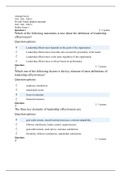
Attempt Score: 100 / 100 - 100 % Overall Grade (highest attempt): 100 / 100 - 100 % Online Exam 1 Question 1 5 / 5 points Which of the following statements is true about the definition of leadership effectiveness? Question options: Leadership effectiveness depends on the goals of the organization. Leadership effectiveness must take into account the personality of the leader. Leadership effectiveness is the same regardless of the organization. Leadership effectiveness is always based on performance. Question 2 5 / 5 points Which one of the following factors is the key element of most definitions of leadership effectiveness? Question options: employee satisfaction stakeholder needs focus on outcome financial measures Question 3 5 / 5 points The three key elements of leadership effectiveness are: Question options: goal achievement, smooth internal processes, external adaptability. follower satisfaction, leader control, empowerment. goal achievement, stock prices, customer satisfaction. flexibility, follower satisfaction, stakeholder satisfaction. Question 4 5 / 5 points In the United States there is a 'population hourglass' whereby the largest percentage of the population is older baby boomers, the millennial generation is at the bottom and generation Xers are in the middle. The challenges arising from issues regarding the differences in these age groups represents which major factor fueling organizational change and their leaders? Question options: increased globalization employee expectations political changes demographic changes Question 5 5 / 5 points Helgesen called the "female" style of management: Question options: non-hierarchical charisma. interconnected management. participative management. the web. Question 6 5 / 5 points __________ is the degree to which a culture values fairness, generosity, caring and kindness. Question options: Uncertainty avoidance Humane orientation In-group collectivism Future orientation Question 7 5 / 5 points Leadership and management become more closely similar when considering the issue of: Question options: effectiveness and competence. national and organizational culture. individual traits. organizational performance. Question 8 5 / 5 points Determining span of control, reporting relationships, and degree of formalization and specialization are all elements of which function of how leaders shape organizational culture? Question options: developing strategies and structures influencing hiring decisions creating effective reward systems role modeling Question 9 5 / 5 points People from high context cultures typically: Question options: rely on non-verbal cues and situational factors to communicate. rely on the written word and clearly stated statement to communicate. value leaders who take care of people. value leaders who focus on the task. Question 10 5 / 5 points Individualistic cultures tend to: Question options: expect people to conform to social norms before they become independent. emphasize performance over social support. focus on individual achievement. value material goods. Question 11 5 / 5 points According to research by Mintzberg, the job of a manager is characterized by: Question options: many cultural encounters. a wide variety of tasks and many interruptions. a series of well-defined activities that start with planning and end in controlling. political activities that are essential to being effective. Question 12 5 / 5 points Vertical/horizontal dimension impacts leadership because: Question options: it deals with people. it relates to how rules are used. it focuses on how leaders use participation in their culture. it affects views of hierarchy and equality. Question 13 5 / 5 points The key argument against the impact of leadership centers around the idea that: Question options: most leaders are simply not effective. social and environmental factors affect organizations more than leaders. culture and organizational rigidity do not allow leaders to make their mark. other managers impact organizations as much as leaders. Question 14 5 / 5 points Japan and Korea are examples of: Question options: loose cultures. individualistic cultures. vertical collectivistic cultures. cultures that are comfortable with uncertainty. Question 15 5 / 5 points Leaders from individualistic cultures would best be characterized by: Question options: engaging in team-oriented activities. seeking recognition. demonstrating high levels of participation behaviors. employing supportive leader behaviors. Question 16 5 / 5 points National organizational heritage refers to: Question options: the wealth of each organization. the culture of different organizations. the management styles based on national cultures. organizational events that shape national culture. Question 17 5 / 5 points Which of the items is one of Hofstede's five dimensions of culture? Question options: Power distance Egalitarian High context Performance orientation Question 18 5 / 5 points When a culture is high in uncertainty avoidance, people are likely to: Question options: search for absolute truths. expect their leaders to allow participation. rely on their community for information. have a short term orientation. Question 19 5 / 5 points Leaders are often role models for their followers. Recent research suggests that leaders must also pay attention to: Question options: sexual harassment and its negative impact. the use of power. how outsiders impact their followers. their own emotional reactions. Question 20 5 / 5 points Tolerance of uncertainty refers to: Question options: how much uncertainty exists in the political system. how quickly managers make decisions. the extent to which employees rely on their manager for decision making. how comfortable people are with ambiguity Attempt Score: 100 / 100 - 100 % Overall Grade (highest attempt): 100 / 100 - 100 %
Escuela, estudio y materia
- Institución
- Ashworth College
- Grado
- BU450 (BU450)
Información del documento
- Subido en
- 4 de marzo de 2021
- Número de páginas
- 6
- Escrito en
- 2020/2021
- Tipo
- Examen
- Contiene
- Desconocido
Temas
-
bu450
-
bu450 leadership skills exam 1 answers ashworth college
-
which of the following statements is true about the definition of leadership effectiveness
-
which one of the following factors is the k

Documento también disponible en un lote