Ocr A level biology paper 2
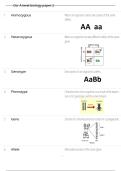
1. Homozygous When an organism carries two copies of the same
alleles.
2. Heterozygous When an organism has two different alleles of the same
gene.
3. Genotype Description of an organism's alleles.
4. Phenotype Characteristics of an organism as a result of the expres-
sion of its genotype and the environment.
5. Gene Section of a chromosome that codes for a polypeptide.
6. Allele Alternative version of the same gene.
, Ocr A level biology paper 2
7. Gene locus Location of a gene on a chromosome.
8. Dominant allele Allele that is always expressed in the phenotype.
9. Recessive allele Allele that is only expressed in the phenotype when
there are two of them i.e. in a homozygote.
10. Codominant allele Both alleles are expressed in the phenotype.
, Ocr A level biology paper 2
11. Multiple alleles More than 2 alleles for a particular gene.
12. Sex linkage Characteristic or trait controlled by a gene found on the
sex chromosomes.
13. Homologous chromosomes Pair of chromosomes that carry genes for the same
characteristics, at the same gene loci.
14. Autosome Any chromosome that is NOT a sex chromosome.
15. Autosomal linkage Genes coding for different characteristics, found on the
same non-sex chromosome, are said to be linked.
, Ocr A level biology paper 2
16. Independent assortment During metaphase I of meiosis, the arrangement of one
pair of homologous chromosomes on the equator of
the spindle is independent of the arrangement of any
other pair of chromosomes. A key event that produces
GENETIC VARIATION in gametes.
17. Crossing over Where chromatids twist around each other and ex-
change genetic material. Happens during prophase
I of meiosis which increases the amount of GENETIC
VARIATION in gametes by producing new combination
of alleles.
18. Carrier Individual who has an allele, often for a disease, which
is not expressed in the phenotype i.e. they are het-
erozygous.
1. Homozygous When an organism carries two copies of the same
alleles.
2. Heterozygous When an organism has two different alleles of the same
gene.
3. Genotype Description of an organism's alleles.
4. Phenotype Characteristics of an organism as a result of the expres-
sion of its genotype and the environment.
5. Gene Section of a chromosome that codes for a polypeptide.
6. Allele Alternative version of the same gene.
, Ocr A level biology paper 2
7. Gene locus Location of a gene on a chromosome.
8. Dominant allele Allele that is always expressed in the phenotype.
9. Recessive allele Allele that is only expressed in the phenotype when
there are two of them i.e. in a homozygote.
10. Codominant allele Both alleles are expressed in the phenotype.
, Ocr A level biology paper 2
11. Multiple alleles More than 2 alleles for a particular gene.
12. Sex linkage Characteristic or trait controlled by a gene found on the
sex chromosomes.
13. Homologous chromosomes Pair of chromosomes that carry genes for the same
characteristics, at the same gene loci.
14. Autosome Any chromosome that is NOT a sex chromosome.
15. Autosomal linkage Genes coding for different characteristics, found on the
same non-sex chromosome, are said to be linked.
, Ocr A level biology paper 2
16. Independent assortment During metaphase I of meiosis, the arrangement of one
pair of homologous chromosomes on the equator of
the spindle is independent of the arrangement of any
other pair of chromosomes. A key event that produces
GENETIC VARIATION in gametes.
17. Crossing over Where chromatids twist around each other and ex-
change genetic material. Happens during prophase
I of meiosis which increases the amount of GENETIC
VARIATION in gametes by producing new combination
of alleles.
18. Carrier Individual who has an allele, often for a disease, which
is not expressed in the phenotype i.e. they are het-
erozygous.