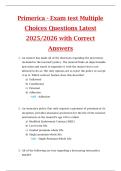
Primerica - Exam test Multiple
Choices Questions Latest
2025/2026 with Correct
Answers
1. An insurer has made all of the decisions regarding the provisions
included in the insured's policy. The insured finds an objectionable
provision and wants to negotiate it with the insurer but is not
allowed to do so. Her only options are to reject the policy or accept
it as is. Which contract feature does this describe?
a) Unilateral
b) Conditional
c) Personal
d) Adhesion
- ANS - Adhesion
2. An insurance policy that only requires a payment of premium at its
inception, provides insurance protection for the life of the insured,
and matures at the insured's age 100 is called
a) Modified Endowment Contract (MEC).
b) Level term life.
c) Graded premium whole life.
d) Single premium whole life.
- ANS - Single Premium Whole Life
3. All of the following are true regarding a decreasing term policy
EXCEPT
, a) The payable premium amount steadily declines throughout
the duration of the contract.
b) It has a lower premium than level term.
c) The contract pays only in the event of death during the term
and there is no cash value.
d) The face amount steadily declines throughout the duration of
the contract.
- ANS - The payable premium amount steadily declines
throughout the duration of the contract
4. The type of policy that can be changed from one that does not
accumulate cash value to the one that does, is a
a) Decreasing Term Policy.
b) Whole Life Policy.
c) Convertible Term Policy.
d) Renewable Term Policy.
- ANS - Convertible Term Policy
5. The policyowner of an adjustable life policy wants to increase the
death benefit. Which of the following statements is correct
regarding this change?
a) The death benefit can be increased by providing evidence of
insurability.
b) The death benefit cannot be increased.
c) The death benefit can be increased only when the policy has
developed a cash value.
d) The death benefit can be increased only by exchanging the
existing policy for a new one.
- ANS - The death benefit can be increased by providing
evidence of insurability
,6. When would a 20-pay whole life policy endow?
a) After 20 payments
b) In 20 years
c) When the insured reaches age 100
d) At the insured's age 65
- ANS - When the insured reaches age 100
7. An insured had a $10,000 term life policy. The annual premium of
$200 was due on February 1; however, the insured failed to pay the
premium. He died on February 28. How much would the beneficiary
receive from the policy?
a) $0
b) $200
c) $9,800
d) $10,000
- ANS - $9,800
8. What is the term for how frequently a policyowner is required to
pay the policy premium?
a) Consideration
b) Mode
c) Schedule
d) Grace period
- ANS - Mode
9. Which of the following types of insurance policies would perform
the function of cash accumulation?
a) Increasing term
b) Whole life
c) Term life
, d) Credit life
- ANS - Whole Life
10. Which of the following is called a "second-to-die" policy?
a) Juvenile life
b) Joint life
c) Survivorship life
d) Family income
- ANS - Survivorship Life
11. When a life insurance policy is cancelled and the insured has
selected the extended term nonforfeiture option, the cash value
will be used to purchase term insurance that has a face amount
a) In lesser amounts for the remaining policy term of age 100.
b) Equal to the cash value surrendered from the policy.
c) The same as the original policy minus the cash value.
d) Equal to the original policy for as long a period of time that
the cash values will purchase.
- ANS - Equal to the original policy for as long a period of
time that the cash values will purchase.
12. Which of the following is the best reason to purchase life
insurance rather than annuities?
a) To liquidate a sum of money over a lifetime
b) To create an estate
c) To liquidate a sum of money over a period of years
d) To create regular income payments
- ANS - To create an estate
13. Which of the following is NOT the consideration in a policy?
Choices Questions Latest
2025/2026 with Correct
Answers
1. An insurer has made all of the decisions regarding the provisions
included in the insured's policy. The insured finds an objectionable
provision and wants to negotiate it with the insurer but is not
allowed to do so. Her only options are to reject the policy or accept
it as is. Which contract feature does this describe?
a) Unilateral
b) Conditional
c) Personal
d) Adhesion
- ANS - Adhesion
2. An insurance policy that only requires a payment of premium at its
inception, provides insurance protection for the life of the insured,
and matures at the insured's age 100 is called
a) Modified Endowment Contract (MEC).
b) Level term life.
c) Graded premium whole life.
d) Single premium whole life.
- ANS - Single Premium Whole Life
3. All of the following are true regarding a decreasing term policy
EXCEPT
, a) The payable premium amount steadily declines throughout
the duration of the contract.
b) It has a lower premium than level term.
c) The contract pays only in the event of death during the term
and there is no cash value.
d) The face amount steadily declines throughout the duration of
the contract.
- ANS - The payable premium amount steadily declines
throughout the duration of the contract
4. The type of policy that can be changed from one that does not
accumulate cash value to the one that does, is a
a) Decreasing Term Policy.
b) Whole Life Policy.
c) Convertible Term Policy.
d) Renewable Term Policy.
- ANS - Convertible Term Policy
5. The policyowner of an adjustable life policy wants to increase the
death benefit. Which of the following statements is correct
regarding this change?
a) The death benefit can be increased by providing evidence of
insurability.
b) The death benefit cannot be increased.
c) The death benefit can be increased only when the policy has
developed a cash value.
d) The death benefit can be increased only by exchanging the
existing policy for a new one.
- ANS - The death benefit can be increased by providing
evidence of insurability
,6. When would a 20-pay whole life policy endow?
a) After 20 payments
b) In 20 years
c) When the insured reaches age 100
d) At the insured's age 65
- ANS - When the insured reaches age 100
7. An insured had a $10,000 term life policy. The annual premium of
$200 was due on February 1; however, the insured failed to pay the
premium. He died on February 28. How much would the beneficiary
receive from the policy?
a) $0
b) $200
c) $9,800
d) $10,000
- ANS - $9,800
8. What is the term for how frequently a policyowner is required to
pay the policy premium?
a) Consideration
b) Mode
c) Schedule
d) Grace period
- ANS - Mode
9. Which of the following types of insurance policies would perform
the function of cash accumulation?
a) Increasing term
b) Whole life
c) Term life
, d) Credit life
- ANS - Whole Life
10. Which of the following is called a "second-to-die" policy?
a) Juvenile life
b) Joint life
c) Survivorship life
d) Family income
- ANS - Survivorship Life
11. When a life insurance policy is cancelled and the insured has
selected the extended term nonforfeiture option, the cash value
will be used to purchase term insurance that has a face amount
a) In lesser amounts for the remaining policy term of age 100.
b) Equal to the cash value surrendered from the policy.
c) The same as the original policy minus the cash value.
d) Equal to the original policy for as long a period of time that
the cash values will purchase.
- ANS - Equal to the original policy for as long a period of
time that the cash values will purchase.
12. Which of the following is the best reason to purchase life
insurance rather than annuities?
a) To liquidate a sum of money over a lifetime
b) To create an estate
c) To liquidate a sum of money over a period of years
d) To create regular income payments
- ANS - To create an estate
13. Which of the following is NOT the consideration in a policy?