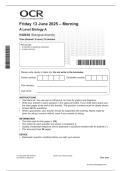
2025 OCR A Level Physics B (Advancing Physics)
H557/02 Scientific literacy in physics
Verified Question paper with Marking Scheme Attached
Oxford Cambridge and RSA
Monday 9 June 2025 – Morning A
Level Physics B (Advancing Physics) H557/02
Scientific literacy in physics
Time allowed: 2 hours 15 minutes
You must have:
• a clean copy of the Advance Notice Article (inside this
document)
• the Data, Formulae and Relationships Booklet
You can use:
• a scientific or graphical calculator
• a ruler (cm/mm)
* H 5 5 7 0 2 *
Please write clearly in black ink. Do not write in the barcodes.
Centre number Candidate number
First name(s)
Last name
INSTRUCTIONS
• Use black ink. You can use an HB pencil, but only for graphs and diagrams.
• Write your answer to each question in the space provided. If you need extra space use the
lined page at the end of this booklet. The question numbers must be clearly shown.
• Answer all the questions.
• Use the Insert to answer questions in Section C.
• Where appropriate, your answer should be supported with working. Marks might be given
for using a correct method, even if your answer is wrong.
INFORMATION
• The total mark for this paper is 100.
• The marks for each question are shown in brackets [ ].
• Quality of extended response will be assessed in questions marked with an asterisk (*).
• This document has 28 pages.
ADVICE
• Read each question carefully before you start your answer.
© OCR 2025 [601/4745/3] OCR is an exempt Charity
DC (CJ/CT) 352214/4 Turn over
, 2
SECTION A
1 This question is about measuring the sizes of atoms and using the structure of materials on a
microscopic scale to explain large‑scale properties.
(a) Fig. 1 shows an image of a sheet of gold atoms. Use the image to determine the radius of a gold atom.
Explain your choice of the number of significant figures in your answer.
Fig. 1
1.0 nm
radius = ..................................................................... m
..........................................................................................................................................................
. .................................................................................................................................................................... [3]
(b) An estimate of the radius of a gold atom can be calculated from the density of gold.
One mole of gold contains 6.02 × 10²³ atoms.
The mass of one mole of gold is 0.197 kg. The density of gold is 19 320 kg m–3.
(i) Show that there are approximately 6 × 1028 gold atoms m–3.
[2]
© OCR 2025
, 3
(ii) The manner in which the gold atoms are packed together means that only 74% of the volume of a
sample of gold is taken up by the atoms themselves. Use this percentage and your answer from (i) to
calculate the radius of a gold atom.
Assume that gold atoms are spherical.
radius of atom = ................................................................ m [2]
(c) Images of arrangements of atoms in a metal sometimes reveal dislocations in the microscopic
structure. Describe what dislocations are and how the presence of dislocations changes the properties
of the metal.
..........................................................................................................................................................
..........................................................................................................................................................
..........................................................................................................................................................
..........................................................................................................................................................
..........................................................................................................................................................
. .................................................................................................................................................................... [3]
© OCR 2025 Turn over
, 4
2 An alpha particle of kinetic energy 5.4 MeV produces 4.4 × 10⁶ ions per metre in dry air. It
transfers all its kinetic energy over 0.035 m.
(a)
(i) Show that the average energy to remove an electron from a molecule (ionisation energy) in air is less
than 6 × 10–18 J.
[2]
(ii) A free electron in air travels about 700 nm between collisions with molecules. Use your answer to (a)(i)
to calculate the strength of a uniform electric field required to give an electron sufficient kinetic energy
to ionise molecules in air.
Assume that the electron accelerates from rest for 700 nm.
field strength =......................................................... V m–1 [2]
(iii) Explain why the number of ions formed per second will initially rise at increasing rate after the first
ionisation event.
..........................................................................................................................................................
..........................................................................................................................................................
..........................................................................................................................................................
..........................................................................................................................................................
. .................................................................................................................................................................... [2]
© OCR 2025
H557/02 Scientific literacy in physics
Verified Question paper with Marking Scheme Attached
Oxford Cambridge and RSA
Monday 9 June 2025 – Morning A
Level Physics B (Advancing Physics) H557/02
Scientific literacy in physics
Time allowed: 2 hours 15 minutes
You must have:
• a clean copy of the Advance Notice Article (inside this
document)
• the Data, Formulae and Relationships Booklet
You can use:
• a scientific or graphical calculator
• a ruler (cm/mm)
* H 5 5 7 0 2 *
Please write clearly in black ink. Do not write in the barcodes.
Centre number Candidate number
First name(s)
Last name
INSTRUCTIONS
• Use black ink. You can use an HB pencil, but only for graphs and diagrams.
• Write your answer to each question in the space provided. If you need extra space use the
lined page at the end of this booklet. The question numbers must be clearly shown.
• Answer all the questions.
• Use the Insert to answer questions in Section C.
• Where appropriate, your answer should be supported with working. Marks might be given
for using a correct method, even if your answer is wrong.
INFORMATION
• The total mark for this paper is 100.
• The marks for each question are shown in brackets [ ].
• Quality of extended response will be assessed in questions marked with an asterisk (*).
• This document has 28 pages.
ADVICE
• Read each question carefully before you start your answer.
© OCR 2025 [601/4745/3] OCR is an exempt Charity
DC (CJ/CT) 352214/4 Turn over
, 2
SECTION A
1 This question is about measuring the sizes of atoms and using the structure of materials on a
microscopic scale to explain large‑scale properties.
(a) Fig. 1 shows an image of a sheet of gold atoms. Use the image to determine the radius of a gold atom.
Explain your choice of the number of significant figures in your answer.
Fig. 1
1.0 nm
radius = ..................................................................... m
..........................................................................................................................................................
. .................................................................................................................................................................... [3]
(b) An estimate of the radius of a gold atom can be calculated from the density of gold.
One mole of gold contains 6.02 × 10²³ atoms.
The mass of one mole of gold is 0.197 kg. The density of gold is 19 320 kg m–3.
(i) Show that there are approximately 6 × 1028 gold atoms m–3.
[2]
© OCR 2025
, 3
(ii) The manner in which the gold atoms are packed together means that only 74% of the volume of a
sample of gold is taken up by the atoms themselves. Use this percentage and your answer from (i) to
calculate the radius of a gold atom.
Assume that gold atoms are spherical.
radius of atom = ................................................................ m [2]
(c) Images of arrangements of atoms in a metal sometimes reveal dislocations in the microscopic
structure. Describe what dislocations are and how the presence of dislocations changes the properties
of the metal.
..........................................................................................................................................................
..........................................................................................................................................................
..........................................................................................................................................................
..........................................................................................................................................................
..........................................................................................................................................................
. .................................................................................................................................................................... [3]
© OCR 2025 Turn over
, 4
2 An alpha particle of kinetic energy 5.4 MeV produces 4.4 × 10⁶ ions per metre in dry air. It
transfers all its kinetic energy over 0.035 m.
(a)
(i) Show that the average energy to remove an electron from a molecule (ionisation energy) in air is less
than 6 × 10–18 J.
[2]
(ii) A free electron in air travels about 700 nm between collisions with molecules. Use your answer to (a)(i)
to calculate the strength of a uniform electric field required to give an electron sufficient kinetic energy
to ionise molecules in air.
Assume that the electron accelerates from rest for 700 nm.
field strength =......................................................... V m–1 [2]
(iii) Explain why the number of ions formed per second will initially rise at increasing rate after the first
ionisation event.
..........................................................................................................................................................
..........................................................................................................................................................
..........................................................................................................................................................
..........................................................................................................................................................
. .................................................................................................................................................................... [2]
© OCR 2025