Genetics summary – VU BMS 2020/2021
Simone Zweers
Reference: Brooker, Genetics: Analysis and prinicples, 7 th edition
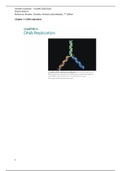
Chapter 11: DNA replication
1
, Genetics summary – VU BMS 2020/2021
Simone Zweers
Reference: Brooker, Genetics: Analysis and prinicples, 7 th edition
11.1: Structural overview of DNA replication
- DNA-replication is the process in which DNA is copied
Existing DNA strands act as template for the synthesis of new strands
- Two DNA strands come apart and serve as template (parental) strands
- Double helix separates nucleotides have access hydrogen bonding
between the template strand and the nucleotides. Covalent bond is formed
between the phosphate of one nucleotide and the sugar of the previous
nucleotide
- Two new daughter strands, both retain the same information as the original
DNA double helix
Experiment 11A
- Three different mechanisms to explain the end result of DNA replication
o Conservative model: the strands remain together
o Semiconservative model: double-stranded DNA is half conserved
o Dispersive model: parental and new DNA interspersed in both strands
- Nog verder!
11.2: Bacterial DNA replication: the formation of two
replication forks at the origin of replication
Bacterial chromosomes contain a single origin of replication
- DNA synthesis starts at the origin of replication
proceeds in both directions (bidirectionally) around the
bacterial chromosome
- Two replication forks move in opposite directions
Replication is initiated by the binding of DnaA proteins to the
origin of replication
- Origin of replication in E.Colli three types of DNA sequences are
found in the origin of replication: AT-rich region, DnaA box
sequences and GATC methylation sites
- DnaA proteins bind to sequences within the origin of replication
(DnaA boxes) bind to the five DnaA boxes to initiate DNA
replication. They bind to each other to form a complex
- Other DNA-binding proteins (HU, IHF) cause the DNA to bend
around the complex separation of the strands at the AT-rich
region (only two hydrogen bonds)
- DnaA and DnaC proteins recruit DNA helicase to this site breaks the
hydrogen bonds between the two strands
- Energy from ATP hydrolysis to catalyse the separation of the double-stranded
DNA and travel along the DNA in a 5’ to 3’ direction
- Bidirectional replication
- GATC methylation sites in the origin of replication are involved with regulation
DNA replication these sites are methylated by the enzyme Dam
- Before replication, GATC sites are methylated in both strands facilitates the
initiation of DNA replication at the origin. The new strands are not methylated
- Replication starts only after the methylation
11.3: Bacterial DNA replication: synthesis of new DNA strands
2
Simone Zweers
Reference: Brooker, Genetics: Analysis and prinicples, 7 th edition
Chapter 11: DNA replication
1
, Genetics summary – VU BMS 2020/2021
Simone Zweers
Reference: Brooker, Genetics: Analysis and prinicples, 7 th edition
11.1: Structural overview of DNA replication
- DNA-replication is the process in which DNA is copied
Existing DNA strands act as template for the synthesis of new strands
- Two DNA strands come apart and serve as template (parental) strands
- Double helix separates nucleotides have access hydrogen bonding
between the template strand and the nucleotides. Covalent bond is formed
between the phosphate of one nucleotide and the sugar of the previous
nucleotide
- Two new daughter strands, both retain the same information as the original
DNA double helix
Experiment 11A
- Three different mechanisms to explain the end result of DNA replication
o Conservative model: the strands remain together
o Semiconservative model: double-stranded DNA is half conserved
o Dispersive model: parental and new DNA interspersed in both strands
- Nog verder!
11.2: Bacterial DNA replication: the formation of two
replication forks at the origin of replication
Bacterial chromosomes contain a single origin of replication
- DNA synthesis starts at the origin of replication
proceeds in both directions (bidirectionally) around the
bacterial chromosome
- Two replication forks move in opposite directions
Replication is initiated by the binding of DnaA proteins to the
origin of replication
- Origin of replication in E.Colli three types of DNA sequences are
found in the origin of replication: AT-rich region, DnaA box
sequences and GATC methylation sites
- DnaA proteins bind to sequences within the origin of replication
(DnaA boxes) bind to the five DnaA boxes to initiate DNA
replication. They bind to each other to form a complex
- Other DNA-binding proteins (HU, IHF) cause the DNA to bend
around the complex separation of the strands at the AT-rich
region (only two hydrogen bonds)
- DnaA and DnaC proteins recruit DNA helicase to this site breaks the
hydrogen bonds between the two strands
- Energy from ATP hydrolysis to catalyse the separation of the double-stranded
DNA and travel along the DNA in a 5’ to 3’ direction
- Bidirectional replication
- GATC methylation sites in the origin of replication are involved with regulation
DNA replication these sites are methylated by the enzyme Dam
- Before replication, GATC sites are methylated in both strands facilitates the
initiation of DNA replication at the origin. The new strands are not methylated
- Replication starts only after the methylation
11.3: Bacterial DNA replication: synthesis of new DNA strands
2