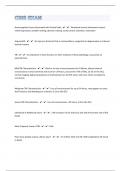
NUR 340 BUNDLED QUESTIONS WITH CORRECT ANSWERS LATEST UPDATE 2025/2026
stroke - Answers stroke
stroke - Answers alters the flow of blood to the brain
continuous - Answers the brain requires a __________ supply of blood because it provides oxygen
and glucose that neurons require.
750-1000 - Answers the brain needs ________ ml/min of blood to function correctly.
2 arteries - Answers blood supplied to the brain by __________.
nonmodifiable risk factors - Answers age
race
sex
genetics
race - Answers african/american, hispanic, native american, asian american
modifiable risk factors - Answers •HTN
•heart disease - Afib, wall motion defects
•DM
•smoking
•obesity
•sedentary lifestyle
•poor diet
•drug and alcohol use
5x - Answers you are _____ more likely to have a stroke if you have atrial fibrillation.
BEFAST - Answers noticing S/S of a stroke
Balance
Eyes
Face
,Arms
Speech
Time
balance - Answers sudden loss of balance or coordination
eyes - Answers vision loss, double vision, blurred vision
face - Answers facial drooping or numbness
Arm - Answers weak or numb arm
speech - Answers slurred, unable to speak
time - Answers call 911 immediately, note when symptoms started
CM of stroke - Answers •motor function
•communication
•affect
•intellectual function
•spacial
motor function - Answers •impairment of mobility, respiratory function, swallowing/speech, gag
reflex, self-care abilities
•Akinesia
akinesia - Answers loss of voluntary movement
communication - Answers •aphasia
•dysphasia
•dysarthria
aphasia - Answers •receptive - loss of comprehension
•expressive - inability to produce language
•global - total inability to communicate
dysphasia - Answers impaired ability to communicate
dysarthria - Answers impaired ability to control musculature with speech
, affect - Answers It can be exaggerated and unpredictable
Intellectual function - Answers Can impair memory and judgment
spatial - Answers perceptual problems
1. incorrect perception of self/illness.
2. Neglects all input from affected side.
3. agnosia
4. apraxia
agnosia - Answers the inability to recognize familiar objects.
apraxia - Answers inability to perform particular purposive actions
CM of right brain stroke - Answers • paralyzed left side
• left sided neglect
• left visual field deficit
• spatial-perceptual deficits
• tends to deny or minimize problems
• rapid performances, short attention span
• impulsive, safety issues
• impaired judgment
• impaired concept of time
CM of left brain stroke - Answers • paralyzed right side
• right visual field deficits
• impaired speech/language aphasias
• impaired right/left discriminations
• slow performance, cautious
• aware of deficits, depression, anxiety
stroke - Answers stroke
stroke - Answers alters the flow of blood to the brain
continuous - Answers the brain requires a __________ supply of blood because it provides oxygen
and glucose that neurons require.
750-1000 - Answers the brain needs ________ ml/min of blood to function correctly.
2 arteries - Answers blood supplied to the brain by __________.
nonmodifiable risk factors - Answers age
race
sex
genetics
race - Answers african/american, hispanic, native american, asian american
modifiable risk factors - Answers •HTN
•heart disease - Afib, wall motion defects
•DM
•smoking
•obesity
•sedentary lifestyle
•poor diet
•drug and alcohol use
5x - Answers you are _____ more likely to have a stroke if you have atrial fibrillation.
BEFAST - Answers noticing S/S of a stroke
Balance
Eyes
Face
,Arms
Speech
Time
balance - Answers sudden loss of balance or coordination
eyes - Answers vision loss, double vision, blurred vision
face - Answers facial drooping or numbness
Arm - Answers weak or numb arm
speech - Answers slurred, unable to speak
time - Answers call 911 immediately, note when symptoms started
CM of stroke - Answers •motor function
•communication
•affect
•intellectual function
•spacial
motor function - Answers •impairment of mobility, respiratory function, swallowing/speech, gag
reflex, self-care abilities
•Akinesia
akinesia - Answers loss of voluntary movement
communication - Answers •aphasia
•dysphasia
•dysarthria
aphasia - Answers •receptive - loss of comprehension
•expressive - inability to produce language
•global - total inability to communicate
dysphasia - Answers impaired ability to communicate
dysarthria - Answers impaired ability to control musculature with speech
, affect - Answers It can be exaggerated and unpredictable
Intellectual function - Answers Can impair memory and judgment
spatial - Answers perceptual problems
1. incorrect perception of self/illness.
2. Neglects all input from affected side.
3. agnosia
4. apraxia
agnosia - Answers the inability to recognize familiar objects.
apraxia - Answers inability to perform particular purposive actions
CM of right brain stroke - Answers • paralyzed left side
• left sided neglect
• left visual field deficit
• spatial-perceptual deficits
• tends to deny or minimize problems
• rapid performances, short attention span
• impulsive, safety issues
• impaired judgment
• impaired concept of time
CM of left brain stroke - Answers • paralyzed right side
• right visual field deficits
• impaired speech/language aphasias
• impaired right/left discriminations
• slow performance, cautious
• aware of deficits, depression, anxiety