Page 1 of 78
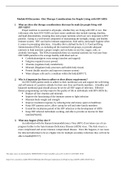
NUR 314 FINAL EXAM LATEST UPDATE
2026-2027 QUESTIONS AND DETAILED
SOLUTIONS
discrimination includes ________________, the identification of known object by touch, and
___________________, tracing a number/letter with stick and identifying number/letter
stereognosis, graphesthesia
reflexes are measured on a scale of _________; with ________ being normal
4;2
deep tendon reflexes are ______________________________, and contraction is expected.
assessed bilaterally
if contraction is diminished or absent, it is ________________ and is a 0 or 1; if contraction is
brisk or brisk and repeating (clonus), it is ___________________ and is a 3 or 4
hyporeflexia, hyperreflexia
the broca area is in the
frontal lobe
the wernicke area is in the
, Page 2 of 78
parietal lobe
the reticular formation governs
wakefulness
What is a dermatome?
specific segment of skin supplied by a single spinal nerve
trying to assess what five things when compiling subjective data
biographical info, past medical history, risk factors, medications, family history
what risks are you trying to prevent with neuro assessment
stroke and iinjury
multiple sclerosis
myelin sheath destruction. disruptions in nerve impulse conduction
parkinson
disease characterized by head nodding, bradykinesia, tremors, and shuffling gait
Alzheimer's disease
a progressive and irreversible brain disorder characterized by gradual deterioration of memory,
reasoning, language, and, finally, physical functioning
, Page 3 of 78
ALS description
affects upper and lower motor neurons.
Most common adult onset motor neuron disease
Hungtington's disease
-mutations in HTT
-dominant disorder
-severe neurodegenerative disorder
-disrupts muscle coordination, memory, concentration, mood
-onset is mid-life
Epilepsy
chronic brain disorder characterized by recurrent seizure activity
age related changes to CNS
brain dec in volume, myelinated axon length dec, cognitive changes, mobility issues, dec
sensation
african americans are _______ as likely to have a stroke than caucasians -- also more likely to
have _____________-,______________,_______________-, and ____________
twice; HTN, obesity, DM, smoking
___________ and _______________ are also at higher risk for stroke
, Page 4 of 78
hispanics, native americans
more cases of _______ in warmer climates
MS
urgent situations that call for assessment
-Acute change in mental status
-Unexplained changes in consciousness
-Seizure activity; posturing
-Pupil size changes; decreased reactivity to light in one or both pupils
-Progressing weakness or paralysis
what to do in urgent assessment for neuro
-Level of consciousness (LOC): Glasgow Coma Scale (GCS)
-Pupillary reaction
-Extremity strength
-Sensation (only possible if patient communicates)
-If consciousness is impaired
--> Extraocular movements; gag reflex; corneal reflex
Normocephalic
round symmetric skull that is appropriately related to body size
NUR 314 FINAL EXAM LATEST UPDATE
2026-2027 QUESTIONS AND DETAILED
SOLUTIONS
discrimination includes ________________, the identification of known object by touch, and
___________________, tracing a number/letter with stick and identifying number/letter
stereognosis, graphesthesia
reflexes are measured on a scale of _________; with ________ being normal
4;2
deep tendon reflexes are ______________________________, and contraction is expected.
assessed bilaterally
if contraction is diminished or absent, it is ________________ and is a 0 or 1; if contraction is
brisk or brisk and repeating (clonus), it is ___________________ and is a 3 or 4
hyporeflexia, hyperreflexia
the broca area is in the
frontal lobe
the wernicke area is in the
, Page 2 of 78
parietal lobe
the reticular formation governs
wakefulness
What is a dermatome?
specific segment of skin supplied by a single spinal nerve
trying to assess what five things when compiling subjective data
biographical info, past medical history, risk factors, medications, family history
what risks are you trying to prevent with neuro assessment
stroke and iinjury
multiple sclerosis
myelin sheath destruction. disruptions in nerve impulse conduction
parkinson
disease characterized by head nodding, bradykinesia, tremors, and shuffling gait
Alzheimer's disease
a progressive and irreversible brain disorder characterized by gradual deterioration of memory,
reasoning, language, and, finally, physical functioning
, Page 3 of 78
ALS description
affects upper and lower motor neurons.
Most common adult onset motor neuron disease
Hungtington's disease
-mutations in HTT
-dominant disorder
-severe neurodegenerative disorder
-disrupts muscle coordination, memory, concentration, mood
-onset is mid-life
Epilepsy
chronic brain disorder characterized by recurrent seizure activity
age related changes to CNS
brain dec in volume, myelinated axon length dec, cognitive changes, mobility issues, dec
sensation
african americans are _______ as likely to have a stroke than caucasians -- also more likely to
have _____________-,______________,_______________-, and ____________
twice; HTN, obesity, DM, smoking
___________ and _______________ are also at higher risk for stroke
, Page 4 of 78
hispanics, native americans
more cases of _______ in warmer climates
MS
urgent situations that call for assessment
-Acute change in mental status
-Unexplained changes in consciousness
-Seizure activity; posturing
-Pupil size changes; decreased reactivity to light in one or both pupils
-Progressing weakness or paralysis
what to do in urgent assessment for neuro
-Level of consciousness (LOC): Glasgow Coma Scale (GCS)
-Pupillary reaction
-Extremity strength
-Sensation (only possible if patient communicates)
-If consciousness is impaired
--> Extraocular movements; gag reflex; corneal reflex
Normocephalic
round symmetric skull that is appropriately related to body size