Tutorial 1: chapter 2+3
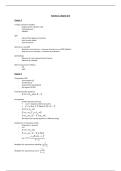
Chapter 2
3 major economic variables
- Output (and it’s growth rate)
- Unemployment
- Inflation
GDP
- Value of final goods and services
- Sum of value added
- Sum of incomes
Nominal vs. real GDP
- Nominal= current prices -> measure of prices (or use GDP deflator)
- Real= prices are constant -> measure of production
GDP deflator
- Measure for rise in general level of prices
- Measure for inflation
Other measures for inflation
- CPI
- HICP
Chapter 3
Composition GDP
- Consumption (C)
- Investment (I)
- Government spending (G)
- Net exports (X-IM)
Total demand for goods (Z)
- Z ≡C + I ea +G+ X −ℑ
Assumptions
- X=IM=0 (closed economy)
I,G,T = exogenous (fixed amounts )
C=c 0+c 1Y D with Y D≡ Y –T
- Z=C+ I ea +G
- Z=c 0 +c 1 Y D + I ea +G
- Z=c 0 +c 1 (Y −T )+ I ea +G
- Not fixed: but interest depends on different things
Equilibrium on the goods market
- Production = demand
- Y=Z
- Y =C + I ea +G
- Y =c 0+ c 1 ( Y −T ) + I +G
c 0 + I +G−c 1 T
- For Y: Y =
1−c 1
1
Multiplier for autonomous spending:
1−c 1
−c1
Multiplier for autonomous taxes:
1−c 1
, - Y=Z
- Y=C + Iea + G
But: Y = S + T + C
- S + T + C = C + Iea + G
- S + T = Iea + G
- S + (T – G) = Iea
Private + public saving = investment
What do households do with the income
- Consumption
- Taxes
- Private saving
Tutorial 2: chapter 4+5
Chapter 4
Md and Ms
- Money demand: Md= €Y L(i)
+ related to €Y
- related to i
- Money supply: determined by CB: Ms=M
- Equilibrium
Md=Ms
CB determine Ms?
- Open market transactions: buying and selling bonds
CB decreases Ms by selling bonds: decrease in bond price and increase in interest rate
CB increases Ms by buying bonds: increase in bond price and decrease in interest rate
Mechanism
- Increase Ms -> decrease interest rate
- CB typically think about interest rate they want to achieve -> and them move Ms to achieve it
Money demand
- Consist out of 2 parts
1. Demand for currency (CUd)
2. Demand for deposits (Dd)
- Suppose Cud=0, hence: Md = Dd
- Increase in deposits -> leads to increase in bank reserves
R=θD
Demand for reserves by banks: Rd = θMd
- Demand for CB money: Hd = CUd + Rd
Hd = 0 + θMd
Hd = θMd = θ €Y L(i)
- Supply of CB money: H (monetary base)
Equilibrium
- H=Hd
Supply CB money = demand CB money
- H = θ €Y L(i)
- H/ θ = €Y L(i)
- M = €Y L(i) (Ms = Md)
Notice that: M = H/θ ->Ms is larger than monetary base
- Money multiplier = 1/ θ (given that there is no currency)
Chapter 2
3 major economic variables
- Output (and it’s growth rate)
- Unemployment
- Inflation
GDP
- Value of final goods and services
- Sum of value added
- Sum of incomes
Nominal vs. real GDP
- Nominal= current prices -> measure of prices (or use GDP deflator)
- Real= prices are constant -> measure of production
GDP deflator
- Measure for rise in general level of prices
- Measure for inflation
Other measures for inflation
- CPI
- HICP
Chapter 3
Composition GDP
- Consumption (C)
- Investment (I)
- Government spending (G)
- Net exports (X-IM)
Total demand for goods (Z)
- Z ≡C + I ea +G+ X −ℑ
Assumptions
- X=IM=0 (closed economy)
I,G,T = exogenous (fixed amounts )
C=c 0+c 1Y D with Y D≡ Y –T
- Z=C+ I ea +G
- Z=c 0 +c 1 Y D + I ea +G
- Z=c 0 +c 1 (Y −T )+ I ea +G
- Not fixed: but interest depends on different things
Equilibrium on the goods market
- Production = demand
- Y=Z
- Y =C + I ea +G
- Y =c 0+ c 1 ( Y −T ) + I +G
c 0 + I +G−c 1 T
- For Y: Y =
1−c 1
1
Multiplier for autonomous spending:
1−c 1
−c1
Multiplier for autonomous taxes:
1−c 1
, - Y=Z
- Y=C + Iea + G
But: Y = S + T + C
- S + T + C = C + Iea + G
- S + T = Iea + G
- S + (T – G) = Iea
Private + public saving = investment
What do households do with the income
- Consumption
- Taxes
- Private saving
Tutorial 2: chapter 4+5
Chapter 4
Md and Ms
- Money demand: Md= €Y L(i)
+ related to €Y
- related to i
- Money supply: determined by CB: Ms=M
- Equilibrium
Md=Ms
CB determine Ms?
- Open market transactions: buying and selling bonds
CB decreases Ms by selling bonds: decrease in bond price and increase in interest rate
CB increases Ms by buying bonds: increase in bond price and decrease in interest rate
Mechanism
- Increase Ms -> decrease interest rate
- CB typically think about interest rate they want to achieve -> and them move Ms to achieve it
Money demand
- Consist out of 2 parts
1. Demand for currency (CUd)
2. Demand for deposits (Dd)
- Suppose Cud=0, hence: Md = Dd
- Increase in deposits -> leads to increase in bank reserves
R=θD
Demand for reserves by banks: Rd = θMd
- Demand for CB money: Hd = CUd + Rd
Hd = 0 + θMd
Hd = θMd = θ €Y L(i)
- Supply of CB money: H (monetary base)
Equilibrium
- H=Hd
Supply CB money = demand CB money
- H = θ €Y L(i)
- H/ θ = €Y L(i)
- M = €Y L(i) (Ms = Md)
Notice that: M = H/θ ->Ms is larger than monetary base
- Money multiplier = 1/ θ (given that there is no currency)