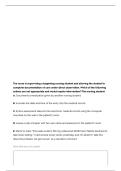
The nurse is supervising a beginning nursing student and allowing the student to
complete documentation of care under direct observation. Which of the following
actions are not appropriate and would require intervention? The nursing student:
A. Documents a medication given by another nursing student.
B. Includes the date and time of the entry into the medical record.
C. Enters assessment data into the electronic medical record using the computer
mounted on the wall in the patient’s room.
D. Leaves a slip of paper with her user name and password in the patient’s room.
E. Starts to enter “Docusate sodium 100 mg ordered at 08:00 held. Patient declined to
take dose stating, “I had several loose stools yesterday, and I’m afraid if I take this
dose the problem will get worse,” as a narrative comment.
Give this one a try later!
, A, D
Nurses only document the care they provide; entries in the chart need to
be dated, timed, and signed. Personal passwords used to access an
electronic medical record need to be kept secure to provide for safety and
confidentiality of patient information. All of the other actions are
appropriate for documentation.
A registered nurse performs the following four steps in delegating a task to a
nursing assistant. Place the steps in the order of appropriate delegation. 1. Do you
have any questions about walking Mr. Malone? 2. Before you take him for his walk
to the end of the hallway and back, please take and record his pulse rate. 3. In the
next 30 minutes please assist Mr. Malone in room 418 with her afternoon walk. 4. I
will make sure that I check with you in about 40 minutes to see how the patient did.
Give this one a try later!
• 3, 2, 4, 1
This is the sequence for effective delegation. The nurse delegated the task
of walking a patient to the nursing assistant, which is in the scope of the
nursing assistant’s duties and responsibilities and matched to his skill level.
The nurse provided clear directions by describing the task (the walk, taking
and recording the pulse), the desired outcome (walk to the end of the
hallway and back), and the time period (within the next 30 minutes). The
nurse then told the nursing assistant that she would follow up with him to
check how the patient did. By asking the nursing assistant if he had any
questions, the nurse provided him an opportunity to ask questions for
clarification.
Polypharmacy
Give this one a try later!
, The use of many different drugs concurrently in treating a patient, who
often has several health problems.
A 63-year-old patient is retiring from his job at an accounting firm where he was in
a management role for the past 20 years. He has been with the same company for
42 years and was a dedicated employee. His wife is a homemaker. She raised their
five children, babysits for her grandchildren as needed, and belongs to numerous
church committees. What are the major concerns for this patient?
Give this one a try later!
*The loss of his work role
*How the wife expects household tasks to be divided in the home in
retirement
The psychosocial stresses of retirement are usually related to role changes
with a spouse or within the family and to loss of the work role. Often there
are new expectations of the retired person. This patient is not likely to
become socially isolated because of the size of the family. Whether the
wife will have to work is not a major concern at this time nor is the age of
the patient.
Health Promotion and Maintenance: Physiological Concerns for older adults-Cancer
Give this one a try later!
• Cancer second most common cause of death
• Nurses educate older adults about early detection, treatment, and cancer
risk factors.
• Non-healing skin lesions
• Unexpected bleeding,
• Change in bowel habits
• Nagging cough
• Lump in breast or another part of body
, • Change in a mole
• Difficulty swallowing, and unexplained weight loss
z track method
Give this one a try later!
-Minimizes skin irritation by locking med in the muscle tissue
-Change needle after drawing up med
-Use the ulnar side of non dominant hand to pull tissue 2-3 cm (1-1.2 inches)
laterally
-Aspirate to ensure no blood return (CDC now says no to this-follow
agency policy
-Hold needle in place foe 10 seconds
-Withdrawal needle and release skin
Health Promotion in older adults-Falls
Give this one a try later!
• Can result if hip, leg, spine pelvic fractures
• Assess home environment for risks, OT and PT consults for strengthening,
encourage cane or walker as appropriate
A nursing student is caring for a 78-year-old patient with multiple sclerosis. The
patient has had an indwelling Foley catheter in for 3 days. Eight hours ago the
patient’s temperature was 37.1° C (98.8° F). The student reports her recent
assessment to the registered nurse (RN): the patient’s temperature is 37.2° C (99° F);
the Foley catheter is still in place, draining dark urine; and the patient is uncertain
what time of day it is. From what the RN knows about presentation of symptoms in
older adults, what should he recommend first?
complete documentation of care under direct observation. Which of the following
actions are not appropriate and would require intervention? The nursing student:
A. Documents a medication given by another nursing student.
B. Includes the date and time of the entry into the medical record.
C. Enters assessment data into the electronic medical record using the computer
mounted on the wall in the patient’s room.
D. Leaves a slip of paper with her user name and password in the patient’s room.
E. Starts to enter “Docusate sodium 100 mg ordered at 08:00 held. Patient declined to
take dose stating, “I had several loose stools yesterday, and I’m afraid if I take this
dose the problem will get worse,” as a narrative comment.
Give this one a try later!
, A, D
Nurses only document the care they provide; entries in the chart need to
be dated, timed, and signed. Personal passwords used to access an
electronic medical record need to be kept secure to provide for safety and
confidentiality of patient information. All of the other actions are
appropriate for documentation.
A registered nurse performs the following four steps in delegating a task to a
nursing assistant. Place the steps in the order of appropriate delegation. 1. Do you
have any questions about walking Mr. Malone? 2. Before you take him for his walk
to the end of the hallway and back, please take and record his pulse rate. 3. In the
next 30 minutes please assist Mr. Malone in room 418 with her afternoon walk. 4. I
will make sure that I check with you in about 40 minutes to see how the patient did.
Give this one a try later!
• 3, 2, 4, 1
This is the sequence for effective delegation. The nurse delegated the task
of walking a patient to the nursing assistant, which is in the scope of the
nursing assistant’s duties and responsibilities and matched to his skill level.
The nurse provided clear directions by describing the task (the walk, taking
and recording the pulse), the desired outcome (walk to the end of the
hallway and back), and the time period (within the next 30 minutes). The
nurse then told the nursing assistant that she would follow up with him to
check how the patient did. By asking the nursing assistant if he had any
questions, the nurse provided him an opportunity to ask questions for
clarification.
Polypharmacy
Give this one a try later!
, The use of many different drugs concurrently in treating a patient, who
often has several health problems.
A 63-year-old patient is retiring from his job at an accounting firm where he was in
a management role for the past 20 years. He has been with the same company for
42 years and was a dedicated employee. His wife is a homemaker. She raised their
five children, babysits for her grandchildren as needed, and belongs to numerous
church committees. What are the major concerns for this patient?
Give this one a try later!
*The loss of his work role
*How the wife expects household tasks to be divided in the home in
retirement
The psychosocial stresses of retirement are usually related to role changes
with a spouse or within the family and to loss of the work role. Often there
are new expectations of the retired person. This patient is not likely to
become socially isolated because of the size of the family. Whether the
wife will have to work is not a major concern at this time nor is the age of
the patient.
Health Promotion and Maintenance: Physiological Concerns for older adults-Cancer
Give this one a try later!
• Cancer second most common cause of death
• Nurses educate older adults about early detection, treatment, and cancer
risk factors.
• Non-healing skin lesions
• Unexpected bleeding,
• Change in bowel habits
• Nagging cough
• Lump in breast or another part of body
, • Change in a mole
• Difficulty swallowing, and unexplained weight loss
z track method
Give this one a try later!
-Minimizes skin irritation by locking med in the muscle tissue
-Change needle after drawing up med
-Use the ulnar side of non dominant hand to pull tissue 2-3 cm (1-1.2 inches)
laterally
-Aspirate to ensure no blood return (CDC now says no to this-follow
agency policy
-Hold needle in place foe 10 seconds
-Withdrawal needle and release skin
Health Promotion in older adults-Falls
Give this one a try later!
• Can result if hip, leg, spine pelvic fractures
• Assess home environment for risks, OT and PT consults for strengthening,
encourage cane or walker as appropriate
A nursing student is caring for a 78-year-old patient with multiple sclerosis. The
patient has had an indwelling Foley catheter in for 3 days. Eight hours ago the
patient’s temperature was 37.1° C (98.8° F). The student reports her recent
assessment to the registered nurse (RN): the patient’s temperature is 37.2° C (99° F);
the Foley catheter is still in place, draining dark urine; and the patient is uncertain
what time of day it is. From what the RN knows about presentation of symptoms in
older adults, what should he recommend first?