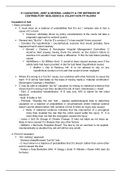
01 CAUSATION, JOINT & SEVERAL LIABILITY & THE DEFENCES OF
CONTRIBUTORY NEGLIGENCE & VOLENTI NON FIT INJURIA
Causation in fact
1. Basic principles
C must show on a balance of probabilities that D’s act / omission was in fact a
cause of C’s harm
However, ultimately driven by policy considerations & the courts will take a
pragmatic approach to achieve justice
General test: “But for” – But for D’s conduct, C’s loss wouldn’t have occurred
- Consider the hypothetical / counterfactual scenario that would probably have
happened had D acted carefully
Barnett v Chelsea & Kensington Hospital Management Committee: C
would’ve died anyway having drunk the arsenic so the doctor’s failure to
examine him wouldn’t have made a difference But for test failed (existing
cause)
McWilliams v Sir William Arrol: C would’ve been injured anyway even if the
safety belts had been provided But for test failed (hypothetical cause)
Bolitho v City & Hackney HA: D is not allowed to rely on any
hypothetical conduct on his part that would’ve been negligent
Where D’s wrong is a “but for” cause, but combines with other factor(s) to cause the
harm D will be held liable on the basis of having made a “material contribution”
(Bonnington Castings v Wardlaw)
C may be able to establish “but for” causation by relying on statistical evidence that
shows that D’s wrong more than doubled the risk of harm (Sienkiewicz v Grief)
- Fact: C contracted mesothelioma D was only 18% to blame for the initial
exposure
- Held: D liable in full
- Principle: “Doubles the risk” test – Applies epidemiological data to determine
causation on a balance of probabilities in circumstances where medical science
doesn’t permit determination with certainty of how & when an injury was caused
Ratio: If statistical evidence indicates that the intervention of a wrongdoer
more than doubled the risk that the victim would suffer the injury It is
more likely than not that the wrongdoer caused the injury
- Jones v SoS for Energy & Climate Change: D held not liable as not twice as
likely to have caused C’s disease than any other factors
- Williams v Bermuda Hospitals Board: The test is not an exercise to be applied
mechanistically (a doubled tiny risk will still be very small)
2. Proof of causation
“All / nothing” approach
- General straightforward “but for” test
- C must show on a balance of probabilities that D’s breach (rather than some other
event) caused the loss
- Hotson v East Berkshire AHA Gregg v Scott Wilsher v Essex AHA (see (6)
for facts)
, “Material contribution” approach
- Bonnington Castings v Wardlaw
Fact: C contracted a lung disease from a cumulative combination of non-
tortious & tortious dust from his workplace, of which the tortious dust was in
the minority
Held: D liable (the tortious dust contributed to a tipping point towards
contracting the disease)
Principle:
Onus lies with C to prove that D’s fault on the balance of probabilities
materially contributed his injury (no need to show that it was the sole /
dominant cause)
What is “material” is a question of degree on the facts of each case
- Bailey v MoD
Fact: C was cared for negligently post-operation & resulted in brain damage
Held: Hospital liable
Principle: For cumulative cause cases which produce indivisible harm, where
medical science cannot establish the evidence needed to apply the “but for”
test Sufficient to show that D’s conduct materially contributed to the injury
- McGhee v National Coal Board
Fact: C contracted dermatitis due to D’s failure to provide washing facilities
Held: D liable (material contribution)
Principle: For cumulative cause cases, the mere presence of an above de
minimis tortious factor among the cumulative causes is enough
The interpretation of “material contribution” as an exception to the “but
for” test
- Where there are cumulative causes, it matters not whether they are concurrent /
successive (Williams v Bermuda Hospitals Board)
- Where the harm is indivisible, D who has tortiously contributed to the cause will be
liable in full; Where the harm is divisible, D will be liable in respect of the share of
the harm for which he is responsible (Sienkiewicz v Grief)
“Material increase in risk” approach
- McGhee v National Coal Board: Sufficient to show that D’s wrong materially
increased the risk of harm
- Doesn’t apply where D’s negligent act increases the risk of harm but there are
other (non-tortious) factors which may have caused the harm
Wilsher v Essex AHA
Fact: A baby was given excess oxygen by a junior doctor & suffered
eye condition as a result
Held: D not liable (numerous possibilities)
3. Apportionment
Where more than 1 D is liable for a particular harm Each is liable in full for that
harm (the risk of insolvency is borne amongst Ds, not C)
Where D’s wrong is not on its own sufficient but combined with a non-tortious factor
caused the harm D is liable in full
, Apportionment will not be justified in cases of a single indivisible injury
Claims for the aggravation of an existing harm
- D2 is only liable for the additional loss he has caused
Claims for the advancement of a harm that would’ve occurred non-tortiously at a
later date (Bonnington Castings v Wardlaw)
Claims where separate negligent acts of D1 & D2 each caused a distinct harm to C
- Rahman v Arearose
Fact: An employee was assaulted at work & sustained eye injuries A
hospital later negligently treated the eyes & caused blindness
Held: Damages apportioned (distinct injuries)
Principle: Whether the harms are distinct / divisible is a question of fact’
A special apportionment rule has been adopted in the case of cumulatively caused
industrial injuries
- Holtby v Brigham & Cowan
Fact: C was exposed to asbestos while for working for different employers
(including D for 12 years) & developed asbestosis (a disease that gets
progressively worse with on-going exposure)
Held: D liable, but damages reduced (D only liable in proportion to the
exposure he had actually caused)
Principle: Responsibility for the development of cumulatively caused
industrial diseases is divided between successive employers on a “time-
exposure” basis
Claims in respect of indivisible injuries based on Fairchild: A further special
apportionment rule applies here
- Fairchild v Glenhaven Funeral Services
Fact: C contracted mesothelioma (the risk of which cannot be attributed
cumulatively) having worked for different employers
Held: All employers jointly liable (material increase in risk, not cumulative)
Affirmed McGhee v National Coal Board
- Barker v Corus
Fact: C contracted mesothelioma due to exposure to asbestos in the course
of employment with several employers & self-employment
Held: Fairchild applies even where there is a period of self-employment
However, cases like Fairchild should impose several liability, not joint
liability Apportionment Overruled by Compensation Act 2006, s
3 in relation to mesothelioma cases but still applies to non-
mesothelioma cases (Heneghan v Manchester Dry Docks)
Compensation Act 2006, s 3
- Damages are not to be apportioned in mesothelioma cases
D liable in full; Liability exists “jointly & severally” with any other D
responsible
- Confirmed in International Energy Group v Zurich Insurance
CONTRIBUTORY NEGLIGENCE & VOLENTI NON FIT INJURIA
Causation in fact
1. Basic principles
C must show on a balance of probabilities that D’s act / omission was in fact a
cause of C’s harm
However, ultimately driven by policy considerations & the courts will take a
pragmatic approach to achieve justice
General test: “But for” – But for D’s conduct, C’s loss wouldn’t have occurred
- Consider the hypothetical / counterfactual scenario that would probably have
happened had D acted carefully
Barnett v Chelsea & Kensington Hospital Management Committee: C
would’ve died anyway having drunk the arsenic so the doctor’s failure to
examine him wouldn’t have made a difference But for test failed (existing
cause)
McWilliams v Sir William Arrol: C would’ve been injured anyway even if the
safety belts had been provided But for test failed (hypothetical cause)
Bolitho v City & Hackney HA: D is not allowed to rely on any
hypothetical conduct on his part that would’ve been negligent
Where D’s wrong is a “but for” cause, but combines with other factor(s) to cause the
harm D will be held liable on the basis of having made a “material contribution”
(Bonnington Castings v Wardlaw)
C may be able to establish “but for” causation by relying on statistical evidence that
shows that D’s wrong more than doubled the risk of harm (Sienkiewicz v Grief)
- Fact: C contracted mesothelioma D was only 18% to blame for the initial
exposure
- Held: D liable in full
- Principle: “Doubles the risk” test – Applies epidemiological data to determine
causation on a balance of probabilities in circumstances where medical science
doesn’t permit determination with certainty of how & when an injury was caused
Ratio: If statistical evidence indicates that the intervention of a wrongdoer
more than doubled the risk that the victim would suffer the injury It is
more likely than not that the wrongdoer caused the injury
- Jones v SoS for Energy & Climate Change: D held not liable as not twice as
likely to have caused C’s disease than any other factors
- Williams v Bermuda Hospitals Board: The test is not an exercise to be applied
mechanistically (a doubled tiny risk will still be very small)
2. Proof of causation
“All / nothing” approach
- General straightforward “but for” test
- C must show on a balance of probabilities that D’s breach (rather than some other
event) caused the loss
- Hotson v East Berkshire AHA Gregg v Scott Wilsher v Essex AHA (see (6)
for facts)
, “Material contribution” approach
- Bonnington Castings v Wardlaw
Fact: C contracted a lung disease from a cumulative combination of non-
tortious & tortious dust from his workplace, of which the tortious dust was in
the minority
Held: D liable (the tortious dust contributed to a tipping point towards
contracting the disease)
Principle:
Onus lies with C to prove that D’s fault on the balance of probabilities
materially contributed his injury (no need to show that it was the sole /
dominant cause)
What is “material” is a question of degree on the facts of each case
- Bailey v MoD
Fact: C was cared for negligently post-operation & resulted in brain damage
Held: Hospital liable
Principle: For cumulative cause cases which produce indivisible harm, where
medical science cannot establish the evidence needed to apply the “but for”
test Sufficient to show that D’s conduct materially contributed to the injury
- McGhee v National Coal Board
Fact: C contracted dermatitis due to D’s failure to provide washing facilities
Held: D liable (material contribution)
Principle: For cumulative cause cases, the mere presence of an above de
minimis tortious factor among the cumulative causes is enough
The interpretation of “material contribution” as an exception to the “but
for” test
- Where there are cumulative causes, it matters not whether they are concurrent /
successive (Williams v Bermuda Hospitals Board)
- Where the harm is indivisible, D who has tortiously contributed to the cause will be
liable in full; Where the harm is divisible, D will be liable in respect of the share of
the harm for which he is responsible (Sienkiewicz v Grief)
“Material increase in risk” approach
- McGhee v National Coal Board: Sufficient to show that D’s wrong materially
increased the risk of harm
- Doesn’t apply where D’s negligent act increases the risk of harm but there are
other (non-tortious) factors which may have caused the harm
Wilsher v Essex AHA
Fact: A baby was given excess oxygen by a junior doctor & suffered
eye condition as a result
Held: D not liable (numerous possibilities)
3. Apportionment
Where more than 1 D is liable for a particular harm Each is liable in full for that
harm (the risk of insolvency is borne amongst Ds, not C)
Where D’s wrong is not on its own sufficient but combined with a non-tortious factor
caused the harm D is liable in full
, Apportionment will not be justified in cases of a single indivisible injury
Claims for the aggravation of an existing harm
- D2 is only liable for the additional loss he has caused
Claims for the advancement of a harm that would’ve occurred non-tortiously at a
later date (Bonnington Castings v Wardlaw)
Claims where separate negligent acts of D1 & D2 each caused a distinct harm to C
- Rahman v Arearose
Fact: An employee was assaulted at work & sustained eye injuries A
hospital later negligently treated the eyes & caused blindness
Held: Damages apportioned (distinct injuries)
Principle: Whether the harms are distinct / divisible is a question of fact’
A special apportionment rule has been adopted in the case of cumulatively caused
industrial injuries
- Holtby v Brigham & Cowan
Fact: C was exposed to asbestos while for working for different employers
(including D for 12 years) & developed asbestosis (a disease that gets
progressively worse with on-going exposure)
Held: D liable, but damages reduced (D only liable in proportion to the
exposure he had actually caused)
Principle: Responsibility for the development of cumulatively caused
industrial diseases is divided between successive employers on a “time-
exposure” basis
Claims in respect of indivisible injuries based on Fairchild: A further special
apportionment rule applies here
- Fairchild v Glenhaven Funeral Services
Fact: C contracted mesothelioma (the risk of which cannot be attributed
cumulatively) having worked for different employers
Held: All employers jointly liable (material increase in risk, not cumulative)
Affirmed McGhee v National Coal Board
- Barker v Corus
Fact: C contracted mesothelioma due to exposure to asbestos in the course
of employment with several employers & self-employment
Held: Fairchild applies even where there is a period of self-employment
However, cases like Fairchild should impose several liability, not joint
liability Apportionment Overruled by Compensation Act 2006, s
3 in relation to mesothelioma cases but still applies to non-
mesothelioma cases (Heneghan v Manchester Dry Docks)
Compensation Act 2006, s 3
- Damages are not to be apportioned in mesothelioma cases
D liable in full; Liability exists “jointly & severally” with any other D
responsible
- Confirmed in International Energy Group v Zurich Insurance