NR 605 WEEK 5 FINAL STUDY GUIDE
Study online at https://quizlet.com/_ft628k
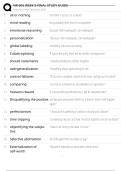
1. all or nothing I'm either a success or a failure."
2. mind reading they probably think that I'm incompetent
3. emotional reasoning because I feel inadequate I am inadequate
4. personalization "Because I feel inadequate, I am inadequate."
5. global labeling everything I do turns out wrong
6. Catastrophizing If I go to the party, there will be terrible consequences."
7. should statements I should probably be a better daughter
8. overgeneralization "Everything always goes wrong for me.
9. control fallacies "If I'm not in complete control all the time, I will go out of control."
10. comparing I am not as competent as my coworkers or supervisors."
11. heavens reward If I do everything perfectly here, I will be rewarded later."
12. Disqualifying the positive Just because one person liked me, it doesn't mean it will happen
again."
13. perfectionism "I must do this perfectly or I will be criticized and a failure."
14. time tripping I screwed up my past and now I must be vigilant to secure my future."
15. objectifying the subjec- I have to be funny to be liked. It is fact."
tive
16. Selective abstraction All of the good men are taken or gay."
17. Externalization of "My worth depends on what others think of me."
self-worth
, NR 605 WEEK 5 FINAL STUDY GUIDE
Study online at https://quizlet.com/_ft628k
18. Fallacy of the change of If everyone would just follow the rules I would feel happier/feel better."
others
19. Ostrich technique If I ignore it, maybe it will go away."
20. Unrealistic expectations I must be the best absolutely all of the time."
21. Filtering "I tend to focus on the negative details while I ignore and filter out all
the positive aspects of a situation."
22. Being right I must prove that I am right as being wrong is unthinkable."
23. fallacy of attachment "I can't live without a partner." "If I was in a relationship, all of my
problems would be solved."
24. fallacy of perfect effect "If I do things perfectly, the results will be perfect.
25. Cognitive distortions are irrational or biased ways of thinking that can negatively influence
a person's perception of reality. These patterns of thinking can lead to
distorted views of oneself, others, or the world, and are often asso-
ciated with anxiety, depression, and other mental health challenges.
_____ can cause people to interpret situations in overly negative or
self-defeating ways, often amplifying stress or emotional distress.
26. CBT is based on the belief on how well a person is able to positively adapt, both cognitively and
that psychological health functionally, to changing conditions and situations in the environment.
depends
27. What stabilization tech- Socratic Dialogue is the hallmark of CBT and helps facilitate guided
nique is the hallmark of discovery. Therapist guides the client through a series of questions and
CBT and explain more... answers to draw out the client's automatic thoughts and assumptions
to collaboratively examine the logic underlying the assumptions and
to identify thought processes that may be creating problems for the
Study online at https://quizlet.com/_ft628k
1. all or nothing I'm either a success or a failure."
2. mind reading they probably think that I'm incompetent
3. emotional reasoning because I feel inadequate I am inadequate
4. personalization "Because I feel inadequate, I am inadequate."
5. global labeling everything I do turns out wrong
6. Catastrophizing If I go to the party, there will be terrible consequences."
7. should statements I should probably be a better daughter
8. overgeneralization "Everything always goes wrong for me.
9. control fallacies "If I'm not in complete control all the time, I will go out of control."
10. comparing I am not as competent as my coworkers or supervisors."
11. heavens reward If I do everything perfectly here, I will be rewarded later."
12. Disqualifying the positive Just because one person liked me, it doesn't mean it will happen
again."
13. perfectionism "I must do this perfectly or I will be criticized and a failure."
14. time tripping I screwed up my past and now I must be vigilant to secure my future."
15. objectifying the subjec- I have to be funny to be liked. It is fact."
tive
16. Selective abstraction All of the good men are taken or gay."
17. Externalization of "My worth depends on what others think of me."
self-worth
, NR 605 WEEK 5 FINAL STUDY GUIDE
Study online at https://quizlet.com/_ft628k
18. Fallacy of the change of If everyone would just follow the rules I would feel happier/feel better."
others
19. Ostrich technique If I ignore it, maybe it will go away."
20. Unrealistic expectations I must be the best absolutely all of the time."
21. Filtering "I tend to focus on the negative details while I ignore and filter out all
the positive aspects of a situation."
22. Being right I must prove that I am right as being wrong is unthinkable."
23. fallacy of attachment "I can't live without a partner." "If I was in a relationship, all of my
problems would be solved."
24. fallacy of perfect effect "If I do things perfectly, the results will be perfect.
25. Cognitive distortions are irrational or biased ways of thinking that can negatively influence
a person's perception of reality. These patterns of thinking can lead to
distorted views of oneself, others, or the world, and are often asso-
ciated with anxiety, depression, and other mental health challenges.
_____ can cause people to interpret situations in overly negative or
self-defeating ways, often amplifying stress or emotional distress.
26. CBT is based on the belief on how well a person is able to positively adapt, both cognitively and
that psychological health functionally, to changing conditions and situations in the environment.
depends
27. What stabilization tech- Socratic Dialogue is the hallmark of CBT and helps facilitate guided
nique is the hallmark of discovery. Therapist guides the client through a series of questions and
CBT and explain more... answers to draw out the client's automatic thoughts and assumptions
to collaboratively examine the logic underlying the assumptions and
to identify thought processes that may be creating problems for the