Chapter 3 Operations Strategy
What is strategy and what is operations strategy?
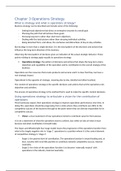
Business strategy can be described and include some of the following:
- Setting broad objectives that direct an enterprise towards its overall goal.
- Planning the path that will achieve these goals.
- Stressing long-term rather than short-term objectives.
- Dealing with the total picture rather than stressing individual activities.
- Being detached from, and above, the confusion and distractions of day-to-day activities.
But strategy is more than a single decision: it is the total pattern of the decisions and actions that
influence the long-term direction of the business.
Observing the total pattern of decisions gives an indication of the actual strategic behavior. These
points relating to strategy apply equally to operations strategy.
Operations strategy: the pattern of decisions and actions that shape the long-term vision,
objectives and capabilities of the operation and its contribution to the overall strategy of the
business.
Operations are the resources that create products and services and it is clear that they can have a
real strategic impact.
Operational is the opposite of strategic, meaning day-to-day, detailed and often localized.
The content of operations strategy is the specific decisions and actions that set the operations role,
objectives and activities.
The process of operations strategy is the method that is used to make the specific content decisions.
Using operations strategy to articulate a vision for the contribution of
operations
Most businesses expect their operations strategy to improve operations performance over time. In
doing this, operations should be progressing from a state where they contribute very little to the
competitive success of the business through to the point where they are directly responsible for its
competitive success.
Vision: a clear statement of how operations intend to contribute value for the business.
It is not a statement of what the operations want to achieve, but rather an idea of what it must
become and what contribution it should make.
The Hayes and Wheelwright four-stage model traces the progression of the operations function from
what is the largely negative role in ‘stage 1’ operations to a position where it is the central element
of competitive strategy in ‘stage 4’.
- Stage 1: the poorest level of contribution. The operations function is inward-looking and, at
best, reactive with very little positive to contribute towards competitive success. Internal
neutrality.
- Stage 2: the vision of the operations function is to become ‘externally neutral’ with
operations in the industry. External neutrality.
, - Stage 3: have typically reached the ‘first division’ of their markets. The operation is trying to
be ‘internally supportive’ by providing a credible operations strategy. Internally supportive.
- Stage 4: the operations function is one that is proving the foundation for an organization’s
competitive success. Operations are innovative, creative and proactive and are driving the
company’s strategy by being ‘one step ahead’ of competitors. Externally supportive.
The four perspectives on operations strategy
1. Operations strategy should align with what the whole group or business wants – sometimes
called the ‘top-down’ perspective.
2. Operations strategy should translate the enterprise’s intended market position so as to
provide the required objectives for operations decisions – sometimes called the ‘outside-in’
perspective.
3. Operations strategy should learn from day-to-day activities so as to cumulatively build
strategic capabilities – sometimes called the ‘bottom-up’ perspective.
4. Operations strategy should develop the business’s resources and processes so that its
capabilities can be exploited in its
chosen markets – sometimes
called the ‘inside-out’ perspective.
What is strategy and what is operations strategy?
Business strategy can be described and include some of the following:
- Setting broad objectives that direct an enterprise towards its overall goal.
- Planning the path that will achieve these goals.
- Stressing long-term rather than short-term objectives.
- Dealing with the total picture rather than stressing individual activities.
- Being detached from, and above, the confusion and distractions of day-to-day activities.
But strategy is more than a single decision: it is the total pattern of the decisions and actions that
influence the long-term direction of the business.
Observing the total pattern of decisions gives an indication of the actual strategic behavior. These
points relating to strategy apply equally to operations strategy.
Operations strategy: the pattern of decisions and actions that shape the long-term vision,
objectives and capabilities of the operation and its contribution to the overall strategy of the
business.
Operations are the resources that create products and services and it is clear that they can have a
real strategic impact.
Operational is the opposite of strategic, meaning day-to-day, detailed and often localized.
The content of operations strategy is the specific decisions and actions that set the operations role,
objectives and activities.
The process of operations strategy is the method that is used to make the specific content decisions.
Using operations strategy to articulate a vision for the contribution of
operations
Most businesses expect their operations strategy to improve operations performance over time. In
doing this, operations should be progressing from a state where they contribute very little to the
competitive success of the business through to the point where they are directly responsible for its
competitive success.
Vision: a clear statement of how operations intend to contribute value for the business.
It is not a statement of what the operations want to achieve, but rather an idea of what it must
become and what contribution it should make.
The Hayes and Wheelwright four-stage model traces the progression of the operations function from
what is the largely negative role in ‘stage 1’ operations to a position where it is the central element
of competitive strategy in ‘stage 4’.
- Stage 1: the poorest level of contribution. The operations function is inward-looking and, at
best, reactive with very little positive to contribute towards competitive success. Internal
neutrality.
- Stage 2: the vision of the operations function is to become ‘externally neutral’ with
operations in the industry. External neutrality.
, - Stage 3: have typically reached the ‘first division’ of their markets. The operation is trying to
be ‘internally supportive’ by providing a credible operations strategy. Internally supportive.
- Stage 4: the operations function is one that is proving the foundation for an organization’s
competitive success. Operations are innovative, creative and proactive and are driving the
company’s strategy by being ‘one step ahead’ of competitors. Externally supportive.
The four perspectives on operations strategy
1. Operations strategy should align with what the whole group or business wants – sometimes
called the ‘top-down’ perspective.
2. Operations strategy should translate the enterprise’s intended market position so as to
provide the required objectives for operations decisions – sometimes called the ‘outside-in’
perspective.
3. Operations strategy should learn from day-to-day activities so as to cumulatively build
strategic capabilities – sometimes called the ‘bottom-up’ perspective.
4. Operations strategy should develop the business’s resources and processes so that its
capabilities can be exploited in its
chosen markets – sometimes
called the ‘inside-out’ perspective.