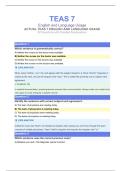
TEAS 7
English and Language Usage
ACTUAL TEAS 7 ENGLISH AND LANGUAGE USAGE
50 Questions with Detailed Explanations
OF STANDARD ENGL (2025/2026) (2025/2026)ISH
Questions 1-20 | Grammar, Punctuation, Spelling
Question 1
Which sentence is grammatically correct?
A) Neither the nurses nor the doctor were available.
B) Neither the nurses nor the doctor was available.
C) Neither the nurse nor the doctors was available.
D) Neither the nurses nor the doctors was available.
💡 EXPLANATION
When using "neither...nor," the verb agrees with the subject closest to it. Since "doctor" (singular) is
closest to the verb, we use the singular verb "was." This is called the proximity rule in subject-verb
agreement.
✓ CLINICAL TIP
In medical documentation, precise grammar ensures clear communication. Always make your subject and
verb agree to avoid ambiguity in patient records.
Question 2
Identify the sentence with correct subject-verb agreement:
A) The team of physicians are meeting today.
B) The team of physicians is meeting today.
C) The team of physicians were meeting today.
D) The teams of physician is meeting today.
💡 EXPLANATION
Collective nouns like "team" are treated as singular when acting as a unit. Even though the team
consists of multiple physicians, "team" itself is singular and requires the singular verb "is."
Question 3
Which sentence uses the correct pronoun case?
A) Between you and I, this diagnosis seems incorrect.
, B) The doctor gave the prescription to John and I.
C) Her and me studied together for the exam.
D) The supervisor assigned the task to him and me.
💡 EXPLANATION
After prepositions (like "to"), use objective pronouns (me, him, her, us, them). The object of the
preposition "to" requires "me," not "I." A quick test: remove the other person and see if it still sounds
correct: "assigned the task to me" ✓
⚠️ COMMON ERROR
Many people incorrectly use "I" after prepositions because it sounds more formal. Remember: "between
you and me" is always correct, never "between you and I."
Question 4
Choose the sentence with correct verb tense:
A) By the time the ambulance arrived, the patient already left.
B) By the time the ambulance arrived, the patient had already left.
C) By the time the ambulance arrives, the patient already left.
D) By the time the ambulance arrived, the patient has already left.
💡 EXPLANATION
Use past perfect tense (had + past participle) to show that one past action occurred before another
past action. The patient left BEFORE the ambulance arrived, so "had left" is correct.
Question 5
Which sentence contains a dangling modifier?
A) Walking to the clinic, the rain started to fall.
B) While walking to the clinic, I noticed the rain starting to fall.
C) The rain started to fall as I walked to the clinic.
D) I walked to the clinic when the rain started to fall.
💡 EXPLANATION
A dangling modifier occurs when the subject of the modifying phrase is unclear. In option A,
"walking" illogically modifies "rain" - rain cannot walk! The sentence suggests the rain was walking to
the clinic.
✓ WRITING TIP
To fix dangling modifiers, make sure the subject doing the action in the modifier appears immediately
after the comma.
English and Language Usage
ACTUAL TEAS 7 ENGLISH AND LANGUAGE USAGE
50 Questions with Detailed Explanations
OF STANDARD ENGL (2025/2026) (2025/2026)ISH
Questions 1-20 | Grammar, Punctuation, Spelling
Question 1
Which sentence is grammatically correct?
A) Neither the nurses nor the doctor were available.
B) Neither the nurses nor the doctor was available.
C) Neither the nurse nor the doctors was available.
D) Neither the nurses nor the doctors was available.
💡 EXPLANATION
When using "neither...nor," the verb agrees with the subject closest to it. Since "doctor" (singular) is
closest to the verb, we use the singular verb "was." This is called the proximity rule in subject-verb
agreement.
✓ CLINICAL TIP
In medical documentation, precise grammar ensures clear communication. Always make your subject and
verb agree to avoid ambiguity in patient records.
Question 2
Identify the sentence with correct subject-verb agreement:
A) The team of physicians are meeting today.
B) The team of physicians is meeting today.
C) The team of physicians were meeting today.
D) The teams of physician is meeting today.
💡 EXPLANATION
Collective nouns like "team" are treated as singular when acting as a unit. Even though the team
consists of multiple physicians, "team" itself is singular and requires the singular verb "is."
Question 3
Which sentence uses the correct pronoun case?
A) Between you and I, this diagnosis seems incorrect.
, B) The doctor gave the prescription to John and I.
C) Her and me studied together for the exam.
D) The supervisor assigned the task to him and me.
💡 EXPLANATION
After prepositions (like "to"), use objective pronouns (me, him, her, us, them). The object of the
preposition "to" requires "me," not "I." A quick test: remove the other person and see if it still sounds
correct: "assigned the task to me" ✓
⚠️ COMMON ERROR
Many people incorrectly use "I" after prepositions because it sounds more formal. Remember: "between
you and me" is always correct, never "between you and I."
Question 4
Choose the sentence with correct verb tense:
A) By the time the ambulance arrived, the patient already left.
B) By the time the ambulance arrived, the patient had already left.
C) By the time the ambulance arrives, the patient already left.
D) By the time the ambulance arrived, the patient has already left.
💡 EXPLANATION
Use past perfect tense (had + past participle) to show that one past action occurred before another
past action. The patient left BEFORE the ambulance arrived, so "had left" is correct.
Question 5
Which sentence contains a dangling modifier?
A) Walking to the clinic, the rain started to fall.
B) While walking to the clinic, I noticed the rain starting to fall.
C) The rain started to fall as I walked to the clinic.
D) I walked to the clinic when the rain started to fall.
💡 EXPLANATION
A dangling modifier occurs when the subject of the modifying phrase is unclear. In option A,
"walking" illogically modifies "rain" - rain cannot walk! The sentence suggests the rain was walking to
the clinic.
✓ WRITING TIP
To fix dangling modifiers, make sure the subject doing the action in the modifier appears immediately
after the comma.