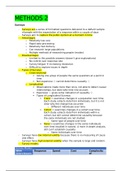
METHODS 2
Surveys
- Surveys are a series of formatted questions delivered to a defiant sample
of people with the expectation of a response within a couple of days
- Surveys aim to capture the public opinion at a moment in time
- Advantages
o Relatively low cost
o Rapid data processing
o Relatively fast delivery
o Can research large populations
o Multiple methods of researching people (modes)
- Disadvantages
o Limited to the possible answers (doesn’t give explanations)
o No control over response rate
o Survey fatigue increasing resistance
o Difficult to explore issues in depth
- Types of Surveys:
o Cross-sectional
Asking one group of people the same questions at a point in
time
Not expensive 😊 cannot determine causality ☹
o Longitudinal
Observations made more than once, not able to detect causal
relationships, but does take time into account.
Expensive ☹ gives some indication of causality 😊
Types of Longitudinal Surveys:
Trend = examines changes in a population over time.
Each study collects data from individuals, but it is not
clear why the change has occurred
o Different individuals over time
Cohort = examines changes in a cohort over time.
Each study collects data from individuals within a
cohort, but still cannot determine causality because
the same individuals are not studied.
o Same type of people over time
Panel = examines changes in the same individuals
over time (studied in waves). A more in-depth analysis,
still can’t establish causality
o Same individuals over time
- Surveys have low internal validity because there is no measuring of cause
and effect.
- Surveys have high external validity when the sample is large and random.
- Survey modes:
Survey Modes:
With Response Speed Cost Complexity
interviewers of
,: Questionnai
re
Face to Face Good Slow Very high Very high
By phone Reasonable Fast high Very high
Without
interviewers
:
Paper/pencil Low Low
Email/web low Very fast Very low Very high
- Types of Survey Questions:
o Dichotomous
o Open ended
o Multiple choice (mutually exclusive)
o Multiple choice (check any that apply)
o Rank order
o Likert scale
o Semantic differential scale
- Filter questions = routes respondents around questions that don’t apply to
them e.g. if yes go to Q16
- Problems with Survey wording:
o Overlapping answer options
o Double barrel questions
o Social desirability bias
This is important to avoid when you are investigating
sensitive or controversial topics
To Prevent:
Indirect questioning
Making them comfortable
Give indication that it is okay to answer in a way that is
not socially desirable
- Pre-testing
o Its important to pre-test because surveys are expensive to put out
o Look at: survey wording, aesthetic design, logic and flow of wording,
clear meanings, length of time to complete survey
o How to pre-test:
Ask respondents for feedback
Cognitive interviewing
- Unit non response = not answering entire survey
- Item non response = respondent answering all but one question
Sampling
- Census = study of an entire population
- Parameter = describing a population
- Sample frame = list from which a sample is drawn
- Types of sampling:
o Probability Sampling = random selection of respondents
Simple random lottery, random number generator
Systematic random starting point, every third number
, Stratified random sampling used when you want different
groups in a population to be represented (divide group into
strata then pick randomly from both)
Cluster sampling used when you want to study groups that
are in regular contact with each other
Multistage cluster sampling divide into clusters then divide
into more clusters e.g. Schools, one high school, one class
o Non-probability Sampling = respondents selected based on
judgement of the researcher
Convenience sampling
Quota sampling like stratified sampling but without a
sampling frame
Snowball sampling referrals, leads to distortions
Purposive sampling specific criteria of interest for study
- Sampling error = the degree to which the sample statistics differ from the
parameters of the population from which it was selected avoided by
using probability sampling
True experiments
- Are experimental research designs that maximise internal validity and
enable us to test for causality
- Characteristics of true experiments:
o Manipulation to ensure the cause proceeds the effect
o Comparison to ensure the effect didn’t occur naturally
o Random assignment/randomization ensures there are no other
explanations for the effect
- Manipulation
o When the researcher creates different level or conditions that
represent different values of the independent variable, while
keeping the external variables constant
o Manipulation check = used to assess how effective a manipulation
is
o Individual difference variables cannot be manipulated
- Randomization
o Provides a way of eliminating all possible systematic differences
between participants in different conditions at once
o Randomization failure = when there is an uneven distribution
o Statistical nuisance = the experimental group is not equal to the
control group
o Randomization check = measure relevant variables to see if
conditions are the same
- Elements of experimental designs
1. DV is manipulated into 2 groups (exp & con) + manipulation check
2. DV is measured in the 2 groups
3. Results are compared to see if they statistically differ
4. All other variables that can influence the IV & DV are controlled
- Random assignment = controlling for individual differences in
experimental conditions when you have a large sample the biases will
Surveys
- Surveys are a series of formatted questions delivered to a defiant sample
of people with the expectation of a response within a couple of days
- Surveys aim to capture the public opinion at a moment in time
- Advantages
o Relatively low cost
o Rapid data processing
o Relatively fast delivery
o Can research large populations
o Multiple methods of researching people (modes)
- Disadvantages
o Limited to the possible answers (doesn’t give explanations)
o No control over response rate
o Survey fatigue increasing resistance
o Difficult to explore issues in depth
- Types of Surveys:
o Cross-sectional
Asking one group of people the same questions at a point in
time
Not expensive 😊 cannot determine causality ☹
o Longitudinal
Observations made more than once, not able to detect causal
relationships, but does take time into account.
Expensive ☹ gives some indication of causality 😊
Types of Longitudinal Surveys:
Trend = examines changes in a population over time.
Each study collects data from individuals, but it is not
clear why the change has occurred
o Different individuals over time
Cohort = examines changes in a cohort over time.
Each study collects data from individuals within a
cohort, but still cannot determine causality because
the same individuals are not studied.
o Same type of people over time
Panel = examines changes in the same individuals
over time (studied in waves). A more in-depth analysis,
still can’t establish causality
o Same individuals over time
- Surveys have low internal validity because there is no measuring of cause
and effect.
- Surveys have high external validity when the sample is large and random.
- Survey modes:
Survey Modes:
With Response Speed Cost Complexity
interviewers of
,: Questionnai
re
Face to Face Good Slow Very high Very high
By phone Reasonable Fast high Very high
Without
interviewers
:
Paper/pencil Low Low
Email/web low Very fast Very low Very high
- Types of Survey Questions:
o Dichotomous
o Open ended
o Multiple choice (mutually exclusive)
o Multiple choice (check any that apply)
o Rank order
o Likert scale
o Semantic differential scale
- Filter questions = routes respondents around questions that don’t apply to
them e.g. if yes go to Q16
- Problems with Survey wording:
o Overlapping answer options
o Double barrel questions
o Social desirability bias
This is important to avoid when you are investigating
sensitive or controversial topics
To Prevent:
Indirect questioning
Making them comfortable
Give indication that it is okay to answer in a way that is
not socially desirable
- Pre-testing
o Its important to pre-test because surveys are expensive to put out
o Look at: survey wording, aesthetic design, logic and flow of wording,
clear meanings, length of time to complete survey
o How to pre-test:
Ask respondents for feedback
Cognitive interviewing
- Unit non response = not answering entire survey
- Item non response = respondent answering all but one question
Sampling
- Census = study of an entire population
- Parameter = describing a population
- Sample frame = list from which a sample is drawn
- Types of sampling:
o Probability Sampling = random selection of respondents
Simple random lottery, random number generator
Systematic random starting point, every third number
, Stratified random sampling used when you want different
groups in a population to be represented (divide group into
strata then pick randomly from both)
Cluster sampling used when you want to study groups that
are in regular contact with each other
Multistage cluster sampling divide into clusters then divide
into more clusters e.g. Schools, one high school, one class
o Non-probability Sampling = respondents selected based on
judgement of the researcher
Convenience sampling
Quota sampling like stratified sampling but without a
sampling frame
Snowball sampling referrals, leads to distortions
Purposive sampling specific criteria of interest for study
- Sampling error = the degree to which the sample statistics differ from the
parameters of the population from which it was selected avoided by
using probability sampling
True experiments
- Are experimental research designs that maximise internal validity and
enable us to test for causality
- Characteristics of true experiments:
o Manipulation to ensure the cause proceeds the effect
o Comparison to ensure the effect didn’t occur naturally
o Random assignment/randomization ensures there are no other
explanations for the effect
- Manipulation
o When the researcher creates different level or conditions that
represent different values of the independent variable, while
keeping the external variables constant
o Manipulation check = used to assess how effective a manipulation
is
o Individual difference variables cannot be manipulated
- Randomization
o Provides a way of eliminating all possible systematic differences
between participants in different conditions at once
o Randomization failure = when there is an uneven distribution
o Statistical nuisance = the experimental group is not equal to the
control group
o Randomization check = measure relevant variables to see if
conditions are the same
- Elements of experimental designs
1. DV is manipulated into 2 groups (exp & con) + manipulation check
2. DV is measured in the 2 groups
3. Results are compared to see if they statistically differ
4. All other variables that can influence the IV & DV are controlled
- Random assignment = controlling for individual differences in
experimental conditions when you have a large sample the biases will