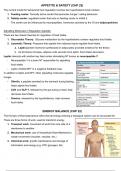
APPETITE & SATIETY (CHP 22)
The current model for behavioral food regulation involves two hypothalamic brain centers.
1. Feeding center: Tonically active center that promotes hunger / eating behaviors.
2. Satiety center: regulated center that acts on feeding center to inhibit it.
- The center can be influenced by neuropeptides, hormones secreted by the GI and adipocytokines
Signalling Molecules in Regulation Appetite:
There are two classic theories for regulation of food intake.
1. Glucostatic Theory: Glucose metabolism by the hypothalamic centers regulates food intake.
2. Lipostatic Theory: Proposes that signals from adipose tissue regulate food intake.
a. Leptin (protein hormone synthesized in adipocytes) provided evidence for the theory
b. As fat stores increase, adipose cells secrete more leptin, food intake decreases.
Leptin interacts with another key feed center stimulating NT known as neuropeptide Y.
- Neuropeptide Y is a brain NT responsible for signalling
food intake
- Leptin inhibits NPY in a negative feedback loop
In addition to leptin and NPY, other signalling molecules regulate
hunger.
- Ghrelin, a peptide secreted by the stomach during fasting,
helps signal food intake.
- CCK and GLP-1, released by the gut during a meal, help
decrease food intake.
- Orexins, released by the hypothalamus, help increase
food intake.
ENERGY BALANCE (CHP 22)
The first law of thermodynamics infers that all energy entering a biological system can be accounted for.
There are three forms of work, used to transform energy.
1. Transport work: movement of work from one side of a
membrane to another.
2. Mechanical work: use of intracellular fibers/filaments to
create movement (muscles, vesicles, etc.)
3. Chemical work: growth maintenance and storage of
information and energy (e.g. ATP, glycogen, fat)
, Measuring work:
The most direct way to measure energy content of food is through direct calorimetry.
- 1 kcal = amount of heat needed to raise the temperature of one liter of water by 1ºC
- The calorie content can also be calculatedmy multiplying the grams of each component by their
metabolic energy content:
- Fat: 9 kcal/g
- Carbohydrates: 4 kcal/g
- Protein: 4 kcal/g
Metabolic rate is defined as an individual’s energy expenditure.
- Simplest way to measure is oxygen consumption (rate at which the the body consumes oxygen)
- The measurement of oxygen consumption is through indirect calorimetry
- Can also be measured by carbon dioxide production (rate at which the the body produces CO)
- The ratio of CO2 of O2 produced is known as the respiratory quotient (RQ) or respiratory
exchange ratio (RER). This measure varies depending on diet.
- Pure carbohydrate diet = 1.
- Pure protein diet = 0.8
- Pure fat diet = 0.7
- Metabolic rate is calculated as the product of oxygen consumption and number of kcal metabolized
per liter of O2.
- 𝑚𝑒𝑡𝑎𝑏𝑜𝑙𝑖𝑐 𝑟𝑎𝑡𝑒 (𝑘𝑐𝑎𝑙/𝑑𝑎𝑦) = 𝐿 𝑂2 × 𝑘𝑐𝑎𝑙 / 𝐿 𝑂2
- Kcal / L O2 inferred using RQ, L O2 directly provided by resting oxygen consumption.
Basal metabolic rate is defined as a person lowest metabolic rate. Effected by several factors.
1. Age and sex. Women have higher %age adipose tissue (lower BMR). Both sexes decrease w age.
2. Amount of lean muscle mass. Muscle has higher oxygen consumption at rest than adipose tissue.
3. Activity level. Muscle contraction increases metabolic rate above BMR.
4. Diet. Resting metabolic rate increases after a meal (diet induced thermogenesis). Fats cause little
DIT, carbohydrates more, proteins the most DIT. Costs most energy to break down protein.
5. Hormones. BMR is increased by thyroid hormones and catecholamines.
6. Genetics. Effects efficiency of metabolism.
- Technically would need to be measured during sleep. Instead a 12 hour rested fast is used ⇒ resting
metabolic rate (RMR)
The current model for behavioral food regulation involves two hypothalamic brain centers.
1. Feeding center: Tonically active center that promotes hunger / eating behaviors.
2. Satiety center: regulated center that acts on feeding center to inhibit it.
- The center can be influenced by neuropeptides, hormones secreted by the GI and adipocytokines
Signalling Molecules in Regulation Appetite:
There are two classic theories for regulation of food intake.
1. Glucostatic Theory: Glucose metabolism by the hypothalamic centers regulates food intake.
2. Lipostatic Theory: Proposes that signals from adipose tissue regulate food intake.
a. Leptin (protein hormone synthesized in adipocytes) provided evidence for the theory
b. As fat stores increase, adipose cells secrete more leptin, food intake decreases.
Leptin interacts with another key feed center stimulating NT known as neuropeptide Y.
- Neuropeptide Y is a brain NT responsible for signalling
food intake
- Leptin inhibits NPY in a negative feedback loop
In addition to leptin and NPY, other signalling molecules regulate
hunger.
- Ghrelin, a peptide secreted by the stomach during fasting,
helps signal food intake.
- CCK and GLP-1, released by the gut during a meal, help
decrease food intake.
- Orexins, released by the hypothalamus, help increase
food intake.
ENERGY BALANCE (CHP 22)
The first law of thermodynamics infers that all energy entering a biological system can be accounted for.
There are three forms of work, used to transform energy.
1. Transport work: movement of work from one side of a
membrane to another.
2. Mechanical work: use of intracellular fibers/filaments to
create movement (muscles, vesicles, etc.)
3. Chemical work: growth maintenance and storage of
information and energy (e.g. ATP, glycogen, fat)
, Measuring work:
The most direct way to measure energy content of food is through direct calorimetry.
- 1 kcal = amount of heat needed to raise the temperature of one liter of water by 1ºC
- The calorie content can also be calculatedmy multiplying the grams of each component by their
metabolic energy content:
- Fat: 9 kcal/g
- Carbohydrates: 4 kcal/g
- Protein: 4 kcal/g
Metabolic rate is defined as an individual’s energy expenditure.
- Simplest way to measure is oxygen consumption (rate at which the the body consumes oxygen)
- The measurement of oxygen consumption is through indirect calorimetry
- Can also be measured by carbon dioxide production (rate at which the the body produces CO)
- The ratio of CO2 of O2 produced is known as the respiratory quotient (RQ) or respiratory
exchange ratio (RER). This measure varies depending on diet.
- Pure carbohydrate diet = 1.
- Pure protein diet = 0.8
- Pure fat diet = 0.7
- Metabolic rate is calculated as the product of oxygen consumption and number of kcal metabolized
per liter of O2.
- 𝑚𝑒𝑡𝑎𝑏𝑜𝑙𝑖𝑐 𝑟𝑎𝑡𝑒 (𝑘𝑐𝑎𝑙/𝑑𝑎𝑦) = 𝐿 𝑂2 × 𝑘𝑐𝑎𝑙 / 𝐿 𝑂2
- Kcal / L O2 inferred using RQ, L O2 directly provided by resting oxygen consumption.
Basal metabolic rate is defined as a person lowest metabolic rate. Effected by several factors.
1. Age and sex. Women have higher %age adipose tissue (lower BMR). Both sexes decrease w age.
2. Amount of lean muscle mass. Muscle has higher oxygen consumption at rest than adipose tissue.
3. Activity level. Muscle contraction increases metabolic rate above BMR.
4. Diet. Resting metabolic rate increases after a meal (diet induced thermogenesis). Fats cause little
DIT, carbohydrates more, proteins the most DIT. Costs most energy to break down protein.
5. Hormones. BMR is increased by thyroid hormones and catecholamines.
6. Genetics. Effects efficiency of metabolism.
- Technically would need to be measured during sleep. Instead a 12 hour rested fast is used ⇒ resting
metabolic rate (RMR)