CONTENTS
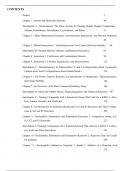
Preface 5
Chapter 1 | Atomic and Molecular Structure 40
Interchapter A | Nomenclature: The Basic System for Naming Simple Organic Compounds—
Alkanes, Haloalkanes, Nitroalkanes, Cycloalkanes, and Ethers 31
Chapter 2 | Three-Dimensional Geometry, Intermolecular Interactions, and Physical Properties
40
Chapter 3 | Orbital Interactions 1: Hybridization and Two-Center Molecular Orbitals 60
Interchapter B | Naming Alkenes, Alkynes, and Benzene Derivatives 81
Chapter 4 | Isomerism 1: Conformers and Constitutional Isomers 90
Chapter 5 | Isomerism 2: Chirality, Enantiomers, and Diastereomers 112
Interchapter C | Stereochemistry in Nomenclature: R and S Configurations about Asymmetric
Carbons and Z and E Configurations about Double Bonds 134
Chapter 6 | The Proton Transfer Reaction: An Introduction to Mechanisms, Thermodynamics,
and Charge Stability 144
Chapter 7 | An Overview of the Most Common Elementary Steps 164
Interchapter D | Molecular Orbital Theory, Hyperconjugation, and Chemical Reactions 187
Interchapter E | Naming Compounds with a Functional Group That Calls for a Suffix 1: Alco-
hols, Amines, Ketones, and Aldehydes 196
Chapter 8 | An Introduction to Multistep Mechanisms: SN1 and E1 Reactions and Their Compar-
isons to SN2 and E2 Reactions 205
Chapter 9 | Nucleophilic Substitution and Elimination Reactions 1: Competition among SN2,
SN1, E2, and E1 Reactions 227
Interchapter F | Naming Compounds with a Functional Group That Calls for a Suffix 2: Carbox-
ylic Acids and Their Derivatives 247
Chapter 10 | Nucleophilic Substitution and Elimination Reactions 2: Reactions That Are Useful
for Synthesis 256
Chapter 11 | Electrophilic Addition to Nonpolar Bonds 1: Addition of a Brønsted Acid
278
,Chapter 12 | Electrophilic Addition to Nonpolar Bonds 2: Reactions Involving Cyclic Transi-
tion States 298
Chapter 13 | Organic Synthesis 1: Beginning Concepts in Designing Multistep Synthesis 319
Chapter 14 | Orbital Interactions 2: Extended Systems, Conjugation, and Aromaticity 341
Chapter 15 | Structure Determination 1: Ultraviolet–Visible and Infrared Spectroscopies 359
Chapter 16 | Structure Determination 2: Nuclear Magnetic Resonance Spectroscopy and Mass
Spectrometry 380
Chapter 17 | Nucleophilic Addition to Polar Bonds 1: Addition of Strong Nucleophiles 404
Chapter 18 | Nucleophilic Addition to Polar Bonds 2: Weak Nucleophiles and Acid and Base
Catalysis 429
Chapter 19 | Organic Synthesis 2: Intermediate Topics in Synthesis Design, and Useful Redox
and Carbon–Carbon Bond-Forming Reactions 457
Chapter 20 | Nucleophilic Addition–Elimination Reactions 1: The General Mechanism Involv-
ing Strong Nucleophiles 485
Chapter 21 | Nucleophilic Addition–Elimination Reactions 2: Weak Nucleophiles 511
Chapter 22 | Aromatic Substitution 1: Electrophilic Aromatic Substitution on Benzene; Useful
Accompanying Reactions 541
Chapter 23 | Aromatic Substitution 2: Reactions of Substituted Benzenes and Other Rings 564
Chapter 24 | The Diels–Alder Reaction and Other Pericyclic Reactions 590
Chapter 25 | Reactions Involving Free Radicals 616
Interchapter G | Fragmentation Pathways in Mass Spectrometry 639
Chapter 26 | Polymers 653
Credits 672
,Chapter 1: Atomic and Molecular Structure
LEARNING OBJECTIVES
Determine the number of valence and/or core electrons for an atom or ion.
Interpret the electron configuration and formal charge for an atom or ion.
Identify forces that are involved in chemical bonding.
Analyze an energy versus internuclear distance diagram to understand the properties of a chemical bond.
Predict the properties of a covalent bond based on known periodic trends, and vice versa.
Assess the validity of a Lewis structure.
Apply knowledge of chemical structure to determine the formal charge of an unknown species.
Compare a series of structures to determine if they are resonance structures.
Determine the molecular formula of an organic compound from a structural drawing or condensed formula.
Master the structural drawing of organic molecules—specifically, Lewis structures and line structures.
Assimilate your knowledge of molecular structure to identify and/or draw organic functional groups.
Identify the key structural features of amino acids, saccharides, and nucleotides.
Deduce and draw the resonance structures that contribute to the resonance hybrid, and vice versa.
Elaborate how an electrostatic potential map correlates to molecular structure and properties.
Predict the ionic or covalent nature of an organic structure from physical property data.
Indicate bond dipoles and lone pairs on an organic structure, and predict how these structural features impact chemical reactivity.
Apply the concept of resonance to predict the outcome of a chemical reaction.
Depict electron delocalization via resonance using appropriate arrow notation.
Recognize and name functional groups within a complex molecule.
Draw a structure of a given molecular formula that contains a specific functional group.
, MULTIPLE CHOICE
1. Which orbital does NOT house core electrons for a bromine atom?
a. 1s d. 2s
b. 4p e. 3s
c. 3p
ANS: B DIF: Easy REF: 1.3
OBJ: Determine the number of valence and/or core electrons for an atom or ion.
MSC: Remembering
2. An atom of which element would have an electron configuration of 1s22s22p63s23p1?
a. Al d. Si
b. Ne e. Na
c. B
ANS: A DIF: Easy REF: 1.3
OBJ: Interpret the electron configuration and formal charge for an atom or ion.
MSC: Understanding
3. Which electron configuration is correct for a carbon atom with a formal charge of −1?
a. 1s22s22p63s1 d. 1s22s22p63s23p5
2 2 3
b. 1s 2s 2p e. 1s22s22p4
c. 1s22s22p5
ANS: B DIF: Easy REF: 1.3 | 1.9
OBJ: Interpret the electron configuration and formal charge for an atom or ion.
MSC: Understanding
4. Which electron configuration is correct for the carbon of a carbocation?
a. 1s22s22p1 d. 1s22s22p63s23p5
2 2 3
b. 1s 2s 2p e. 1s22s22p4
c. 1s22s22p5
ANS: A DIF: Easy REF: 1.3 | 1.9
OBJ: Interpret the electron configuration and formal charge for an atom or ion.
MSC: Understanding
5. Which electron configuration is correct for a Ca 2+ ion?
a. 1s22s22p63s23p1 d. 1s22s22p63s23p64s24p6
b. 1s22s22p63s23p64s2 e. 1s22s22p63s2
c. 1s22s22p63s23p6
ANS: C DIF: Easy REF: 1.3 | 1.9
OBJ: Interpret the electron configuration and formal charge for an atom or ion.
MSC: Applying
6. How many valence electrons are assigned to oxygen when determining formal charge in the ionic compound sodium methoxide,
NaOCH3?
a. 4 d. 7
b. 5 e. 8
c. 6
ANS: D DIF: Easy REF: 1.3 | 1.9
OBJ: Determine the number of valence and/or core electrons for an atom or ion.
MSC: Analyzing
7. Which of the following is an example of an electrostatic attractive force between particles at the atomic level?
a. Neutrons attract protons.
b. Protons repel protons.
c. Core electrons attract valence electrons.
d. Protons attract electrons.
e. Electrons attract neutrons.
Preface 5
Chapter 1 | Atomic and Molecular Structure 40
Interchapter A | Nomenclature: The Basic System for Naming Simple Organic Compounds—
Alkanes, Haloalkanes, Nitroalkanes, Cycloalkanes, and Ethers 31
Chapter 2 | Three-Dimensional Geometry, Intermolecular Interactions, and Physical Properties
40
Chapter 3 | Orbital Interactions 1: Hybridization and Two-Center Molecular Orbitals 60
Interchapter B | Naming Alkenes, Alkynes, and Benzene Derivatives 81
Chapter 4 | Isomerism 1: Conformers and Constitutional Isomers 90
Chapter 5 | Isomerism 2: Chirality, Enantiomers, and Diastereomers 112
Interchapter C | Stereochemistry in Nomenclature: R and S Configurations about Asymmetric
Carbons and Z and E Configurations about Double Bonds 134
Chapter 6 | The Proton Transfer Reaction: An Introduction to Mechanisms, Thermodynamics,
and Charge Stability 144
Chapter 7 | An Overview of the Most Common Elementary Steps 164
Interchapter D | Molecular Orbital Theory, Hyperconjugation, and Chemical Reactions 187
Interchapter E | Naming Compounds with a Functional Group That Calls for a Suffix 1: Alco-
hols, Amines, Ketones, and Aldehydes 196
Chapter 8 | An Introduction to Multistep Mechanisms: SN1 and E1 Reactions and Their Compar-
isons to SN2 and E2 Reactions 205
Chapter 9 | Nucleophilic Substitution and Elimination Reactions 1: Competition among SN2,
SN1, E2, and E1 Reactions 227
Interchapter F | Naming Compounds with a Functional Group That Calls for a Suffix 2: Carbox-
ylic Acids and Their Derivatives 247
Chapter 10 | Nucleophilic Substitution and Elimination Reactions 2: Reactions That Are Useful
for Synthesis 256
Chapter 11 | Electrophilic Addition to Nonpolar Bonds 1: Addition of a Brønsted Acid
278
,Chapter 12 | Electrophilic Addition to Nonpolar Bonds 2: Reactions Involving Cyclic Transi-
tion States 298
Chapter 13 | Organic Synthesis 1: Beginning Concepts in Designing Multistep Synthesis 319
Chapter 14 | Orbital Interactions 2: Extended Systems, Conjugation, and Aromaticity 341
Chapter 15 | Structure Determination 1: Ultraviolet–Visible and Infrared Spectroscopies 359
Chapter 16 | Structure Determination 2: Nuclear Magnetic Resonance Spectroscopy and Mass
Spectrometry 380
Chapter 17 | Nucleophilic Addition to Polar Bonds 1: Addition of Strong Nucleophiles 404
Chapter 18 | Nucleophilic Addition to Polar Bonds 2: Weak Nucleophiles and Acid and Base
Catalysis 429
Chapter 19 | Organic Synthesis 2: Intermediate Topics in Synthesis Design, and Useful Redox
and Carbon–Carbon Bond-Forming Reactions 457
Chapter 20 | Nucleophilic Addition–Elimination Reactions 1: The General Mechanism Involv-
ing Strong Nucleophiles 485
Chapter 21 | Nucleophilic Addition–Elimination Reactions 2: Weak Nucleophiles 511
Chapter 22 | Aromatic Substitution 1: Electrophilic Aromatic Substitution on Benzene; Useful
Accompanying Reactions 541
Chapter 23 | Aromatic Substitution 2: Reactions of Substituted Benzenes and Other Rings 564
Chapter 24 | The Diels–Alder Reaction and Other Pericyclic Reactions 590
Chapter 25 | Reactions Involving Free Radicals 616
Interchapter G | Fragmentation Pathways in Mass Spectrometry 639
Chapter 26 | Polymers 653
Credits 672
,Chapter 1: Atomic and Molecular Structure
LEARNING OBJECTIVES
Determine the number of valence and/or core electrons for an atom or ion.
Interpret the electron configuration and formal charge for an atom or ion.
Identify forces that are involved in chemical bonding.
Analyze an energy versus internuclear distance diagram to understand the properties of a chemical bond.
Predict the properties of a covalent bond based on known periodic trends, and vice versa.
Assess the validity of a Lewis structure.
Apply knowledge of chemical structure to determine the formal charge of an unknown species.
Compare a series of structures to determine if they are resonance structures.
Determine the molecular formula of an organic compound from a structural drawing or condensed formula.
Master the structural drawing of organic molecules—specifically, Lewis structures and line structures.
Assimilate your knowledge of molecular structure to identify and/or draw organic functional groups.
Identify the key structural features of amino acids, saccharides, and nucleotides.
Deduce and draw the resonance structures that contribute to the resonance hybrid, and vice versa.
Elaborate how an electrostatic potential map correlates to molecular structure and properties.
Predict the ionic or covalent nature of an organic structure from physical property data.
Indicate bond dipoles and lone pairs on an organic structure, and predict how these structural features impact chemical reactivity.
Apply the concept of resonance to predict the outcome of a chemical reaction.
Depict electron delocalization via resonance using appropriate arrow notation.
Recognize and name functional groups within a complex molecule.
Draw a structure of a given molecular formula that contains a specific functional group.
, MULTIPLE CHOICE
1. Which orbital does NOT house core electrons for a bromine atom?
a. 1s d. 2s
b. 4p e. 3s
c. 3p
ANS: B DIF: Easy REF: 1.3
OBJ: Determine the number of valence and/or core electrons for an atom or ion.
MSC: Remembering
2. An atom of which element would have an electron configuration of 1s22s22p63s23p1?
a. Al d. Si
b. Ne e. Na
c. B
ANS: A DIF: Easy REF: 1.3
OBJ: Interpret the electron configuration and formal charge for an atom or ion.
MSC: Understanding
3. Which electron configuration is correct for a carbon atom with a formal charge of −1?
a. 1s22s22p63s1 d. 1s22s22p63s23p5
2 2 3
b. 1s 2s 2p e. 1s22s22p4
c. 1s22s22p5
ANS: B DIF: Easy REF: 1.3 | 1.9
OBJ: Interpret the electron configuration and formal charge for an atom or ion.
MSC: Understanding
4. Which electron configuration is correct for the carbon of a carbocation?
a. 1s22s22p1 d. 1s22s22p63s23p5
2 2 3
b. 1s 2s 2p e. 1s22s22p4
c. 1s22s22p5
ANS: A DIF: Easy REF: 1.3 | 1.9
OBJ: Interpret the electron configuration and formal charge for an atom or ion.
MSC: Understanding
5. Which electron configuration is correct for a Ca 2+ ion?
a. 1s22s22p63s23p1 d. 1s22s22p63s23p64s24p6
b. 1s22s22p63s23p64s2 e. 1s22s22p63s2
c. 1s22s22p63s23p6
ANS: C DIF: Easy REF: 1.3 | 1.9
OBJ: Interpret the electron configuration and formal charge for an atom or ion.
MSC: Applying
6. How many valence electrons are assigned to oxygen when determining formal charge in the ionic compound sodium methoxide,
NaOCH3?
a. 4 d. 7
b. 5 e. 8
c. 6
ANS: D DIF: Easy REF: 1.3 | 1.9
OBJ: Determine the number of valence and/or core electrons for an atom or ion.
MSC: Analyzing
7. Which of the following is an example of an electrostatic attractive force between particles at the atomic level?
a. Neutrons attract protons.
b. Protons repel protons.
c. Core electrons attract valence electrons.
d. Protons attract electrons.
e. Electrons attract neutrons.