1
Week 3: Personality disorders
Lecture 5: Evidence based practice
Leerdoelen
To identify the key characteristics of psychotherapy
To identify the key characteristics of effectivity research related to psychotherapy, incl:
o Research goals
o Dodo-bird hypothesis/verdict
o Pitfalls
o Factors responsible for therapeutic change
o Differences over time (pre/during/post)
To apply knowledge related to the effectivity of psychotherapy to evaluate research findings and statements
What is psychotherapy?
Psychotherapy is the systematic use of a human relationship for therapeutic purposes of alleviating
emotional distress by effecting enduring changes in a patient’s thinking, feelings, and behavior (Strupp,
1986).
The primary therapeutic agent is a person
Who relies exclusively on verbal, psychoeducational, or behavioral methods
A broad array of behavioral and psychological problems
Which fall under the contemporary medical terms, “mental illnesses” and “psychiatric disorders”
Is psychotherapy for PDs effective?
Effectivity? (= the confidence in which we can state that factor A is causing a change in dependent variable
B)
o The efficacy of treatment is determined by randomized clinical trials (RCTs)
o Variables are carefully controlled
o To investigate the relationship between treatment and outcome in an unambiguous way
o Effect size (= indicates magnitude of an effect)
Effectivity research plagued by dichotomies:
o Client versus therapist
o Therapy A versus therapy B
o Brief versus Long-term
o Specific techniques versus common factors
o Process versus Outcome
o Qualitative versus Quantitative
o Statistical vs clinical significance (= does a statistical significant effect change things for the client)
o Practice- vs evidence-based
Yes!
o Smith et al. (1980): 80% of patients fared better on outcome measures than those who received no
treatment
o Lots of research since..
Psychotherapy is safe and effective across a wide range of psychological, addictive, health, and relational
problems
o Children and youths (Kazdin & Weisz, 2003; Weisz, Hawley, & Doss, 2004)
o Adults (Barlow, 2004; Nathan & Gorman, 2002; Roth & Fonagy, 2004; Wampold et al., 1997)
o Older adults (Duffy, 1999; Zarit & Knight,1996)
What makes psychotherapy for PDs effective?
Dodo bird verdict:
o When bona fide treatments (= treatment models that are established and evaluated as effective)
are compared they yield similar outcomes, consistent with a common factors or contextual model
of psychotherapy (Wampold et al. 1997)
o Psychotherapy is more effective than no treatment
o Psychotherapy is more effective than placebo controls
o Psychotherapy is more effective than medication (ratio depends on the disorder and the
medication)
, 2
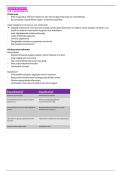
o All psychotherapies have similar
outcomes
Factors responsible for change
o Factor most responsible is
extratherapeutic change (= things that
have nothing to do with the therapy that
you are conducting but are happening
during life, such as season changes, job
changes, which affect the outcome of
therapy)
o Common factors: e.g. is there a
therapeutic framework that we use, is
there a certain schedule that we use,
therapeutic relationship, etc.
o Specific techniques: e.g. mindfulness,
mentalization, exposure.
o Expectancy: the expectancy that you expect something to work elicits change.
o Important to know this because this e.g. implies that it is more important to focus on common
factors than specific therapeutic techniques during training and research.
Common assumption (which is wrong): specific techniques explain most differences
o Therapeutic alliance as well as therapist and client characteristics explain more
o Interaction
Patient and therapist/therapy
Patient and specific techniques
Common assumption (which is wrong): EBM (= evidence based models) are most effective for all patients
o EBM are about specific factors
o Number of patient characteristics that influence the therapy are countless
o Holy grail: determining what therapy works best for what type of patient
Recent RCTs show no to limited differences between the effectiveness of different “specific” treatment
models for personality disorders:
o TFP/DBT/SPT (Clarkin et al. 2007)
o DBT vs GPM (= general psychiatric management) (McMain et al., 2009, 2012)
o DBT vs SCM (= structured clinical management) (Feigenbaum et al. 2011)
o MBT vs SCM (Bateman & Fonagy, 2009)
o MBT vs SPT (Jorgensen et al. 2012)
o CAT (= cognitive analytical therapy) vs GCC (Chanen et al. 2008)
o ………..
o ………..
o What type of effect are you trying to measure?
Evidence either supporting or refuting the Dodo bird verdict has implications for
o Research:
(a) specific techniques
(b) common factors
o Practice:
Treatment manuals: to like or not to like?
Role of CBT
o Is CBT superior to other treatments?
o Is the EBM biased toward CBT treatments?
o Biased because of outcome?
Marcus et al (2014) (see literature)
o At termination
Primary outcomes: small differences
Secondary outcomes: no differences
o Follow up
Differences mostly dissipate (= verdwijnen)
o Conclusion
“both/and” rather than “either/or”
, 3
What we should focus on is common factors and specific factors rather than either
common factors or specific factors.
How effective is psychotherapy for PD?
Mostly research on BPD
o Sample size
o Characteristics of the clients
o Characteristics of the disorder
o Working mechanism
Cristea et al (2017; see literature) conducted a systematic review and meta-analysis of RCTs to assess the
efficacy of psychotherapies for BPD
o Significant yet modest benefits of DBT and PD approaches for borderline-relevant outcomes
(symptoms, self-harm, suicide) compared to control.
o Differences dissipated when taking into account manualization of treatment or involved of study
team
Future research should investigate:
o Efficacy for specific PDs
o Common factors
o Cost effectiveness
o When short vs. long-term is warranted
o "Failure: the essence of our profession” (Dr. P. Luyten):
"This is actually the essence of our profession. We all fail
on a daily basis. Instead of feeling like a failure constantly,
we might want to start learning from our faults. If there is
one thing that I have learned in the past decade or so, it is from my treatment failures. When we do
well, it probably has more to do with the patient than with us. Patients often improve, even despite
us. But if treatment fails, we can really learn what it entails to be more effective.”
Marcus et al. (2014). Is the Dodo bird endangered in the 21 st century? A meta-analysis of treatment comparison
studies
Abstract
De Dodo bird hypothese stelt dat wanneer bonafide (= betrouwbare) behandelingen met elkaar vergeleken
worden ze overeenkomende uitkomsten hebben. Deze hypothese is consistent met de common factors of
het contextuele model van psychotherapie. De meest recente uitgebreide meta-analyse die de dodo bird
hypothese toetst, is uit 1997 en hieruit volgde overtuigende gelijkheid in behandelingen.
De huidige meta-analyse is een update over de dodo bird hypothese, waarin studies van de daaropvolgende
16 jaren zijn geïncludeerd. Bovendien bleek dat CBT behandelingen mogelijk meer effectief zijn dan
alternatieve behandelingen ten aanzien van de primaire uitkomsten. Tegengesteld aan de hypothese werd
bewijs gevonden voor verschillen in behandelingen voor primaire uitkomsten na afloop van de behandeling.
Consistent met de hypothese werden weinig verschillen gevonden in behandelingen ten aanzien van de
secundaire uitkomsten na afloop van de behandeling en bij follow-up. Er zijn kleine, statistisch significante
verschillen gevonden tussen bonafide behandelingen wanneer specifieke behandeldoelen worden
gemeten, maar niet wanneer secundaire uitkomsten worden beoordeeld. Hieruit volgt gemixte
ondersteuning voor zowel de specific factors als de contextuele modellen van psychotherapie.
Introduction
De dodo bird hypothese stelt dat wanneer bonafide behandelingen vergeleken worden met elkaar ze ruwweg
dezelfde uitkomsten hebben. Eerdere meta-analyses vinden over het algemeen bewijs voor deze
hypotheses, maar desondanks zijn er twijfels op basis van methodologische en conceptuele gronden.
Er is grotendeels consensus over dat psychotherapie werkt (effectiever dan geen behandeling of placebo
controls). Er is in mindere mate consensus over hoe psychotherapie dan werkt. Dit wordt onderzocht door
actieve behandelingen met elkaar e vergelijken. Wanneer een van de twee effectiever is, dan suggereert
dit dat bij deze ene behandeling iets bijdraagt aan de positieve uitkomst. Wanneer beide behandelingen
even effectief zijn, is het mogelijk dat verschillende mechanismes leiden tot soortgelijke verbeteringen of
dat factoren die overeenkomstig zijn in beide behandelingen leiden tot de verbeteringen.
Cognitve contrast: gelinkt aan de dodo bird hypothese is de vraag of CBT superieur is aan andere
behandelingen. Hier is gemixte empirische ondersteuning voor, wat met name afhangt van de
uitkomstmaten die gebruikt worden.
Week 3: Personality disorders
Lecture 5: Evidence based practice
Leerdoelen
To identify the key characteristics of psychotherapy
To identify the key characteristics of effectivity research related to psychotherapy, incl:
o Research goals
o Dodo-bird hypothesis/verdict
o Pitfalls
o Factors responsible for therapeutic change
o Differences over time (pre/during/post)
To apply knowledge related to the effectivity of psychotherapy to evaluate research findings and statements
What is psychotherapy?
Psychotherapy is the systematic use of a human relationship for therapeutic purposes of alleviating
emotional distress by effecting enduring changes in a patient’s thinking, feelings, and behavior (Strupp,
1986).
The primary therapeutic agent is a person
Who relies exclusively on verbal, psychoeducational, or behavioral methods
A broad array of behavioral and psychological problems
Which fall under the contemporary medical terms, “mental illnesses” and “psychiatric disorders”
Is psychotherapy for PDs effective?
Effectivity? (= the confidence in which we can state that factor A is causing a change in dependent variable
B)
o The efficacy of treatment is determined by randomized clinical trials (RCTs)
o Variables are carefully controlled
o To investigate the relationship between treatment and outcome in an unambiguous way
o Effect size (= indicates magnitude of an effect)
Effectivity research plagued by dichotomies:
o Client versus therapist
o Therapy A versus therapy B
o Brief versus Long-term
o Specific techniques versus common factors
o Process versus Outcome
o Qualitative versus Quantitative
o Statistical vs clinical significance (= does a statistical significant effect change things for the client)
o Practice- vs evidence-based
Yes!
o Smith et al. (1980): 80% of patients fared better on outcome measures than those who received no
treatment
o Lots of research since..
Psychotherapy is safe and effective across a wide range of psychological, addictive, health, and relational
problems
o Children and youths (Kazdin & Weisz, 2003; Weisz, Hawley, & Doss, 2004)
o Adults (Barlow, 2004; Nathan & Gorman, 2002; Roth & Fonagy, 2004; Wampold et al., 1997)
o Older adults (Duffy, 1999; Zarit & Knight,1996)
What makes psychotherapy for PDs effective?
Dodo bird verdict:
o When bona fide treatments (= treatment models that are established and evaluated as effective)
are compared they yield similar outcomes, consistent with a common factors or contextual model
of psychotherapy (Wampold et al. 1997)
o Psychotherapy is more effective than no treatment
o Psychotherapy is more effective than placebo controls
o Psychotherapy is more effective than medication (ratio depends on the disorder and the
medication)
, 2
o All psychotherapies have similar
outcomes
Factors responsible for change
o Factor most responsible is
extratherapeutic change (= things that
have nothing to do with the therapy that
you are conducting but are happening
during life, such as season changes, job
changes, which affect the outcome of
therapy)
o Common factors: e.g. is there a
therapeutic framework that we use, is
there a certain schedule that we use,
therapeutic relationship, etc.
o Specific techniques: e.g. mindfulness,
mentalization, exposure.
o Expectancy: the expectancy that you expect something to work elicits change.
o Important to know this because this e.g. implies that it is more important to focus on common
factors than specific therapeutic techniques during training and research.
Common assumption (which is wrong): specific techniques explain most differences
o Therapeutic alliance as well as therapist and client characteristics explain more
o Interaction
Patient and therapist/therapy
Patient and specific techniques
Common assumption (which is wrong): EBM (= evidence based models) are most effective for all patients
o EBM are about specific factors
o Number of patient characteristics that influence the therapy are countless
o Holy grail: determining what therapy works best for what type of patient
Recent RCTs show no to limited differences between the effectiveness of different “specific” treatment
models for personality disorders:
o TFP/DBT/SPT (Clarkin et al. 2007)
o DBT vs GPM (= general psychiatric management) (McMain et al., 2009, 2012)
o DBT vs SCM (= structured clinical management) (Feigenbaum et al. 2011)
o MBT vs SCM (Bateman & Fonagy, 2009)
o MBT vs SPT (Jorgensen et al. 2012)
o CAT (= cognitive analytical therapy) vs GCC (Chanen et al. 2008)
o ………..
o ………..
o What type of effect are you trying to measure?
Evidence either supporting or refuting the Dodo bird verdict has implications for
o Research:
(a) specific techniques
(b) common factors
o Practice:
Treatment manuals: to like or not to like?
Role of CBT
o Is CBT superior to other treatments?
o Is the EBM biased toward CBT treatments?
o Biased because of outcome?
Marcus et al (2014) (see literature)
o At termination
Primary outcomes: small differences
Secondary outcomes: no differences
o Follow up
Differences mostly dissipate (= verdwijnen)
o Conclusion
“both/and” rather than “either/or”
, 3
What we should focus on is common factors and specific factors rather than either
common factors or specific factors.
How effective is psychotherapy for PD?
Mostly research on BPD
o Sample size
o Characteristics of the clients
o Characteristics of the disorder
o Working mechanism
Cristea et al (2017; see literature) conducted a systematic review and meta-analysis of RCTs to assess the
efficacy of psychotherapies for BPD
o Significant yet modest benefits of DBT and PD approaches for borderline-relevant outcomes
(symptoms, self-harm, suicide) compared to control.
o Differences dissipated when taking into account manualization of treatment or involved of study
team
Future research should investigate:
o Efficacy for specific PDs
o Common factors
o Cost effectiveness
o When short vs. long-term is warranted
o "Failure: the essence of our profession” (Dr. P. Luyten):
"This is actually the essence of our profession. We all fail
on a daily basis. Instead of feeling like a failure constantly,
we might want to start learning from our faults. If there is
one thing that I have learned in the past decade or so, it is from my treatment failures. When we do
well, it probably has more to do with the patient than with us. Patients often improve, even despite
us. But if treatment fails, we can really learn what it entails to be more effective.”
Marcus et al. (2014). Is the Dodo bird endangered in the 21 st century? A meta-analysis of treatment comparison
studies
Abstract
De Dodo bird hypothese stelt dat wanneer bonafide (= betrouwbare) behandelingen met elkaar vergeleken
worden ze overeenkomende uitkomsten hebben. Deze hypothese is consistent met de common factors of
het contextuele model van psychotherapie. De meest recente uitgebreide meta-analyse die de dodo bird
hypothese toetst, is uit 1997 en hieruit volgde overtuigende gelijkheid in behandelingen.
De huidige meta-analyse is een update over de dodo bird hypothese, waarin studies van de daaropvolgende
16 jaren zijn geïncludeerd. Bovendien bleek dat CBT behandelingen mogelijk meer effectief zijn dan
alternatieve behandelingen ten aanzien van de primaire uitkomsten. Tegengesteld aan de hypothese werd
bewijs gevonden voor verschillen in behandelingen voor primaire uitkomsten na afloop van de behandeling.
Consistent met de hypothese werden weinig verschillen gevonden in behandelingen ten aanzien van de
secundaire uitkomsten na afloop van de behandeling en bij follow-up. Er zijn kleine, statistisch significante
verschillen gevonden tussen bonafide behandelingen wanneer specifieke behandeldoelen worden
gemeten, maar niet wanneer secundaire uitkomsten worden beoordeeld. Hieruit volgt gemixte
ondersteuning voor zowel de specific factors als de contextuele modellen van psychotherapie.
Introduction
De dodo bird hypothese stelt dat wanneer bonafide behandelingen vergeleken worden met elkaar ze ruwweg
dezelfde uitkomsten hebben. Eerdere meta-analyses vinden over het algemeen bewijs voor deze
hypotheses, maar desondanks zijn er twijfels op basis van methodologische en conceptuele gronden.
Er is grotendeels consensus over dat psychotherapie werkt (effectiever dan geen behandeling of placebo
controls). Er is in mindere mate consensus over hoe psychotherapie dan werkt. Dit wordt onderzocht door
actieve behandelingen met elkaar e vergelijken. Wanneer een van de twee effectiever is, dan suggereert
dit dat bij deze ene behandeling iets bijdraagt aan de positieve uitkomst. Wanneer beide behandelingen
even effectief zijn, is het mogelijk dat verschillende mechanismes leiden tot soortgelijke verbeteringen of
dat factoren die overeenkomstig zijn in beide behandelingen leiden tot de verbeteringen.
Cognitve contrast: gelinkt aan de dodo bird hypothese is de vraag of CBT superieur is aan andere
behandelingen. Hier is gemixte empirische ondersteuning voor, wat met name afhangt van de
uitkomstmaten die gebruikt worden.