Summary Health Economics week 1
Table of content
1.1 Studies
1.2 Elasticity
1.3 Risk aversion
1.4 Basic health insurance contract
1.5 Adverse selection
1.6 Government intervention
1.1 Studies
RAND study
randomly assigned 2000 families to different insurance coverage plans. The copayment rate for
an insurance plan is the fraction of the medical bill for which the patient is responsible. There were
several co-payment groups: Free, 25%, 50% and 95%. They tracked the utilization of healthcare (q) in
each co-payment plan (p)
Problem: health economy has changed in fundamental ways since the 1980s. Consequently, the
results found in the RAND HIE may not apply to the demand for health care today.
cost-sharing plan is one with a positive co-payment rate, so that costs are shared between the
insured and the insurer
Oregon Medicaid Experiment
Compared 2 groups of low-income adults:
(a) Medicaid lottery winners, who won a 2008 lottery to receive the opportunity to apply for public
health insurance coverage through Medicaid, and
(b) lottery entrants who did not win and were not given a chance to apply for Medicaid.
In effect, this lottery randomly assigned insurance coverage to a subset of the winners. Hence, the
lottery winners tended to face lower out-of-pocket prices for care.
Aim of this two studies: To what extend is the demand for healthcare price (in)elastic?
Results:
Outpatient care= any medical care that does not involve an overnight hospital stay (also: ambulatory
care)
both experiments found a downward-sloping demand. RAND found that also patients with chronic
conditions and acute conditions had similar downward-sloping demand
Inpatient care= medical care requiring overnight stays
demand is still downward-sloping but less elastic than outpatient care
ER care= care involving the emergency room
no significant difference found in the Oregon study. RAND found that the highest co-payment are
less likely to buy care
Pediatric care= care for infants and children which is typically paid for by parents
RAND found that parents are price-sensitive even with respect to health care for their children.
(immunizations and other preventive health care)
, Other care: mental health care, dental care, and prescription drug use
In each case, both studies find strong evidence of downward-sloping demand.
1.2 Elasticity
How to measure price sensitivity with elastics?
Elasticity of demand= the ratio that represents how a change in the price of a good leads to a change
in the quantity demanded, measured as a percentage change from the original quantity.
(Q 2−Q 1) /Q 1
ɛ= (P2−P1)/ P1
Example: suppose an individual starts with an insurance plan with a 25% copayment rate and
switches to a plan with a 95% copayment rate.
This represents a 280% increase in the price of care for the
individual: (95−25)/25×100%=280%.
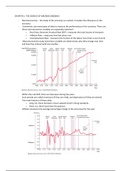
The figure shows how her quantity of outpatient care
demanded changes with the switch in insurance: it
decreases from 2.32 episodes per year to 1.9, an 18%
decline. The elasticity of demand for this individual is 20
(1,9−2,32)/2,32
ɛ = (0,95−0,25)/0,25 = -0,06
When the price rises with 1, the Q declines with 0,06
arc elasticity= A measure to compare the relative price sensitivity of different goods with different
unities.
∆ Q/(Q 1+Q 2)
ɛ= where ∆ Q= (Q2 − Q1) and ∆ P = (P2 − P1)
∆ P /(P1+ P 2)
Inelastic= price insensitive= when 1 ≤ ɛ-arc ≤ 0
Elastic= price sensitive= when ɛ ≤ -1
(1,25−1,5) /(1,25+1,5)
Q P ɛ= (20−10) /(20+10) = -0,27
Tokyo 1,25 20
Hokka 1,5 10
Incomes are generally much higher in Tokyo than Hokka. This means that -0,27 is an
underestimation. Demand in Tokyo is lower (1,25) than in Hokka because of the higher price (20),but
it is higher than it would be in Hokka at that higher price due to the income effect. Demand in each
region will be more responsive to price than our answer suggest.
(If incomes lower overestimation)
Table of content
1.1 Studies
1.2 Elasticity
1.3 Risk aversion
1.4 Basic health insurance contract
1.5 Adverse selection
1.6 Government intervention
1.1 Studies
RAND study
randomly assigned 2000 families to different insurance coverage plans. The copayment rate for
an insurance plan is the fraction of the medical bill for which the patient is responsible. There were
several co-payment groups: Free, 25%, 50% and 95%. They tracked the utilization of healthcare (q) in
each co-payment plan (p)
Problem: health economy has changed in fundamental ways since the 1980s. Consequently, the
results found in the RAND HIE may not apply to the demand for health care today.
cost-sharing plan is one with a positive co-payment rate, so that costs are shared between the
insured and the insurer
Oregon Medicaid Experiment
Compared 2 groups of low-income adults:
(a) Medicaid lottery winners, who won a 2008 lottery to receive the opportunity to apply for public
health insurance coverage through Medicaid, and
(b) lottery entrants who did not win and were not given a chance to apply for Medicaid.
In effect, this lottery randomly assigned insurance coverage to a subset of the winners. Hence, the
lottery winners tended to face lower out-of-pocket prices for care.
Aim of this two studies: To what extend is the demand for healthcare price (in)elastic?
Results:
Outpatient care= any medical care that does not involve an overnight hospital stay (also: ambulatory
care)
both experiments found a downward-sloping demand. RAND found that also patients with chronic
conditions and acute conditions had similar downward-sloping demand
Inpatient care= medical care requiring overnight stays
demand is still downward-sloping but less elastic than outpatient care
ER care= care involving the emergency room
no significant difference found in the Oregon study. RAND found that the highest co-payment are
less likely to buy care
Pediatric care= care for infants and children which is typically paid for by parents
RAND found that parents are price-sensitive even with respect to health care for their children.
(immunizations and other preventive health care)
, Other care: mental health care, dental care, and prescription drug use
In each case, both studies find strong evidence of downward-sloping demand.
1.2 Elasticity
How to measure price sensitivity with elastics?
Elasticity of demand= the ratio that represents how a change in the price of a good leads to a change
in the quantity demanded, measured as a percentage change from the original quantity.
(Q 2−Q 1) /Q 1
ɛ= (P2−P1)/ P1
Example: suppose an individual starts with an insurance plan with a 25% copayment rate and
switches to a plan with a 95% copayment rate.
This represents a 280% increase in the price of care for the
individual: (95−25)/25×100%=280%.
The figure shows how her quantity of outpatient care
demanded changes with the switch in insurance: it
decreases from 2.32 episodes per year to 1.9, an 18%
decline. The elasticity of demand for this individual is 20
(1,9−2,32)/2,32
ɛ = (0,95−0,25)/0,25 = -0,06
When the price rises with 1, the Q declines with 0,06
arc elasticity= A measure to compare the relative price sensitivity of different goods with different
unities.
∆ Q/(Q 1+Q 2)
ɛ= where ∆ Q= (Q2 − Q1) and ∆ P = (P2 − P1)
∆ P /(P1+ P 2)
Inelastic= price insensitive= when 1 ≤ ɛ-arc ≤ 0
Elastic= price sensitive= when ɛ ≤ -1
(1,25−1,5) /(1,25+1,5)
Q P ɛ= (20−10) /(20+10) = -0,27
Tokyo 1,25 20
Hokka 1,5 10
Incomes are generally much higher in Tokyo than Hokka. This means that -0,27 is an
underestimation. Demand in Tokyo is lower (1,25) than in Hokka because of the higher price (20),but
it is higher than it would be in Hokka at that higher price due to the income effect. Demand in each
region will be more responsive to price than our answer suggest.
(If incomes lower overestimation)