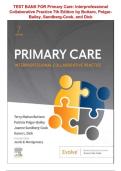
TEST BANK FOR Primary Care: Interprofessional
Collaborative Practice 7th Edition by Buttaro, Polgar-
Bailey, Sandberg-Cook, and Dick
,Chapter 1: Interprofessional Collaborative Forces: Where are We Today?
MULTIPLE CHOICE
1. A small rural hospital, which is a member of an Accountable Care Organization (ACO), has been classified
as a Level 1 ACO. What does this classification involve?
a. Performance bonuses for meeting benchmark goals
b. Managing care for patients with chronic conditions
c. Required standards for minimum financial reserves
d. Mandatory detailed financial documentation
CORRECT ANS✔✔ A
Level 1 ACOs carry the lowest level of financial risk and obligations but can earn shared savings incentives by
meeting quality and expenditure benchmarks. Managing chronic care and cash reserve standards are tied to Level 2
ACOs, while Level 3 ACOs involve detailed financial reporting requirements.
2. What key insight did the 2014 Advisory Board survey reveal about patients’ preferences in primary care?
a. Ties to nearby hospitals
b. Cost factors of outpatient services
c. Convenient access to healthcare
d. Provider-to-patient ratios
CORRECT ANS✔✔ C
The 2014 survey conducted by the Advisory Board revealed that patients valued round-the-clock access, walk-in
appointments, timely care within 30 minutes, and proximity to services. Preferences regarding hospital affiliations,
outpatient costs, or provider ratios were not highlighted in the findings.
,MULTIPLE RESPONSE
1. Which evaluations are included in the value-based purchasing (VBP) program for assessing providers?
(Select all that apply.)
a. Reviewing cost per Medicare case
b. Measuring patient satisfaction with hospital services
c. Analyzing research to develop clinical guidelines
d. Tracking death rates in pneumonia patients
e. Enforcing IT upgrades and financial reserve policies
CORRECT ANS✔✔ A, B, D
The value-based purchasing program focuses on five performance domains, such as cost efficiency (e.g., Medicare
case cost), patient experience (e.g., satisfaction scores), and clinical outcomes (e.g., pneumonia mortality rates).
Developing clinical guidelines from research is a function of evidence-based practice. IT infrastructure and reserve
requirements are linked to ACO regulations.
, Chapter 02: Translating Research into Clinical Practice
Buttaro: Primary Care: A Collaborative Practice, 7th Edition
MULTIPLE CHOICE
1. What is the goal of Level II research?
a. To identify defining traits of patient groups
b. To prove the success of a particular therapy or method
c. To explain how different characteristics or factors are related
d. To analyze the connection between two specific variables
CORRECT ANS✔✔ C
Level II research focuses on clarifying the connections among various traits or factors. In contrast, Level I research
aims to identify group characteristics, while Level II also assesses how variables are linked. Level IV research is
used to validate the success of interventions or treatments.
2. Which type of study design is best suited for a Level III research project?
a. Population-based epidemiological research
b. Controlled experimental approach
c. In-depth qualitative investigation
d. Clinical trials with random assignment
CORRECT ANS✔✔ B
A controlled experimental design is best aligned with Level III research. Epidemiological methods are more
applicable to Level II studies. Qualitative studies are typically used in Level I research, and randomized trials are
associated with Level IV research.
3. Within the stages of translational research, what is the function of clinical research trials?
a. Integrating interventions and practices into everyday healthcare
b. Understanding disease origins and evaluating treatment possibilities
c. Investigating the safety and efficacy of treatments or procedures
d. Studying core biological, behavioral, or disease-related mechanisms
CORRECT ANS✔✔ C
The role of clinical trials in translational research is to evaluate how safe and effective interventions are. Routine
Collaborative Practice 7th Edition by Buttaro, Polgar-
Bailey, Sandberg-Cook, and Dick
,Chapter 1: Interprofessional Collaborative Forces: Where are We Today?
MULTIPLE CHOICE
1. A small rural hospital, which is a member of an Accountable Care Organization (ACO), has been classified
as a Level 1 ACO. What does this classification involve?
a. Performance bonuses for meeting benchmark goals
b. Managing care for patients with chronic conditions
c. Required standards for minimum financial reserves
d. Mandatory detailed financial documentation
CORRECT ANS✔✔ A
Level 1 ACOs carry the lowest level of financial risk and obligations but can earn shared savings incentives by
meeting quality and expenditure benchmarks. Managing chronic care and cash reserve standards are tied to Level 2
ACOs, while Level 3 ACOs involve detailed financial reporting requirements.
2. What key insight did the 2014 Advisory Board survey reveal about patients’ preferences in primary care?
a. Ties to nearby hospitals
b. Cost factors of outpatient services
c. Convenient access to healthcare
d. Provider-to-patient ratios
CORRECT ANS✔✔ C
The 2014 survey conducted by the Advisory Board revealed that patients valued round-the-clock access, walk-in
appointments, timely care within 30 minutes, and proximity to services. Preferences regarding hospital affiliations,
outpatient costs, or provider ratios were not highlighted in the findings.
,MULTIPLE RESPONSE
1. Which evaluations are included in the value-based purchasing (VBP) program for assessing providers?
(Select all that apply.)
a. Reviewing cost per Medicare case
b. Measuring patient satisfaction with hospital services
c. Analyzing research to develop clinical guidelines
d. Tracking death rates in pneumonia patients
e. Enforcing IT upgrades and financial reserve policies
CORRECT ANS✔✔ A, B, D
The value-based purchasing program focuses on five performance domains, such as cost efficiency (e.g., Medicare
case cost), patient experience (e.g., satisfaction scores), and clinical outcomes (e.g., pneumonia mortality rates).
Developing clinical guidelines from research is a function of evidence-based practice. IT infrastructure and reserve
requirements are linked to ACO regulations.
, Chapter 02: Translating Research into Clinical Practice
Buttaro: Primary Care: A Collaborative Practice, 7th Edition
MULTIPLE CHOICE
1. What is the goal of Level II research?
a. To identify defining traits of patient groups
b. To prove the success of a particular therapy or method
c. To explain how different characteristics or factors are related
d. To analyze the connection between two specific variables
CORRECT ANS✔✔ C
Level II research focuses on clarifying the connections among various traits or factors. In contrast, Level I research
aims to identify group characteristics, while Level II also assesses how variables are linked. Level IV research is
used to validate the success of interventions or treatments.
2. Which type of study design is best suited for a Level III research project?
a. Population-based epidemiological research
b. Controlled experimental approach
c. In-depth qualitative investigation
d. Clinical trials with random assignment
CORRECT ANS✔✔ B
A controlled experimental design is best aligned with Level III research. Epidemiological methods are more
applicable to Level II studies. Qualitative studies are typically used in Level I research, and randomized trials are
associated with Level IV research.
3. Within the stages of translational research, what is the function of clinical research trials?
a. Integrating interventions and practices into everyday healthcare
b. Understanding disease origins and evaluating treatment possibilities
c. Investigating the safety and efficacy of treatments or procedures
d. Studying core biological, behavioral, or disease-related mechanisms
CORRECT ANS✔✔ C
The role of clinical trials in translational research is to evaluate how safe and effective interventions are. Routine